
The Alhambra is Granada's most famous landmark and one of Spain's most recognisable symbols. For more than seven centuries, this magnificent palace complex has stood proudly above the city, preserving the legacy of the flourishing Emirate of Granada.
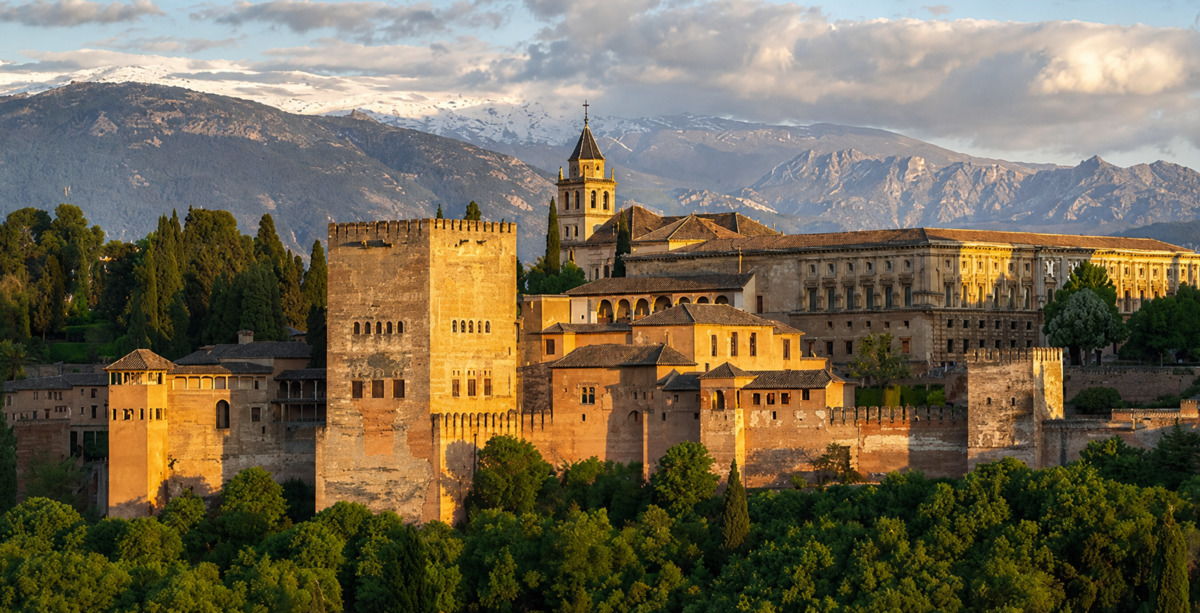
Today, the Alhambra is a UNESCO World Heritage Site and attracts millions of visitors from around the world every year. Behind its ancient walls lies a remarkable combination of history, architecture, gardens, and breathtaking panoramic views, making a visit to the complex one of the highlights of any trip to Andalusia.
What Is Included in the Alhambra Complex
The Alhambra is not a single palace but a vast historic complex comprising a fortress, royal palaces, gardens, and other structures dating back to the time of the Emirate of Granada. It was developed over more than two centuries, with each section built for a specific purpose and playing an important role in the lives of the rulers and the city's inhabitants.
The history of the Alhambra began in the 13th century, when Muhammad I, the founder of the Nasrid dynasty, decided to transform Sabika Hill into a new royal residence. Over time, a true city emerged behind its fortified walls, where the sultans and their families lived, a military garrison was stationed, foreign ambassadors were received, and the most important affairs of state were conducted.
The main parts of this remarkable complex have survived to the present day. Each of them reveals a different chapter of the Alhambra's history and offers a fascinating insight into life in the last Muslim state on the territory of modern-day Spain.
The Alcazaba Fortress
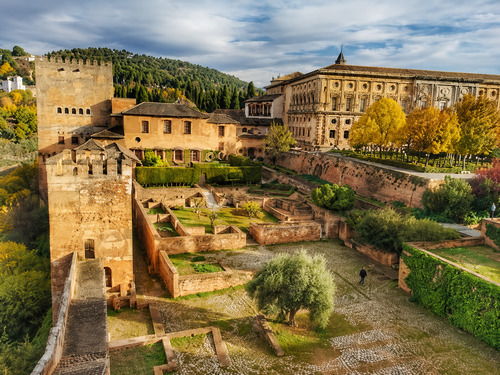
The history of the Alhambra began with the Alcazaba. In the 13th century, on the orders of Muhammad I, a powerful fortress was built on the summit of Sabika Hill to protect the new capital of the Emirate of Granada. It housed the military garrison, provided accommodation for soldiers, stored weapons, and its watchmen kept constant vigil over the surrounding area, warning of any approaching enemy.
Although magnificent palaces and gardens were later built around it, the Alcazaba remained the Alhambra's main line of defence. It was here that the life of the entire complex began, and for several centuries its massive walls and towers protected both the sultan's residence and the inhabitants of the palace city.
Today, the Alcazaba is regarded as one of the finest viewpoints in Granada. Climb the Torre de la Vela and you'll enjoy spectacular views of the Albaicín district, Granada Cathedral, the Genil River valley, and the snow-capped peaks of the Sierra Nevada. From this vantage point, it becomes easy to understand why this particular hill was chosen for the construction of the Alhambra.
The Nasrid Palaces
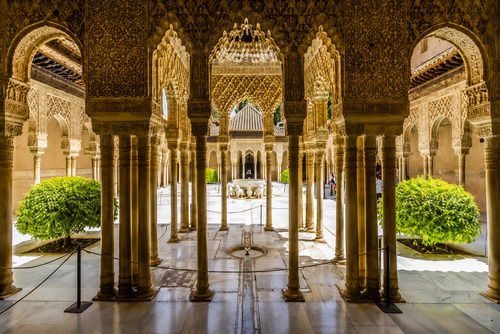
The Nasrid Palaces were the heart of the Alhambra and served as the official residence of the rulers of the Emirate of Granada. It was here that everyday life at the sultan's court unfolded: foreign ambassadors were received, ceremonial events were held, affairs of state were discussed, and decisions were made that shaped the future of the last Muslim state on the territory of modern-day Spain.
Over several generations, each new sultan sought to expand and embellish his royal residence. Gradually, this gave rise to the Mexuar, the Palace of Comares, and the famous Palace of the Lions, all of which are now regarded as masterpieces of Islamic architecture in Europe. Elegant Arabic calligraphy, exquisitely carved stonework, marble columns, peaceful courtyards, and the gentle sound of fountains create an atmosphere that has remained almost unchanged for centuries.
One of the most significant events in Spanish history is closely associated with these palaces. In 1492, the last Sultan of Granada, Boabdil, handed over the keys of the city to the Catholic Monarchs, Isabella of Castile and Ferdinand of Aragon. This event marked the end of the Reconquista and brought to a close nearly eight centuries of Muslim rule on the Iberian Peninsula. Today, as you wander through the Nasrid Palaces, it is hard to imagine that the fate of an entire era was once decided within these very walls.
The Generalife Gardens
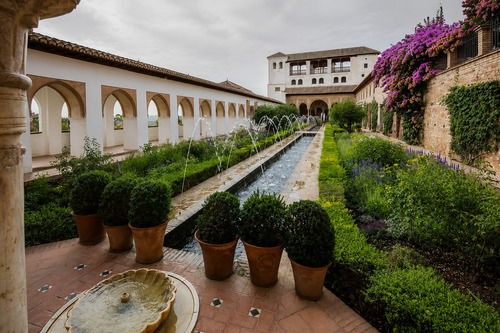
After official receptions, diplomatic meetings, and the formalities of court life, the sultans would retreat to the Generalife, a summer palace built as a peaceful place for rest and seclusion. Here they could escape the summer heat, stroll along shaded pathways, listen to the soothing sound of flowing water, and leave matters of state behind for a while. For the rulers of the Emirate of Granada, the Generalife was a place where nature and architecture existed in perfect harmony.
The gardens were designed so that water would accompany visitors wherever they went. Narrow channels, fountains, pools, and small waterfalls not only enhanced the beauty of the surroundings but also helped keep the area pleasantly cool, even on the hottest summer days. As a result, the Generalife became one of the finest examples of medieval Islamic garden design.
Today, the Generalife is regarded as one of the most picturesque parts of the Alhambra. Its cypress-lined avenues, blooming gardens, historic courtyards, and numerous viewpoints create a completely different atmosphere from that of the Nasrid Palaces and the Alcazaba Fortress. It is the perfect place to pause for a while and simply enjoy the peace and quiet, the fragrance of the flowers, and the magnificent views over Granada.
What to Expect When Visiting the Alhambra
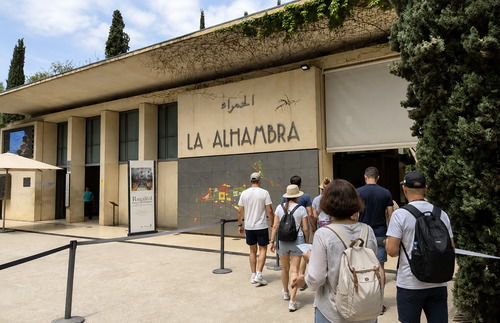
You can reach the Alhambra on foot from the centre of Granada, although it's worth bearing in mind that the route is uphill and usually takes around 20–30 minutes. Many visitors prefer to take the city buses C30 or C32, which depart from Plaza Isabel la Católica and stop almost directly outside the entrance to the complex. If you're travelling by car, there is a large car parking nearby.
Once you pass through the entrance gates, you find yourself inside what is essentially a genuine medieval city. Behind its fortified walls are preserved palaces, towers, gardens, and ancient streets, making a walk around the Alhambra feel more like exploring an entire historic district than visiting a single monument. The one important rule to remember is that the Nasrid Palaces can only be visited at the time printed on your ticket. For this reason, most visitors plan their itinerary around their palace entry time before taking their time to explore the Alcazaba, the Generalife Gardens, the Palace of Charles V, and the rest of the complex.
If you're visiting independently, it's well worth hiring an audio guide before you begin your tour. While the Alhambra is impressive for its architecture alone, many fascinating details can easily go unnoticed without historical context. The stories behind the palaces, the symbolism of the Arabic ornamentation, the purpose of the various halls, and the fate of the last sultans offer a completely different perspective on this remarkable historic monument.
Each of the main areas of the complex can only be visited once, so it is not possible to return to them later. Most visitors spend between three and four hours exploring the Alhambra, although if you take your time, enjoy the viewpoints, wander through the courtyards and gardens, your visit can easily last almost the entire day. It is at this relaxed pace that the unique atmosphere of this extraordinary place is best experienced.
Alhambra Tickets
The right ticket largely depends on how you would like to experience the Alhambra. For some visitors, a standard admission ticket is enough, while others prefer to explore the complex with a guide or choose a combined package that also includes visits to other attractions in Granada.
If you already know your travel dates, it's best not to delay booking your tickets. During the peak tourist season, tickets – especially those that include access to the Nasrid Palaces – often sell out several weeks in advance. If your preferred option is no longer available, it's worth checking again from time to time, as cancelled or amended bookings occasionally become available again.
What Else to See in Granada
For most visitors, the Alhambra is only one part of their trip to Granada. After exploring the palace complex, take some time to wander through the city's historic neighbourhoods, enjoy a flamenco performance, sample traditional Andalusian cuisine, and discover the many other attractions that make Granada one of Spain's most beautiful cities.
- Top attractions in Granada — a route through the city's most interesting sights.
- Flamenco in Granada — where to enjoy the best performances in Sacromonte, Albaicín, and the city centre.
- Where to eat in Granada — the best Andalusian dishes, tapas, and the city's top food districts.
- Granada's markets — the city's historic, food, and street markets.
- Sierra Nevada — the largest ski resort in southern Spain, located just a few dozen kilometres from Granada.

 English
  Español
  Русский