
The Sagrada Família is the ultimate symbol of Barcelona and one of the world's most recognisable architectural landmarks. For millions of people, their introduction to Barcelona begins with the Sagrada Família. This basilica has long since become much more than an architectural attraction – today it is regarded as the symbol of the city and one of Antoni Gaudí's greatest masterpieces.
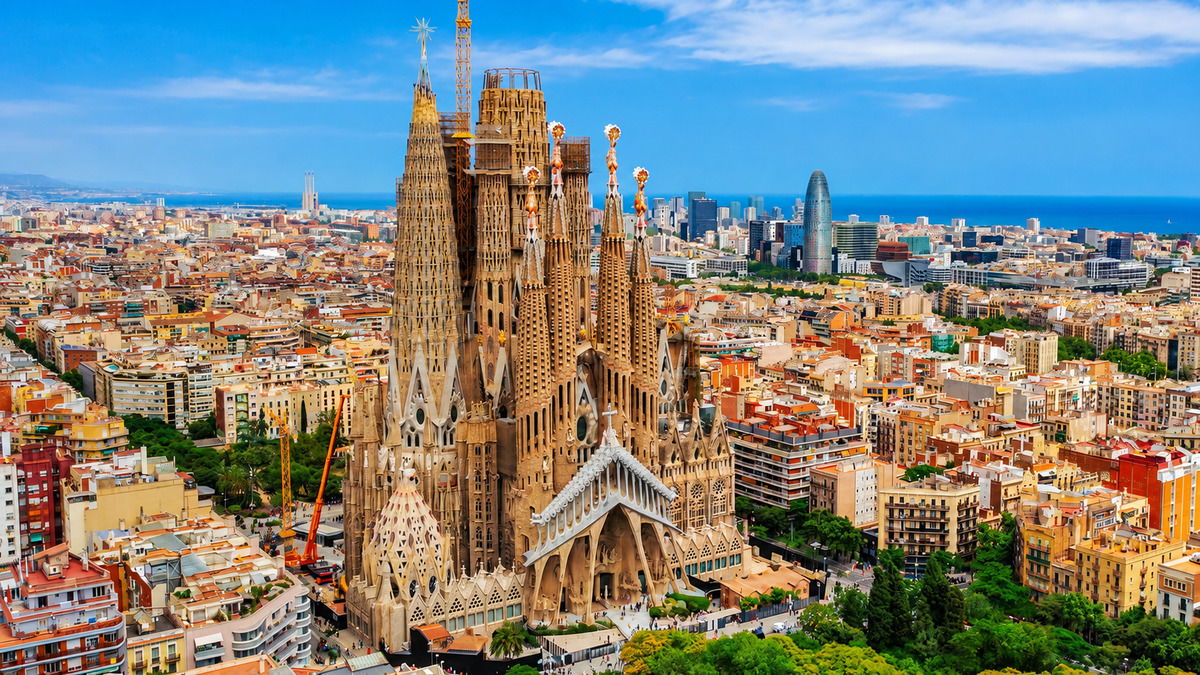
The history of this basilica is just as remarkable as its appearance. Construction began back in 1882 and has continued for almost a century and a half. During that time, the Sagrada Família has witnessed changing eras, survived the Spanish Civil War, endured the loss of part of Antoni Gaudí's original drawings, and seen several generations of architects carefully continue bringing his vision to life.
In 2026, the basilica reached its planned height with the completion of the central Tower of Jesus Christ. Many believed that construction had finally come to an end. However, this marks only one of the most significant milestones in the long-term project. Work still remains on the Glory Facade and several architectural elements of the complex. For this reason, the Sagrada Família remains not only one of the world's most celebrated architectural monuments but also one of the most extraordinary "living" basilicas, where history continues to unfold before the eyes of its visitors.
To understand why Antoni Gaudí devoted most of his life to this project and how his vision has endured for more than 140 years, it is worth beginning with the story of how the Sagrada Família came into being.
The History of the Sagrada Família
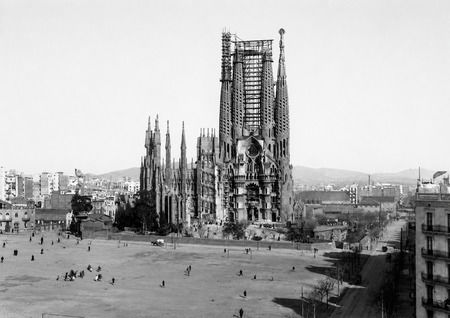
Today, the Sagrada Família is regarded as the symbol of Barcelona, yet the history of this basilica began long before Antoni Gaudí took charge of the project. Over the course of almost a century and a half, dozens of architects, engineers, sculptors, and craftsmen have contributed to its construction. However, it is Gaudí's name that has become inseparably linked with this extraordinary basilica. His ideas were so visionary that construction continues even more than a hundred years after the architect's death.
The Beginning of Construction
The story of the Sagrada Família began in 1882, when the Barcelona publisher and philanthropist Josep Maria Bocabella proposed building a church that would serve as a place of spiritual renewal for society. The original design was created by the architect Francisco de Paula del Villar, who envisioned the church in a traditional Neo-Gothic style. However, after just one year, disagreements with the project's promoters led him to leave the construction.
He was replaced by the young architect Antoni Gaudí, who was only thirty-one years old at the time. Initially, he continued working on the existing design, but he soon realised that he wanted to create not just another Gothic church, but something entirely new. Gradually, the original concept was completely transformed, and the future Sagrada Família evolved into a unique architectural masterpiece unlike anything the world had ever seen.
Antoni Gaudí and the Work of His Lifetime
With each passing year, the Sagrada Família became increasingly important in Gaudí's life. He gradually gave up almost all of his other commissions and devoted himself entirely to the construction of the basilica. During the final years of his life, he spent almost every day on the building site, personally supervising the work, refining his drawings, creating plaster models, and working alongside craftsmen to develop innovative engineering solutions capable of bringing his boldest ideas to life.
For Gaudí, the Sagrada Família was far more than an architectural project. He described the basilica as the work of his lifetime and famously said, "My client is in no hurry," referring to God. The architect fully understood that he would never see the building completed, yet this did not trouble him in the slightest. He believed that future generations would continue the work while remaining faithful to its central vision.
It was during these years that the most remarkable design ideas emerged, making the Sagrada Família unlike any other place of worship in the world. Gaudí rejected conventional straight lines and drew inspiration from trees, mountains, caves, and other forms found in nature, believing that nature itself has always been the greatest architect.
After Gaudí's Death
On 7 June 1926, Antoni Gaudí was struck by a tram while walking to the Church of Sant Felip Neri. Because of his modest clothing, passers-by assumed he was simply an elderly man and did not immediately recognise the famous architect. Only some time later did it become known that the injured man was the creator of the Sagrada Família. A few days later, Gaudí passed away, and his funeral became one of the largest public events in Barcelona's history.
It seemed that after the architect's death, bringing his vision to completion would be impossible. The situation became even more difficult during the Spanish Civil War, when Gaudí's workshop was ransacked and a significant number of his plaster models, drawings, and documents were destroyed. However, his students and followers managed to reconstruct much of the lost material using surviving photographs, fragments of models, and personal notes.
Today, construction continues with the help of modern technologies, including 3D modelling and digital design. Nevertheless, the architects remain committed to following Gaudí's vision as faithfully as possible. As a result, the Sagrada Família remains a rare example of an architectural project that unites the ideas of the 19th century with the capabilities of the 21st century while staying true to its original concept.
What the Facades of the Sagrada Família Tell Us
Your introduction to the Sagrada Família begins long before you step inside the basilica. Antoni Gaudí conceived its exterior as an enormous stone book, whose pages can be read by slowly walking around the building. Instead of conventional church decoration, the architect created an entire narrative of the life of Jesus Christ, in which every sculpture, tower, and decorative element forms part of one unified story.
For Gaudí, it was important that the basilica should make a powerful impression even on someone who had never opened the Bible. That is why he believed the architecture itself should tell the story. It is almost impossible to find a random detail here: the countless sculptures, plants, animals, symbols, and figures do not merely decorate the facades but help to reveal, step by step, the key events of Christian history.
The Nativity Facade
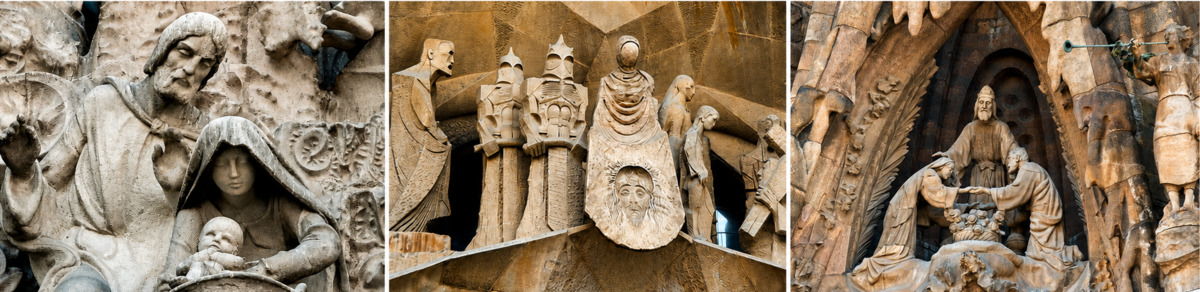
This is the facade that Antoni Gaudí lived to see almost completed. It is dedicated to the birth of Jesus Christ and is immediately distinguished from the others by its abundance of decorative detail. Here you will find scenes depicting the Holy Family, the adoration of the shepherds and the Magi, as well as angels, birds, plants, and animals. Gaudí intended this facade to convey the joy of Christ's birth, the beauty of the created world, and the hope that His coming brought to humanity.
The Passion Facade
While the Nativity Facade is full of life and intricate detail, the Passion Facade creates an entirely different impression. Its austere lines, striking geometric forms, and dramatic sculptures depict the final days of Jesus' earthly life – the Last Supper, the betrayal by Judas, the Crucifixion, and His death on the Cross. This artistic contrast was deliberately designed so that visitors could not only see these events but also feel their emotional intensity.
The Glory Facade
The third and largest facade is still under construction today. Once completed, it will become the main entrance to the basilica. According to Gaudí's vision, the Glory Facade will be dedicated to the Resurrection, eternal life, and humanity's spiritual journey towards God, bringing to its conclusion the story that begins with the birth of Christ and continues through His earthly suffering.
The Towers of the Sagrada Família
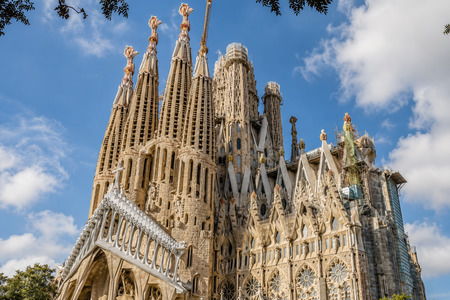
The famous towers of the Sagrada Família are no less symbolic. The complete design includes eighteen towers: twelve dedicated to the Apostles, four to the Evangelists, one to the Virgin Mary, and the tallest of all to Jesus Christ. Following the completion of construction, the central tower reached a height of approximately 172.5 metres, making it the tallest church tower in the world.
Yet even here, Gaudí remained true to his principles. He deliberately designed the central tower to be slightly lower than Montjuïc Hill, believing that the work of man should never surpass the work of nature. This idea has become one of the most famous symbols of his philosophy and once again demonstrates how thoughtfully every aspect of the Sagrada Família was conceived.
After walking all the way around the basilica, you begin to realise that Gaudí was creating far more than an extraordinary architectural masterpiece – he was creating a story that can be read with your eyes. Yet this is only the first part of his vision. To understand why millions of people leave the Sagrada Família so deeply moved, you need to step inside the basilica.
What Awaits You Inside the Sagrada Família
If the facades of the Sagrada Família tell their story from the outside, the interior creates an entirely different impression. Here, the sense of a massive stone building disappears, replaced by a remarkable feeling of space, light, and tranquillity. This is exactly how Antoni Gaudí envisioned his basilica – a place where architecture should evoke emotions just as powerfully as sculpture or works of art.
A Stone Forest
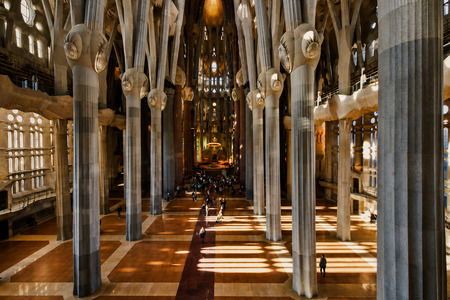
When designing the interior, Antoni Gaudí deliberately rejected the traditional massive columns. He wanted visitors to feel as though they were standing not beneath the vaults of a cathedral, but in the middle of a real forest. That is why the supports resemble mighty tree trunks that gradually branch out as they rise, just like the crowns of trees.
As you step into the central nave for the first time, your eyes are almost instantly drawn upwards towards the ceiling. Despite the enormous size of the basilica, the interior feels surprisingly light and filled with air. Many visitors admit that during their first few minutes inside, they simply stop and silently admire the extraordinary vaults, trying to take in what they are seeing. This is precisely the feeling Gaudí hoped to create, believing that nature is the finest example of harmony and engineering.
Light That Transforms the Basilica
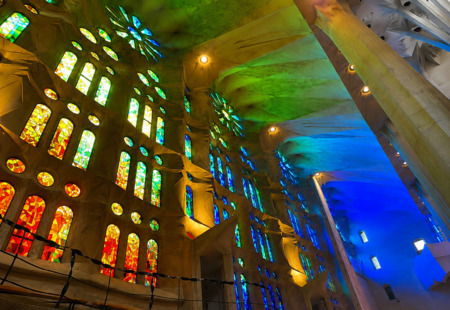
Gaudí also gave natural light an equally important role. The enormous stained-glass windows were positioned so that the interior would change with the movement of the sun and would never look exactly the same. For the architect, light was as much a part of the architecture as the stone or the columns themselves.
In the morning, cool shades of blue and green stream through the eastern windows, creating a sense of freshness and tranquillity. Later in the day, the western stained-glass windows fill the basilica with warm tones of gold, orange, and red. At a certain moment, it seems as though the very air is coloured, while the sun's rays become part of the interior itself. This is why many visitors say that even a second visit to the Sagrada Família feels like an entirely new experience.
Antoni Gaudí's Crypt
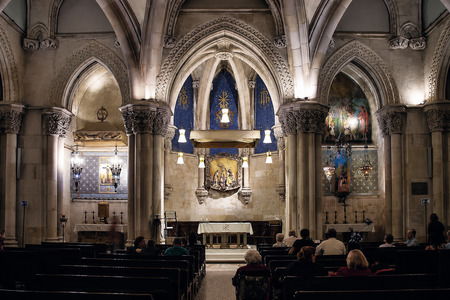
Beneath the main basilica lies the crypt, one of the oldest parts of the complex. It is here that Antoni Gaudí rests, having devoted more than forty years of his life to the construction of the Sagrada Família. For many visitors, this is one of the most moving places in the entire basilica, as it marks the final chapter in the life of the man who gave Barcelona its greatest architectural symbol.
Unlike the main nave, filled with light and colour, the crypt has a completely different atmosphere. It is noticeably quieter here, and the space itself invites calm reflection. Even with many visitors around, people often find themselves lingering a little longer, paying tribute to the architect who dedicated almost his entire life to this extraordinary basilica.
The Sagrada Família Museum
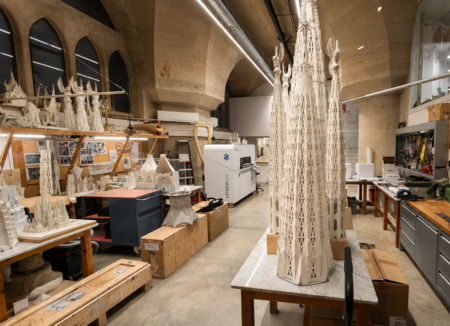
Before leaving, it is well worth visiting the museum located within the complex. It houses original plaster models, archive photographs, surviving drawings, and modern scale models that show how the project has evolved over almost a century and a half. Particularly fascinating are the exhibits dedicated to the reconstruction of Gaudí's ideas after much of his workshop was destroyed during the Spanish Civil War.
Even if you are not particularly interested in architecture, the museum offers an entirely new perspective on the Sagrada Família. After exploring the basilica itself, it is especially fascinating to discover how Gaudí's ideas took shape, the engineering solutions he developed, and how modern architects continue to bring his vision to life more than a century later.
Climbing the Towers
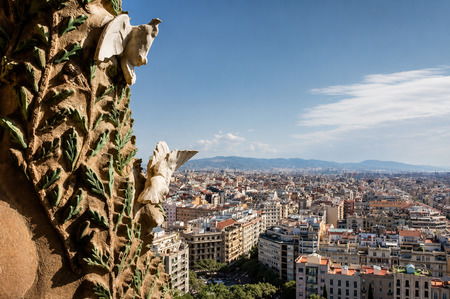
For many visitors, climbing the towers is the perfect conclusion to their visit to the Sagrada Família. From the top, you can enjoy panoramic views across Barcelona, while the decorative details of the facades can be admired from just an arm's length away — something that is simply impossible from ground level.
The ascent is made by lift, while the descent follows a narrow spiral staircase, gradually revealing new perspectives of the basilica. It is from here that you truly appreciate the scale of Antoni Gaudí's vision and how harmoniously the Sagrada Família has become part of Barcelona's modern skyline.
It is worth noting that access to the towers is not included with every ticket. If you would like to complete your visit with these spectacular views, it is best to check whether tower access is included when choosing your ticket.
Tickets for the Sagrada Família
Your choice of ticket depends on how you would like to experience the basilica. Some visitors are happy to explore the interiors at their own pace with an audio guide, while others prefer a guided tour or a climb up one of the towers, which offer panoramic views across Barcelona. Access to the towers depends on the ticket you choose and the time of your visit.
The Sagrada Família remains one of Spain's most popular attractions, so the most convenient time slots, particularly those including tower access, often sell out well in advance. When purchasing your ticket, you will need to select both the date and the entry time. Most ticket options include an audio guide, while some also offer a guided tour with a professional guide or combined packages featuring other attractions in Barcelona.
What to See After Visiting the Sagrada Família
For most visitors, the Sagrada Família is just the beginning of their exploration of Barcelona. After visiting the basilica, you can continue discovering the works of Antoni Gaudí, head into the city's historic centre, or explore other famous landmarks of the Catalan capital. Here are a few places that perfectly complement your itinerary.
- Casa Batlló — one of Antoni Gaudí's most extraordinary buildings, renowned for its wave-like facade, colourful mosaics, and imaginative interiors.
- Casa Milà (La Pedrera) — Gaudí's final civic masterpiece, famous for its unique rooftop that resembles a surreal landscape.
- Park Güell — one of Spain's most famous parks, where Gaudí's architecture blends harmoniously with nature and panoramic views over Barcelona.
- Picasso Museum — an opportunity to discover the artist's early work and see how his distinctive style developed.
- Where to Eat in Barcelona — the best Catalan dishes, tapas, seafood, and the neighbourhoods where you should spend an evening after your sightseeing.
- Top Attractions in Barcelona — a ready-made itinerary featuring the city's most interesting sights if you would like to continue exploring the Catalan capital.

 English
  Español
  Русский