
Montjuïc Hill in Barcelona is one of the city's most interesting elevated areas, offering magnificent views over Barcelona and the Mediterranean Sea. But it is not only the panoramas that make it interesting — Montjuïc is home to a medieval fortress, historic gardens, museums and Olympic venues.
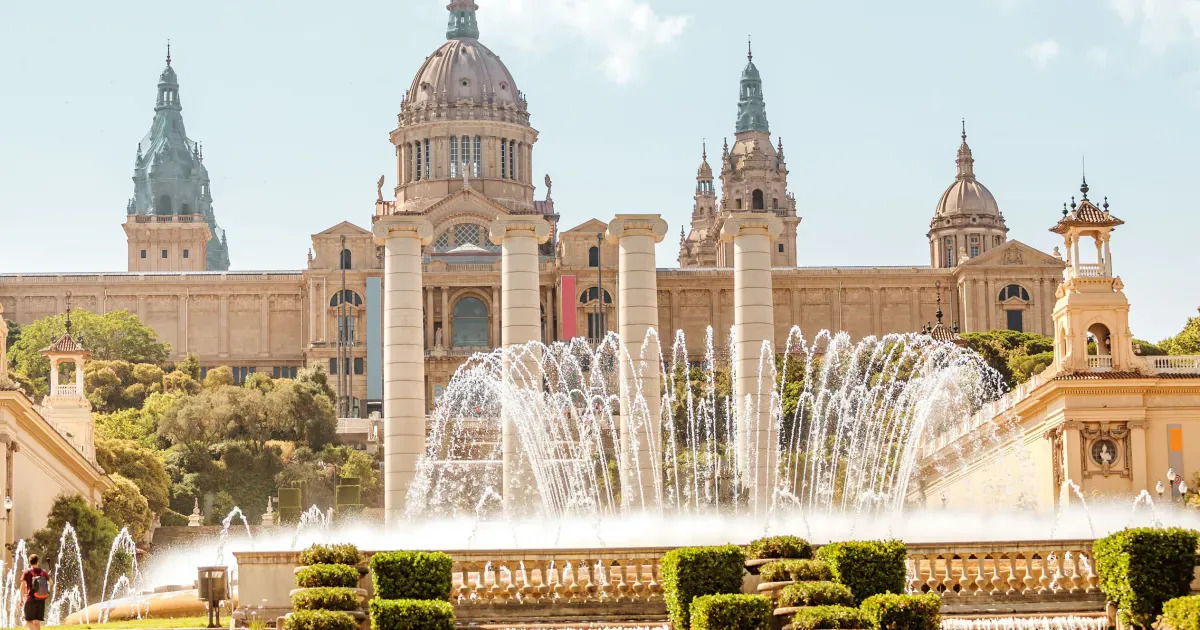
At the same time, Montjuïc's present-day appearance did not emerge all at once. Once, this place was primarily an important defensive height overlooking Barcelona. Over time, as the metropolis developed, exhibition pavilions, palaces, museums and sports facilities appeared here, and after the 1992 Olympic Games the hill finally became one of the city's most diverse areas. Today, you can experience Barcelona here from several different perspectives at once — historical, cultural, sporting and natural.
What to See on Montjuïc
- Montjuïc Castle
- Gardens and the Mirador de l'Alcalde viewpoint
- Mossèn Costa i Llobera Gardens
- Joan Brossa Gardens
- Mossèn Cinto Verdaguer Gardens
- Albéniz Palace
- Laribal Gardens
- Greek Theatre
- Joan Miró Foundation
- Barcelona Botanical Garden
- Historical Botanical Garden of Barcelona
- Palau Sant Jordi
- Olympic Stadium
- Olympic Ring
- Poble Espanyol
- National Art Museum of Catalonia (MNAC)
- Magic Fountain
Montjuïc Castle (Castell de Montjuïc)
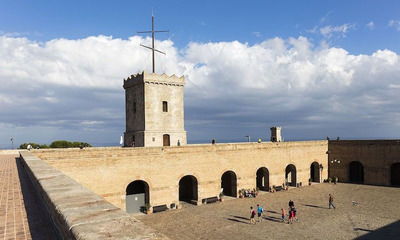
At the highest point of the hill stands Montjuïc Castle — an important symbol of Barcelona's military history. The first fortifications on this site appeared in 1640 during the Catalan revolt against the Spanish Crown. Later, the fortress was rebuilt and acquired its present appearance, with its distinctive bastions and imposing walls.
For centuries, the fort played a strategic role: it protected the city from the sea, controlled the port and at the same time served as an instrument for suppressing uprisings. In 1842, the fortress's cannons were turned on Barcelona itself to suppress revolutionary unrest. Later, the building was used as a military prison — at different periods, political prisoners were held here.
Today, the fortress is open to visitors and is one of the city's best viewpoints. The bastions offer impressive panoramic views of Barcelona's port, the Mediterranean Sea and the city's neighbourhoods. Many tourists make the climb here for these views, even if they do not plan to go inside and explore the historical exhibitions in detail.
If you wish, you can enter the fortress grounds and see the inner courtyard, climb to the viewing platforms and walk along the bastions and terraces. Elements of the old military architecture have been preserved inside, while temporary exhibitions and cultural events are held in the rooms around the inner courtyard. The old watchtower is of particular interest — it is one of the oldest parts of the fortifications.
An entrance ticket costs €5, while the reduced rate is €3. On Sundays after 15:00, admission is free. Certain categories of visitors are also entitled to free admission. Opening hours and visiting conditions may change, so it is best to check the latest information on the official website before your trip.
From the fortress, you can continue your descent through Montjuïc. The next stop will be Mirador de l'Alcalde — one of the most beautiful panoramic spots on the hill, with views of the port and Barcelona. Along the way, you can also stop by the giant Montjuïc slides (Tobogans Gegants de Montjuïc) — a small children's area with slides for children aged 6 to 12.
Mirador de l'Alcalde Gardens and Viewpoint
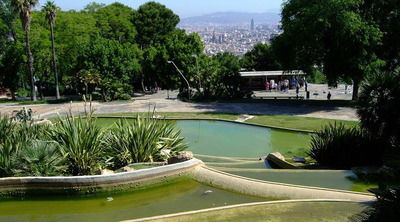
Mirador de l'Alcalde is a small but very picturesque park area, located about a 10-minute leisurely walk downhill from Montjuïc Castle. Here, well-kept gardens, cascading fountains, sculptures and terraces combine to create a space overlooking the port of Barcelona and the Mediterranean Sea.
The main reason to stop here is the wide panorama of the port, sea and city neighbourhoods that opens up from this spot. Thanks to its hillside location, this is one of the most photogenic viewpoints on Montjuïc, especially in clear weather.
The terraces are arranged on several levels, so new views constantly appear as you walk around. It is particularly beautiful here in the morning or towards sunset, when the soft light illuminates the port cranes and the coastline.
After Mirador de l'Alcalde, it is worth heading to the Mossèn Costa i Llobera Gardens, known for their collection of cacti and succulents and their beautiful sea views.
Mossèn Costa i Llobera Gardens (Jardins de Mossèn Costa i Llobera)
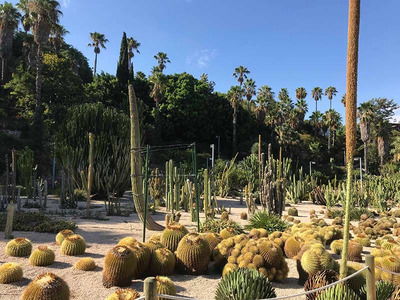
Jardins de Mossèn Costa i Llobera is one of the most unusual parks on Montjuïc, located on the sunny southern slope of the hill facing the sea. Thanks to its mild microclimate, it is home to an impressive collection of more than 800 species of cacti, succulents and other exotic plants from around the world.
Unlike the central green gardens of Montjuïc, this park has an almost Mediterranean and even slightly desert-like atmosphere. Wide paths run among tall cacti, agaves and aloe plants, while the open spaces allow you to enjoy views of Barcelona's port and the coastline. There are usually fewer people here than in other parts of the hill, making it an excellent place for a peaceful walk and photography.
Due to its southern location, it can get quite hot here in summer, so it is best to plan your visit for the morning or towards the evening.
After the cactus garden, you can return to the central part of Montjuïc and continue exploring its green spaces.
Joan Brossa Gardens (Jardins de Joan Brossa)
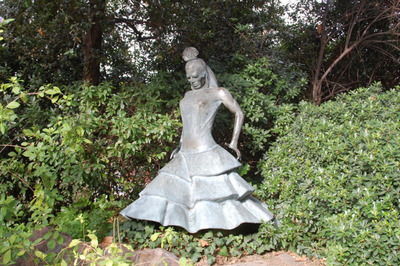
Joan Brossa Gardens is a spacious green area in the central part of Montjuïc, named after the Catalan poet and artist Joan Brossa. Today, it is a peaceful park for walks, although just a few decades ago there was an amusement park here, traces of which can still be seen in the sculptures and unusual art installations scattered throughout the grounds.
Wide paths and shady avenues make this a pleasant place for a leisurely walk. As you follow the route, you seem to move from a natural setting into a space of contemporary art — sculptures unexpectedly appear among the greenery, adding an element of exploration to the walk.
You can get here by heading downhill and crossing the road near the sculpture dedicated to the sardana — a traditional Catalan dance. There are signs throughout the grounds, so it is fairly easy to find your way around.
Continuing downhill along the main avenues, you will reach the Mossèn Cinto Verdaguer Gardens, where the atmosphere becomes more classical and carefully maintained.
Mossèn Cinto Verdaguer Gardens (Jardins de Mossèn Cinto Verdaguer)
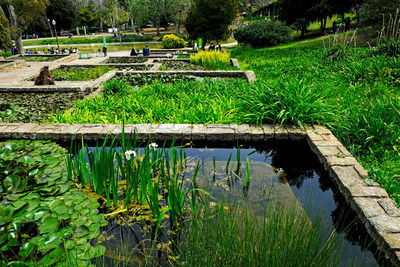
Jardins de Mossèn Cinto Verdaguer is located next to Joan Brossa Gardens and is considered one of the most peaceful and well-kept green spaces on Montjuïc. The garden was designed in a landscape style and is dedicated to aquatic and bulbous plants. It is particularly beautiful in spring and early summer, when the lilies and other plants are in bloom, filling the garden with bright colours.
The garden's main feature is a system of small lakes and ponds arranged at different levels. Water lilies, lotuses and water irises grow in the water, while nearby there is a waterfall, a rocky area and a small Japanese bridge. Paths, steps and green slopes allow you to stroll peacefully between the bodies of water, while the upper part of the garden offers views of Barcelona.
This is a pleasant place to relax away from the hustle and bustle of the city — people come here for a peaceful walk, to sit by the water or enjoy a small picnic.
After the garden, you can continue your walk through Montjuïc towards the Albéniz Palace and its surrounding gardens, where the green spaces gradually give way to the more formal and architectural part of the hill.
Albéniz Palace (Palauet Albéniz)
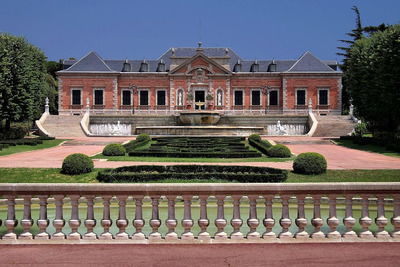
Palauet Albéniz is a historic palace on Montjuïc, built for the International Exhibition of 1929. Today, it belongs to Barcelona City Council and is used for official events and receptions.
As a rule, the interior is closed to general visitors, although during certain city events, such as the La Mercè festival, open days are sometimes held here. This is a rare opportunity to see the historic interiors of the palace from the inside, so it is worth checking the current programme before visiting.
Even if you cannot go inside, you can take a walk through the surrounding Joan Maragall Gardens (Jardins de Joan Maragall). There are neat avenues, monumental fountains, sculptures and other decorative elements, creating an atmosphere of tranquillity and elegance. The gardens themselves are open to the public free of charge at weekends and on public holidays from 10:00 to 15:00, although opening times may change.
After the palace, you can continue walking downhill through Montjuïc — further on are the Laribal Gardens and the Greek Theatre, where the hill's green spaces merge with cultural venues and early 20th-century architecture.
Laribal Gardens in Barcelona (Jardins de Laribal)
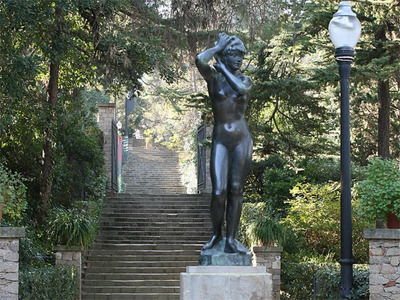
Jardins de Laribal are among the most atmospheric gardens on Montjuïc, situated on the hillside and built on several levels. There are numerous stairways, terraces, gazebos, shady avenues and small bodies of water, making a walk here feel like a gradual journey up and down through a series of green spaces.
The modern gardens were created for the International Exhibition of 1929 to a design by French landscape architect Jean-Claude Nicolas Forestier. At the same time, the upper part of today's gardens once belonged to the estate of lawyer and journalist Josep Laribal, after whom they were named. Today, the gardens are considered one of the most beautiful corners of Montjuïc, with charming stairways, terraces, fountains and Mediterranean vegetation.
This is a pleasant place to take a short break during your walk: the noise of the city is barely audible, while the combination of water, greenery and stone features creates a sense of seclusion. The cascades and water-filled stairways are particularly interesting, reminiscent of the Generalife Gardens in Granada.
As you continue down through the terraces, you will gradually reach the Greek Theatre — one of the most unusual cultural venues on Montjuïc.
Greek Theatre (Teatre Grec)
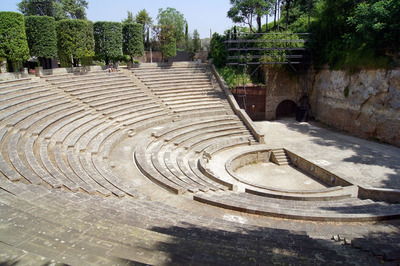
The Greek Theatre is located next to the Laribal Gardens and is part of the cultural complex created for the International Exhibition of 1929. Despite its name, the theatre is not of ancient origin — it was built in a former quarry, where the natural stone wall became the stage, while the amphitheatre with its stone seating accommodates around 1,900 spectators.
The theatre's open-air setting blends naturally into the surrounding landscape, making the venue feel both historic and modern at the same time. In summer, it hosts the famous Grec Festival — one of Barcelona's major cultural events, featuring theatre performances, concerts and dance shows.
Even outside the events, it is worth stopping by for its unusual atmosphere and beautiful views of the surrounding gardens.
From here, you can continue walking downhill — ahead is the Joan Miró Foundation, where the natural spaces of Montjuïc gradually give way to modern architecture and art.
Joan Miró Foundation (Fundació Joan Miró)
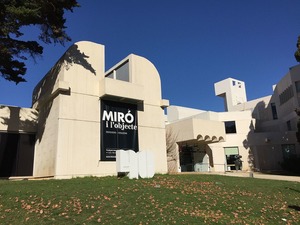
Fundació Joan Miró is one of Barcelona's main museums of modern art, dedicated to the work of 20th-century Catalan artist Joan Miró. The museum building itself deserves special attention: it was designed by architect Josep Lluís Sert — a friend of the artist — and built in such a way that natural light would highlight the colours and forms of the works as much as possible.
The collection comprises more than 14,000 works and other objects — paintings, sculptures, graphic works, ceramics and textiles. The exhibition allows visitors to trace the evolution of Miró's work and see how his art influenced the development of modern art around the world.
Even if you are not a great fan of modern art, the museum is worth visiting for its architecture, spacious, light-filled galleries and open terraces with views of Montjuïc and the city.
Admission costs €17 when purchased online or €18 at the ticket office for adults; a reduced ticket costs €11 online or €12 at the ticket office. Children under 12 enter free of charge. It is best to check the current prices and visiting conditions on the official website, as they may change.
From here, you can continue your walk through Montjuïc. The botanical gardens are slightly off the route, so if you wish, they can be visited separately before continuing to explore the Olympic area and other attractions on the hill.
Barcelona Botanical Garden (Jardí Botànic de Barcelona)
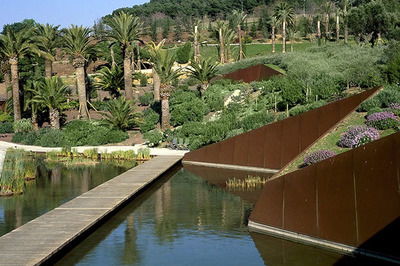
Jardí Botànic de Barcelona is a modern botanical garden located next to the Olympic Stadium. Unlike the traditional parks of Montjuïc, it is organised according to a geographical principle: the grounds are divided into zones representing different regions with similar Mediterranean climates — the Mediterranean, North Africa, Australia, South Africa, Chile and California.
As you walk along the paths, you feel as though you are travelling between continents, observing how plants adapt to similar natural conditions in different parts of the world. The spacious open areas and panoramic viewpoints make the walk particularly enjoyable.
The garden is located close to the Olympic Stadium; signs pointing to the entrance are placed along the road near the car park. Admission costs €5. However, it is still worth checking the current prices and opening hours before your visit, as they may change.
💡 Important: this garden should not be confused with the Montjuïc Historical Botanical Garden — these are two different spaces with completely different atmospheres.
Historical Botanical Garden of Barcelona (Jardí Botànic Històric de Barcelona)
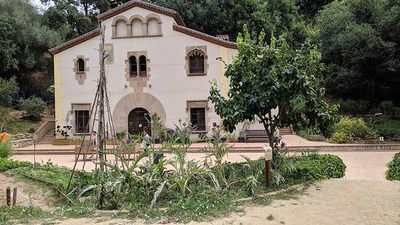
Jardí Botànic Històric de Barcelona is a hidden gem of Montjuïc that tourists often miss. The garden is located inside an old quarry, which has created a unique microclimate here: the air temperature can be several degrees lower than in the surrounding areas.
Unlike the modern botanical garden, this is a more intimate and atmospheric space with tall trees, shady paths, a small waterfall and a traditional Catalan farmhouse. It is a pleasant place to rest after walking through the open, sunny areas of the hill.
Admission to the Historical Botanical Garden is usually free. It is located next to the National Art Museum of Catalonia, making it convenient to visit before continuing to explore the Olympic area of Montjuïc.
Palau Sant Jordi
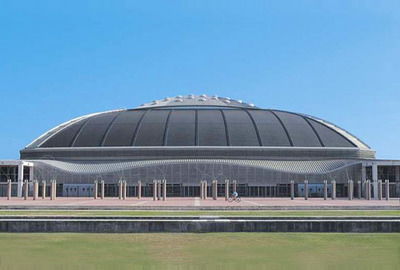
Palau Sant Jordi is one of the main arenas of the Montjuïc Olympic complex, built as part of the preparations for the 1992 Summer Olympic Games. The building was designed by Japanese architect Arata Isozaki and is distinguished by its distinctive domed silhouette, which blends harmoniously into the surrounding hillside landscape.
The arena can accommodate more than 18,000 spectators and is considered one of the largest indoor venues in Spain. Today, it hosts concerts by international stars, sporting competitions and large-scale cultural events, allowing the venue to maintain an active life long after the Olympics.
The building's huge dome is particularly striking: its silhouette resembles a turtle, while the structure itself was raised from the ground using special hydraulic technology. Thanks to this, Palau Sant Jordi has become not only a sports arena but also one of the notable architectural symbols of modern Montjuïc.
The Olympic Stadium is located nearby — the central point of the historic Olympic complex.
Olympic Stadium (Estadi Olímpic Lluís Companys)
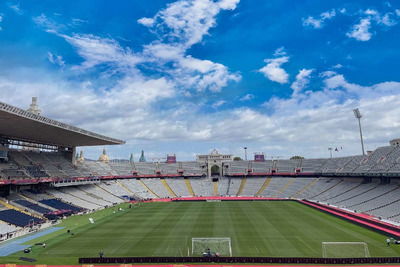
The Montjuïc Olympic Stadium was built in 1929 for the International Exhibition, and underwent a major renovation for the 1992 Olympic Games, becoming the main competition venue. Today, it bears the name of Catalan politician Lluís Companys.
The most interesting thing about the stadium is the combination of old and new. During the renovation, the historic external façades were preserved, while a virtually new arena with stands for approximately 56,000 spectators was created inside. This was where the opening and closing ceremonies of the 1992 Olympic Games and the athletics competitions took place.
Even outside major events, it is worth looking inside to experience the scale of Barcelona's Olympic legacy and see the stadium from within. Today, it also hosts sporting competitions and major concerts.
The Olympic Ring is located nearby — the central square of the complex, with the Calatrava Tower and other iconic Olympic landmarks.
Montjuïc Olympic Ring (Anella Olímpica)
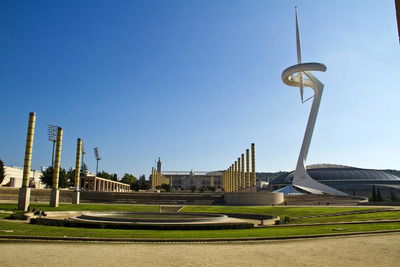
Anella Olímpica is the central space of the Montjuïc Olympic complex, created as part of the preparations for the 1992 Games. The Olympic Stadium, Palau Sant Jordi and a large open square are located here, while other facilities of the Olympic complex can be found nearby.
One of the main attractions is the Montjuïc Telecommunications Tower (Torre de Comunicacions), designed by architect Santiago Calatrava. Its unusual inclined shape resembles the body of an athlete, and it stands 136 metres high. The tower has become one of the architectural symbols of modern Barcelona and, thanks to its orientation, can function as a sundial — its shadow moves across the nearby Plaça d'Europa.
The Olympic Ring is interesting not only for its individual buildings: you can appreciate the scale of the entire 1992 complex here, while the wide open spaces make it easy to admire the architecture and take photographs. The Bernat Picornell swimming pools and other sports facilities are also located nearby.
From here, you can continue your walk downhill through Montjuïc — further on are Poble Espanyol, the National Art Museum of Catalonia and the Magic Fountain.
Spanish Village (Poble Espanyol)
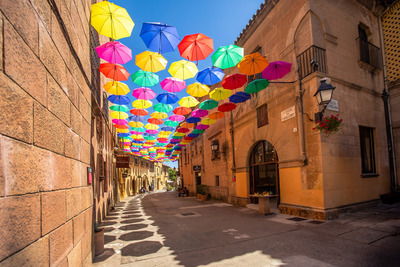
Poble Espanyol is an unusual open-air museum created for the International Exhibition of 1929. The project was originally intended as a temporary exhibition, but it proved so popular that it was preserved and became one of the interesting attractions of Montjuïc.
Covering an area of around 49,000 m², it showcases architectural styles from different regions of Spain: here you can see streets, squares and buildings inspired by the traditional architecture of different parts of the country. The creators of the project travelled to more than 1,600 cities and towns across Spain, gathering material for the future exhibition. Today, there are 117 full-scale architectural structures here, and a walk through the Spanish Village feels like a mini-journey around Spain.
But Poble Espanyol is not just about architecture. There are craft workshops where you can watch artisans at work, as well as exhibitions and concerts, while the Fran Daurel Museum of Contemporary Art displays works by renowned Spanish artists. There are also shops, bars and restaurants on the site.
A standard entrance ticket costs around €15. Before visiting, it is recommended to check the current price and conditions on the ticket sales website, as the price may change. Concerts or private events are sometimes held here, which may affect access to certain areas.
National Art Museum of Catalonia (Museu Nacional d'Art de Catalunya)
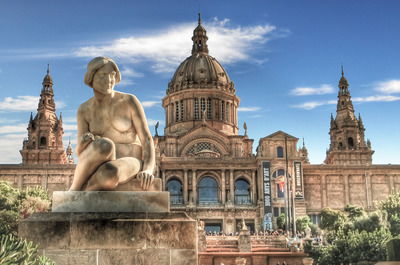
Museu Nacional d'Art de Catalunya (MNAC) is one of Barcelona's main art museums, located in the magnificent National Palace building at the foot of Montjuïc hill. The museum is known for its rich collection of Catalan art — from Romanesque painting and medieval frescoes to Renaissance works and 20th-century art.
Even if you are not planning to visit the exhibitions inside, it is worth going up to the viewing terraces of the National Palace. From here, you can enjoy a 360° panorama of Barcelona: Plaça d'Espanya, Avinguda de la Reina Maria Cristina, the Olympic Ring and other parts of the city are clearly visible.
The wide staircases, fountains and open spaces around MNAC create a sense of a grand finale to a walk through Montjuïc. And if you have time, you can continue exploring the museum inside — its collection spans almost a thousand years of art.
Montjuïc Magic Fountain (Font Màgica de Montjuïc)
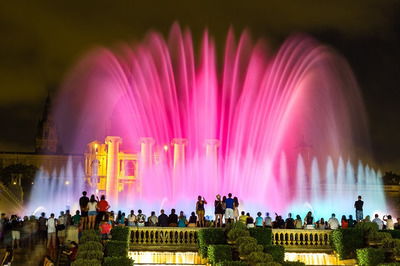
The Montjuïc Magic Fountain is located directly in front of the National Palace and was created for the International Exhibition of 1929. In the evenings, it traditionally became the stage for the famous light and music show, where water, colourful lighting and music came together in a spectacular performance.
This is one of the most popular places to finish a walk around Montjuïc — especially after sunset, when the square gradually fills with people and the atmosphere becomes festive and slightly magical. The show appeals to both children and adults, creating a vivid and memorable impression of Barcelona.
The fountain's operating schedule and the staging of shows depend on the season, weather conditions and the current operating arrangements of the attraction. In recent years, the fountain's operation has also been restricted due to water restrictions in the city, so it is essential to check the latest information on Barcelona's official website before visiting.
From here, you can continue your walk towards Plaça d'Espanya or finish the day by enjoying the evening views and atmosphere of one of Barcelona's most famous places.
What Else to See in Barcelona
- Barcelona's Main Attractions — from the Sagrada Família and the Gothic Quarter to other iconic places in the Catalan capital.
- Tibidabo Mountain — another famous Barcelona landmark with the Temple of the Sacred Heart, a historic amusement park and panoramic views over the city.
- La Rambla and Passeig de Gràcia — two of Barcelona's famous streets, where architecture, shops, cafés and city life follow one another.
- Barcelona's Best Food Markets — where to go for local produce, Catalan flavours and the atmosphere of authentic city markets.
- Street Markets in Barcelona and the Province — flea markets, fairs and small local markets where you can see a completely different side of the city.
- Where to Eat in Barcelona and What to Try — Catalan cuisine, traditional dishes and ideas for a food-focused walk around the city.
- Transport in Barcelona — how to get around the city's neighbourhoods conveniently and reach the main attractions.

 English
  Español
  Русский