
Tibidabo in Barcelona is one of the city's most unusual hills, home to the Temple of the Sacred Heart, a historic amusement park, viewing platforms and nature trails in Collserola. From a height of 512 metres, Barcelona looks completely different: the city, sea and mountains seem to be almost at your feet.
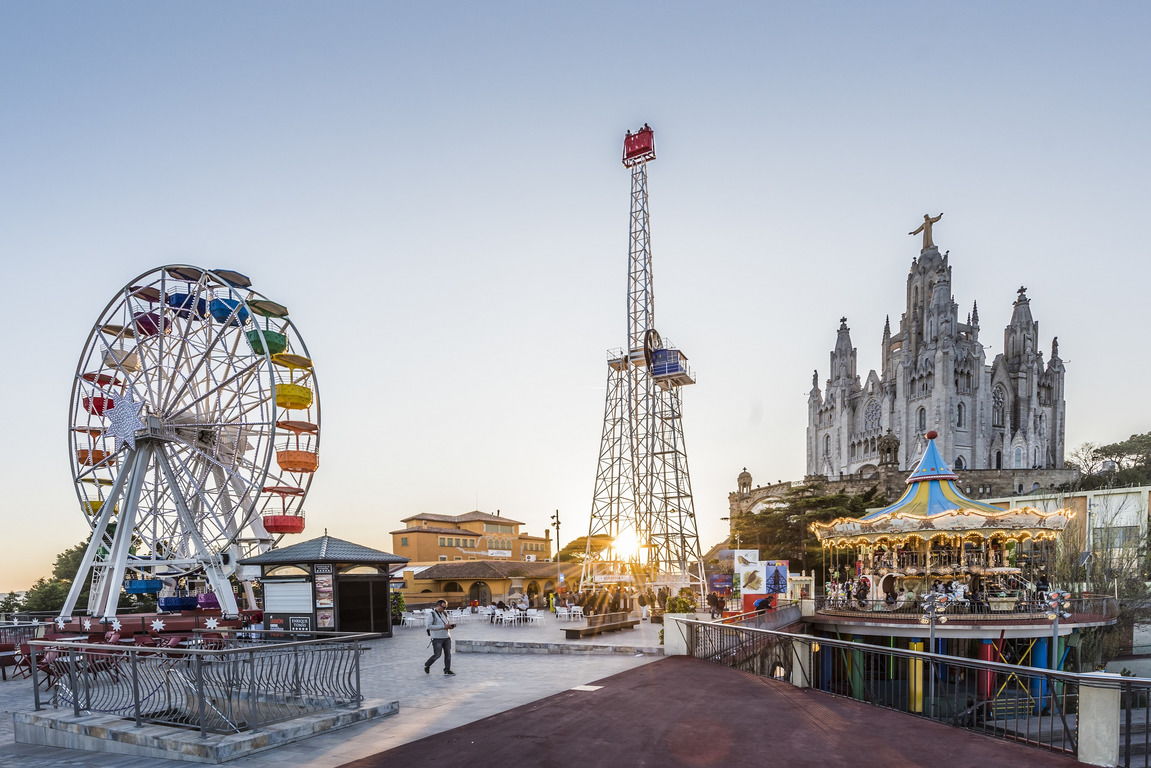
But as recently as the end of the 19th century, Tibidabo was still an inaccessible mountain on the outskirts of Barcelona, where goats grazed and local mountain enthusiasts occasionally came to walk. One day, pharmacist Salvador Andreu decided to turn it into a large leisure area for the city's residents. In 1899, the company Societat Anònima El Tibidabo was established, construction began on a tram and Spain's first funicular railway, and an amusement park soon appeared here. The mountain gradually became one of Barcelona's most unusual leisure destinations — the combination of nature, panoramic views, architecture and entertainment has been preserved here to this day.
What to see on Tibidabo
Temple of the Sacred Heart — Templo del Sagrado Corazón
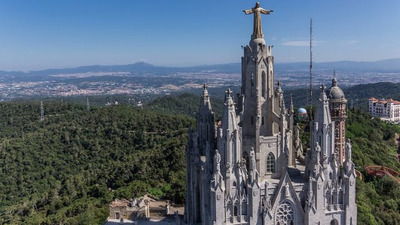
Temple of the Sacred Heart is one of the most recognisable symbols of Tibidabo and can be seen from many parts of Barcelona. The magnificent building rises above the city, while the statue of Christ at the top, with his arms outstretched, seems to embrace Barcelona, creating an impressive silhouette on the horizon.
Construction of the church continued for more than half a century, from 1902 to 1961. Its architecture combines elements of Neo-Gothic and Modernism, while its location is often compared with the Sacré-Cœur Basilica in Paris. At the beginning of the 20th century, it was popular to build Sacred Heart churches on elevated sites, and Tibidabo proved to be an ideal location for such a symbolic structure.
An interesting fact: a casino was originally planned for this site, but the church acquired the land, and instead of an entertainment complex, a religious symbol of the city was built here.
Inside, the church has a peaceful and tranquil atmosphere — colourful stained-glass windows, soft light and silence create a sense of seclusion even during the tourist season. However, the main reason to come up here is the viewing platform. By taking the lift to the upper level (the lift is paid), you can enjoy a 360° panoramic view, with Barcelona opening up below — from the historic centre to the Mediterranean Sea and the Collserola mountain range.
Tibidabo Amusement Park
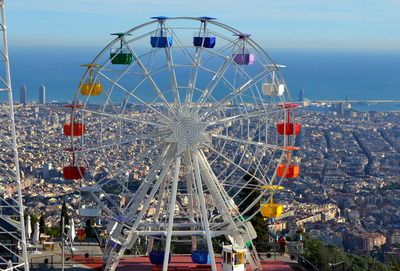
Tibidabo Amusement Park is one of the oldest amusement parks in Europe, having opened in 1901. It began operating just a few years after the first electric amusement rides appeared in Europe and still preserves some of its historic structures. This gives the park a special atmosphere — a combination of retro charm and modern entertainment.
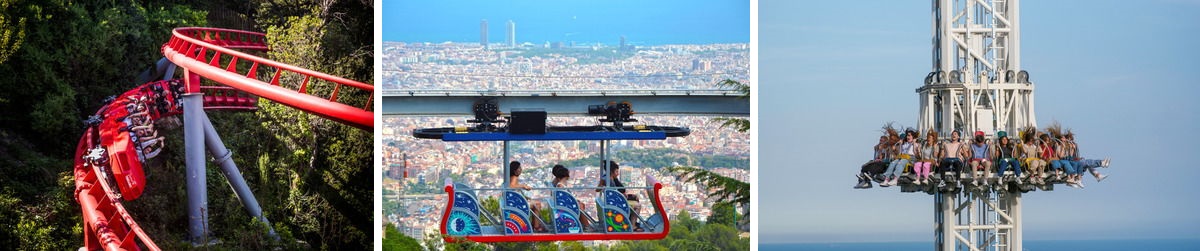
Despite its relatively compact size, the park has more than 25 rides for all ages, from family carousels to more thrilling attractions. The historic Talaia and Avió are particularly impressive and have long been symbols of Tibidabo. Talaia takes visitors to a height of around 551 metres above sea level, while Avió is designed as a real aeroplane and is considered one of the park's most recognisable attractions.
But Tibidabo is not only about rides. The park is home to the Automata Museum, with a collection of mechanical figures and machines that began to be assembled at the start of the 20th century. The oldest exhibit dates back to 1880, and in 1957 the collection impressed Walt Disney so much that he wanted to buy it in its entirety. The park refused to sell the automata, and today they remain part of Tibidabo's history.
The park's main feature is its location at the top of Tibidabo mountain. The rides literally seem to hang over the city, while the views of Barcelona and the Mediterranean Sea create the feeling that you are riding above the horizon. Few amusement parks in the world can boast such a panoramic backdrop.
The park is divided into several levels connected by escalators and panoramic viewing areas. In addition to the rides, there are restaurants, rest areas and viewing terraces. Before visiting, it is worth checking the opening schedule — it is seasonal and varies depending on the time of year.
Collserola Tower — Torre de Collserola
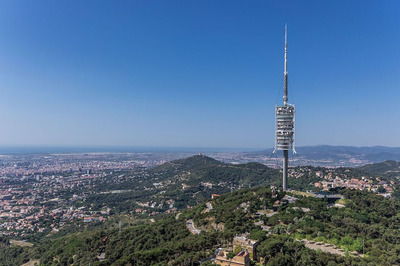
Collserola Tower is one of the most prominent modern symbols of the Collserola mountain range. It was built in 1991 for the 1992 Olympic Games and designed by British architect Norman Foster. The structure is 288 metres high, making it the tallest structure in Barcelona.
The tower's unusual silhouette is clearly visible from different parts of the city. Its slender central shaft supports the platforms with a system of tensioned cables, giving the huge structure a remarkably light and almost weightless appearance. Today, the tower remains an important telecommunications centre for Catalonia and is also home to one of Barcelona's most unusual viewing platforms.
Interestingly, the design caused mixed reactions during construction: many local residents compared the tower's silhouette to a syringe. Over time, however, its unusual design became a familiar part of the city's skyline, and today the tower is regarded as an important element of Barcelona's modern architectural identity.
The tower serves a telecommunications function, but the 10th floor houses a viewing platform located at around 560 metres above sea level. It is one of the highest viewpoints in the city. In good weather, you can see Barcelona, the Mediterranean Sea, Collserola Park, Montserrat and even the Cadí-Moixeró mountain range — visibility can reach up to 70 kilometres.
The ascent is by glass lift and takes around two and a half minutes. Thanks to the panoramic windows, you get an almost 360° view, making the visit particularly impressive for those who enjoy heights and photography. However, it is worth bearing in mind that opening hours depend on weather conditions, and the viewing platform may be closed on windy days.
Fabra Observatory — Observatorio Fabra
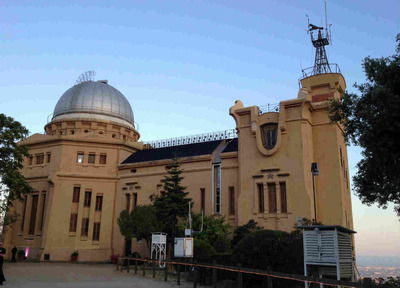
Fabra Observatory is a historic scientific complex, opened in 1904 at an altitude of around 413 metres above sea level. It is located among the pine forests of Collserola Natural Park and is considered one of the oldest operating observatories in Europe.
Research here covers several fields: astronomy, meteorology and seismology. Thanks to its distance from the hustle and bustle of the city and its open horizons, the observatory has become an important scientific centre as well as an unusual attraction for visitors.
Regular guided tours are organised for visitors, allowing them to explore the museum, see historic scientific instruments and go beneath the dome, where the historic 1904 telescope is located. It is still used to observe celestial objects. Night-time visits are particularly popular, giving visitors the opportunity to observe stars and planets through the historic telescope and experience the atmosphere of a true scientific discovery.
In summer, the observatory also hosts the famous dinners under the stars — an unusual format combining gastronomy and astronomy. The programme changes, so it is worth checking the latest information on the official website before visiting.
What else to see in Barcelona
- Barcelona's main attractions — from the Gothic Quarter and Sagrada Família to other iconic sights of the Catalan capital.
- Montjuïc Hill — another place where Barcelona opens up from above, with museums, gardens and historic sights.
- La Rambla and Passeig de Gràcia — two famous streets where you can continue your walk right in the heart of Barcelona.
- Barcelona's amusement parks — more ideas for family entertainment and leisure in the city and its surrounding areas.
- Where to eat in Barcelona and what to try — Catalan cuisine, popular dishes and ideas for where to stop for a gastronomic break.
- Transport in Barcelona — how to get around the city by metro, bus and other forms of public transport.
- Montserrat — mountains, a monastery and impressive scenery not far from Barcelona.

 English
  Español
  Русский