
Ávila is one of the best day trips from Madrid, known for its perfectly preserved medieval walls, historic churches, and authentic Castilian atmosphere. This UNESCO-listed city feels like stepping back in time and offers a unique mix of history, architecture, and local culture.
If you are wondering what to do in Ávila, you will find plenty of experiences packed into a compact historic center — from walking along the famous city walls to visiting Gothic landmarks, exploring quiet squares, and discovering centuries-old monasteries.
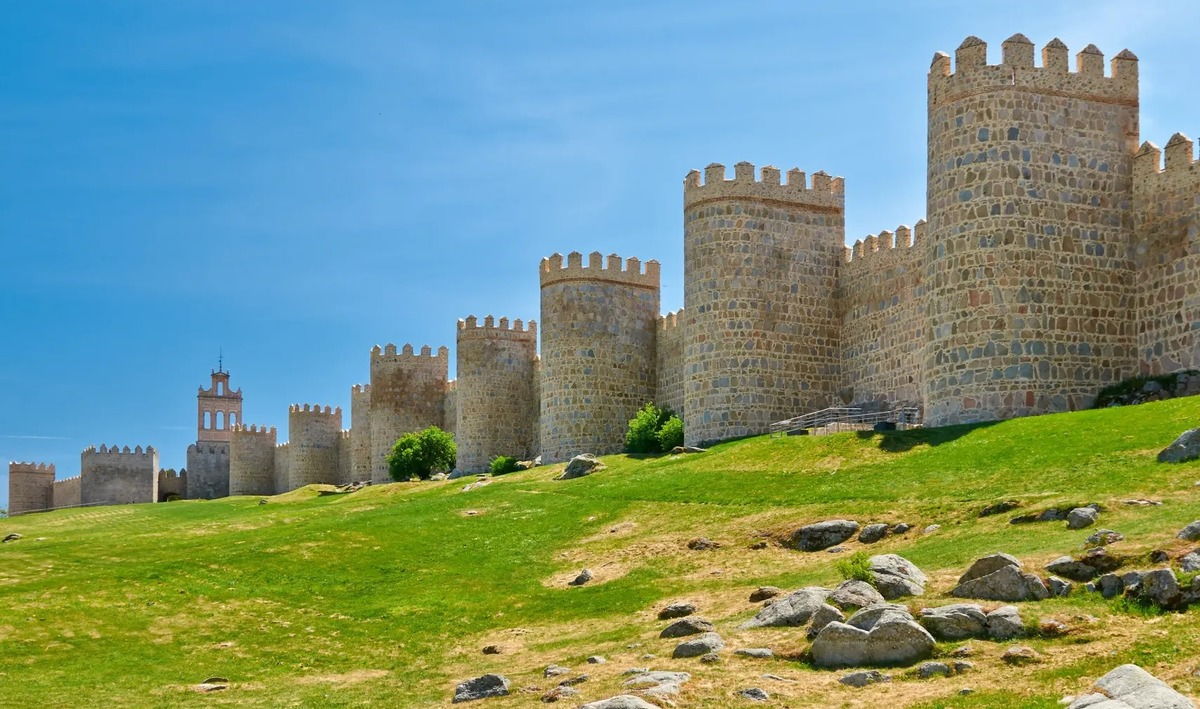
Located just 110 kilometers from Madrid, Ávila is easy to reach and perfect for a one-day itinerary. Whether you are interested in history, architecture, or simply enjoying a relaxed walk through a medieval city, this guide covers the best things to do in Ávila and a convenient walking route through its main attractions.
The main highlight of the city is its impressive city wall, however Ávila is known for more than just that. Here you will find Gothic cathedrals, ancient monasteries, cozy squares, and atmospheric streets that preserve the spirit of old Spain.
In this route, you will find the main attractions of Ávila and a convenient walking order through the historic center.
Best One-Day Walking Route to Explore Ávila’s Main Attractions
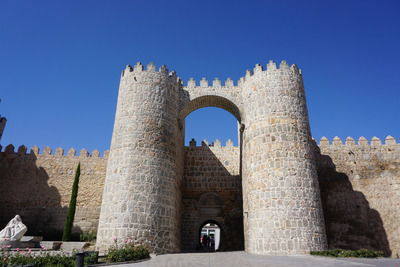
The route through Ávila’s attractions is best started at the Puerta del Alcázar — one of the main entrances to the historic center. From here, you will have an impressive view of the medieval walls, which are the symbol of the city.
Next, the route runs along the city wall to the Basilica of San Vicente, after which you can head to the Cathedral of Ávila — one of the oldest Gothic temples in Spain. Continuing your walk through the narrow streets of the historic center, you will reach the main square Plaza Mercado Chico — an ideal place for a short stop.
You can conveniently finish the route with a visit to the Real Monasterio de Santo Tomás, where you can calmly explore the architecture and museums, as well as feel the atmosphere of old Spain.
- Puerta del Alcázar and the city walls Muralla de Ávila
- Basílica de San Vicente
- Catedral de Ávila
- Plaza Mercado Chico
- Real Monasterio de Santo Tomás
Main Attractions of Ávila
Now let’s move on to a detailed introduction to the main attractions of Ávila
Muralla de Ávila (City Walls of Ávila)
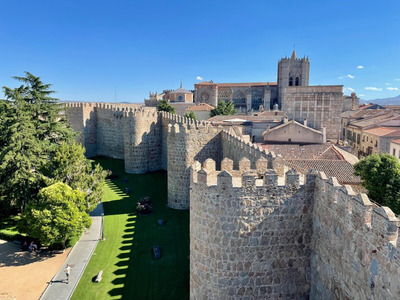
It is impossible to talk about Ávila without mentioning its impressive city walls — the main symbol of the city and a unique example of medieval defensive architecture. Built in the 11th–12th centuries during the Reconquista, they protected Castilian lands and still create the feeling of a true journey into the past.
A walk along the upper walkway of the walls is one of the most memorable experiences when visiting Ávila. From here, panoramic views open over the old town, the surroundings, and the mountainous landscape of Castile.
The total length of the wall is about 2.5 kilometers, its height reaches 12 meters, and its thickness is up to 3 meters. The scale and preservation of the structure allow visitors to imagine how powerful the defensive system of the medieval city once was.
Interestingly, stones from earlier Roman and Visigothic structures were used during construction, which means the walls literally preserve traces of different eras. In addition to their defensive function, they also served as a symbol of the city’s status, emphasizing its strategic and economic importance.
The massive structure includes 88 towers and nine gates through which entry into the city was controlled in the Middle Ages. The most famous are Puerta del Alcázar and Puerta de San Vicente — these are the places where a walk through the historic center most often begins today.
Passing through these gates and heading into the old town, the route naturally leads to one of Ávila’s main architectural symbols — the cathedral.
Basílica de San Vicente (Basilica of San Vicente)
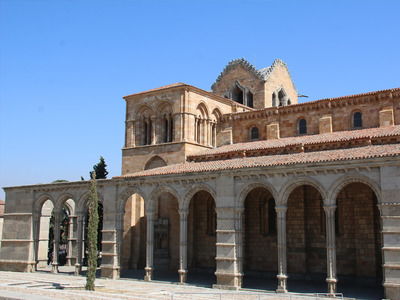
Basílica de San Vicente is one of the most significant Romanesque churches in Ávila and an important stop on the route through the city’s main attractions. The basilica was built in the 12th century and is considered the second-largest religious building after the cathedral.
Its architecture combines powerful stone forms with decorative elements of the Romanesque style. Particular attention should be paid to the richly decorated portal and the interior space, where the atmosphere of medieval spirituality is preserved.
The basilica is associated with the legend of Saint Vincent and his martyrdom, thanks to which the temple became an important religious symbol of the region. Its location near the city wall makes it a convenient stop during a walk along the Muralla de Ávila.
Continuing the route from the basilica towards the historic center, you will naturally reach the Cathedral of Ávila — the next key point of the walk.
Catedral de Ávila (Ávila Cathedral)
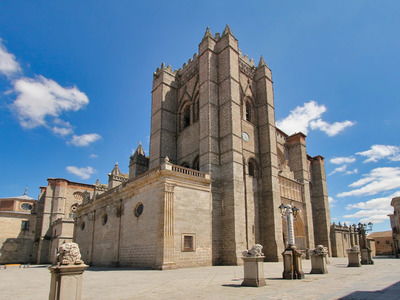
Catedral de Ávila is the first Gothic cathedral in Spain, whose construction began in 1172. Its architecture combines Romanesque and Gothic elements, and the interior is decorated with stained glass windows, chapels, and historical details reflecting the city’s centuries-old history.
The cathedral is unique because its apse is built directly into the city wall, turning the temple into both a religious and defensive structure at the same time. Because of this, Catedral de Ávila is often called a “fortress-cathedral” — a rare example of architecture where spiritual and military functions are combined in one building.
Inside, it is worth paying attention to the light that gently passes through the stained glass, creating a special atmosphere of calm that contrasts with the massive exterior appearance. Walking around the cathedral, it is easy to notice how organically it is integrated into the structure of the old city and the city walls.
Continuing the route from the cathedral along the historic center, you will reach the next important stop — the church Iglesia de San Pedro Apóstol, located near the city gate and Plaza Santa Teresa.
Iglesia de San Pedro Apóstol (Church of Saint Peter)
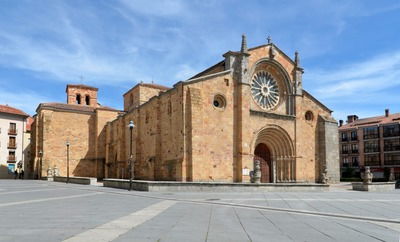
Iglesia de San Pedro Apóstol is located opposite the Arco del Alcázar gate and is considered one of the most important Romanesque churches in Ávila. Its construction began in the 12th century, and the characteristic façade with a large circular rose window immediately attracts attention and makes the temple easily recognizable.
The church is built in a transitional Romanesque style and is distinguished by strict lines, massive walls, and harmonious proportions. Despite its restrained exterior, a calm atmosphere can be felt inside, creating a pleasant contrast with the lively streets around the city gates.
Thanks to its location at the entrance to the historic center, Iglesia de San Pedro Apóstol often becomes one of the first stops during a walk around Ávila. Entry to the church is free, so it is easy to visit even during a short trip.
Continuing the route from Plaza Santa Teresa and heading deeper into the old town, you will arrive at the main square of Ávila — Plaza Mercado Chico, where city life is concentrated and historic buildings are located.
Plaza Mercado Chico (Main Square of Ávila)
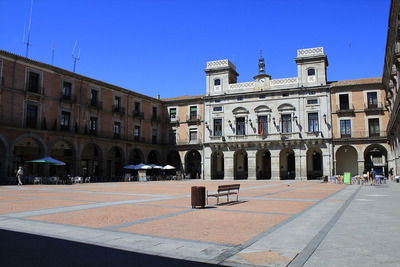
The main square of Ávila — Plaza Mercado Chico — is considered the historical and administrative heart of the city. Since medieval times, markets, public gatherings, and city celebrations have taken place here, which is why the square has preserved the atmosphere of a lively historic center.
The square is surrounded by arcades and historic buildings, among which the town hall (Ayuntamiento) stands out. Despite its compact size, Plaza Mercado Chico creates a feeling of coziness and harmony, and numerous cafés and restaurants with local cuisine make it an ideal place for a short stop during a walk around Ávila.
Here you can conveniently take a break, try local dishes, or simply observe the everyday life of the city before continuing to explore its history.
Continuing the route from the main square along the narrow streets of the old town, you will reach the Ávila Museum, where you can dive deeper into the region’s past and learn more about the city’s cultural heritage.
Museo de Ávila (Ávila Museum)
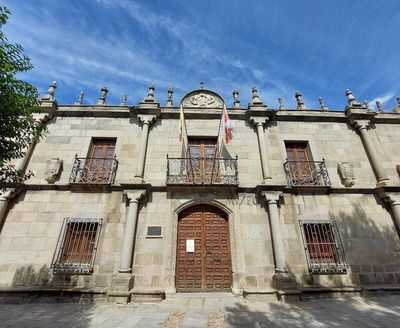
The Ávila Museum is a great place to better understand the city’s history after walking through its streets and main attractions. The exhibition covers different eras — from archaeological finds and the Roman period to medieval life and the modern history of the region.
Of particular interest are the exhibitions dedicated to Saint Teresa of Ávila — one of the city’s most famous historical figures, whose spiritual activity had a huge influence on Spain’s religious life. The museum’s collections allow visitors to see how Ávila’s cultural and religious identity developed over the centuries.
The calm atmosphere of the museum makes it a good stop to take a break from walking and look at the city through the lens of history and art.
Continuing the route, it is worth heading to another important attraction — the Royal Monastery of Santo Tomás (Real Monasterio de Santo Tomás), associated with the Catholic Monarchs and the spiritual heritage of Ávila.
Real Monasterio de Santo Tomás (Royal Monastery of Santo Tomás)
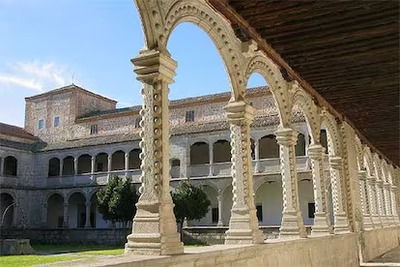
Real Monasterio de Santo Tomás is a 15th-century Dominican monastery associated with the era of the Catholic Monarchs and the religious history of Ávila. The complex was founded with the support of Isabella I of Castile and combines strict architecture with the atmosphere of calm typical of monastic complexes.
The main feature of the monastery is considered to be its three inner courtyards (cloisters), each distinguished by its own style and mood. Walking through them, you can see elegant arcades, carved details, and feel the contrast between the bustle of the city and the quiet monastic life.
Today, the monastery houses museums and historical exhibitions that help visitors better understand the cultural and religious heritage of the region. This place often becomes a logical conclusion to a walk around Ávila — here you can slow down, look back at the completed route, and calmly enjoy the atmosphere of one of the most historically rich corners of the city.
Practical Tips for Visiting Ávila
Ávila is a compact city that is easy to explore on foot, however a few practical tips will help make your trip more comfortable and enjoyable.
- How much time you need: the main attractions of Ávila can be seen in one day. A relaxed walk through the historic center usually takes 4–6 hours.
- Best time to visit: spring and autumn are considered the most comfortable seasons for walking. In summer it can be hot during the day, so it is better to plan your route for the morning or closer to the evening.
- Where to start the route: it is most convenient to enter the city through Puerta del Alcázar or Puerta de San Vicente — from here it is logical to begin exploring the city wall and the historic center.
- Where to park: if you are traveling by car, one of the most convenient parking areas is Parking El Grande, located near the city wall and Mercado Grande square (from approximately €1.7 for the first hour). An alternative option is Parking El Rastro, which is located not far from the center and is often cheaper (around €0.8 for the first hour). Both parking areas operate 24/7 and allow you to quickly start exploring the city. Before your trip, it is also useful to read about parking rules in Spain to avoid fines and understand local signs.
- How to get around: the historic center is compact, so a car inside the walls is usually unnecessary — it is better to leave your vehicle in a parking area and explore the city on foot.
By following these tips, you will be able to see the main attractions of Ávila without rushing and fully enjoy the atmosphere of a medieval city.
Best Places to Visit Near Ávila
Ávila is conveniently located in central Spain and is perfect for traveling around the Castile region and the surroundings of Madrid. If you have time, it is worth including other historic cities nearby in your itinerary:
- Things to do in Madrid — world-class museums, royal palaces, and lively districts of the capital.
- What to see in Segovia — the famous Roman aqueduct, the Alcázar, and a medieval atmosphere.
- What to see in Toledo — the city of three cultures with an impressive historic center.
- Aranjuez — Royal Palace and Historic Gardens — a peaceful royal residence near Madrid, known for its green avenues and country retreat atmosphere.
If you are planning to visit several cities during one trip, traveling by car is the most convenient option — it allows you to freely build your route and stop in small towns and viewpoints. You can check car rental options here in advance, especially if you are flying to Madrid and want to explore the region without being tied to public transport schedules.

 English
  Español
  Русский