
If the Sagrada Família is considered Antoni Gaudí’s greatest temple, then Park Güell is the boldest expression of his imagination. Here, the usual rules of architecture seem to disappear: pathways follow the natural contours of the hillside, columns resemble tree trunks, colourful mosaics cover benches and sculptures, and fairytale-like houses look as though they have stepped straight out of the pages of a children’s book.
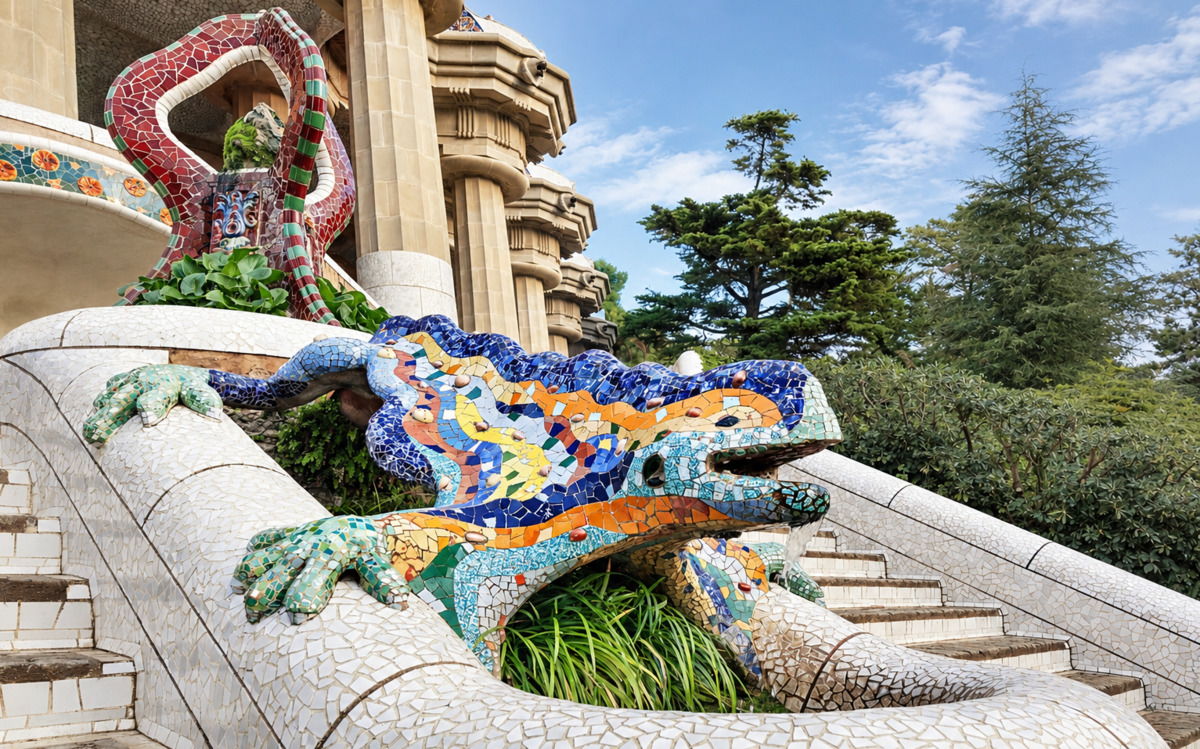
As you make your way up the winding paths of the park, it is difficult to shake the feeling that you are no longer in the heart of one of Europe’s largest cities, but in an entirely different world where nature and architecture exist according to their own rules. It was here that Antoni Gaudí was able to give the freest expression to his ideas, proving that buildings and landscapes do not have to compete with one another but can become a single harmonious whole.
Today, Park Güell is one of Barcelona’s most famous attractions and is included on the UNESCO World Heritage List. Yet millions of visitors come here not only to see the famous mosaic salamander or enjoy the panoramic views over the city. A walk through the park offers the chance to step inside Antoni Gaudí’s world and discover what architecture looks like when nature itself becomes its greatest source of inspiration.
History of Park Güell
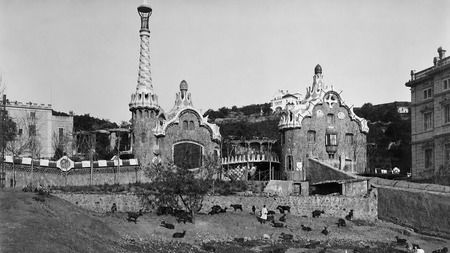
Today, it is hard to imagine that Park Güell was never intended to be a public park. At the beginning of the 20th century, this hillside was meant to become an exclusive residential estate for Barcelona’s wealthy residents — peaceful, surrounded by greenery and completely unlike the noisy industrial city below. The idea belonged to the Catalan entrepreneur Eusebi Güell, who entrusted its realisation to the man whose talent he admired without reservation — Antoni Gaudí.
Eusebi Güell and the Dream of a Garden City
Eusebi Güell was one of Catalonia’s most influential industrialists, a renowned patron of the arts, and a man who deeply admired the work of Antoni Gaudí. Thanks to his support, many of the architect’s most famous creations came to life, including Palau Güell, Colònia Güell and, of course, Park Güell.
During his travels in Britain, Güell became familiar with the then-popular concept of the garden city. The idea was that people would live away from the crowded city centre, surrounded by greenery, fresh air and nature, while still enjoying all the advantages of urban life. After returning to Barcelona, he decided to bring this vision to life on one of the city’s most picturesque hills and entrusted the project to Antoni Gaudí.
For the architect, this was an opportunity to create not just a single building, but an entire environment where houses, roads, stairways, squares and nature would exist as one harmonious whole. Rather than forcing the landscape to adapt to architecture, Gaudí chose the opposite approach — allowing the future neighbourhood to grow naturally from the hillside itself, following its organic forms.
Why the Project Never Became a Residential Estate
Despite its original concept and Antoni Gaudí’s remarkable talent, the project proved to be a commercial failure. Around sixty residential plots were planned, but very few buyers showed any interest. At the beginning of the 20th century, the site was quite far from the centre of Barcelona, reaching the hill was not easy, and the price of the plots was too high even for wealthy families.
In the end, only two plots were sold over several years. One house was purchased by a friend of Eusebi Güell, while Antoni Gaudí himself lived for a time in the other. The rest of the land remained undeveloped. For the entrepreneur, the project became a financial disappointment. Yet it is precisely because of this that visitors today can experience the park much as the architect originally envisioned it, free from dense residential development.
How a Failed Project Became a Symbol of Barcelona
After the death of Eusebi Güell, his heirs decided to sell the land to the city. In 1926, Park Güell was opened to the public and gradually became one of Barcelona’s favourite places for recreation. Over time, tourists from all over the world began coming here to admire Antoni Gaudí’s extraordinary architecture and wander among his remarkable creations.
Today, it is hard to believe that this park was once considered a commercial failure. It is now a UNESCO World Heritage Site, welcomes millions of visitors every year, and is regarded as one of Barcelona’s most iconic landmarks. The story of Park Güell is a rare example of a project that was a complete failure during the lifetime of its creators, yet decades later became a world-famous attraction.
What Awaits You at Park Güell
A walk through Park Güell is unlike a visit to an ordinary city attraction. Rather than thinking of it as an open-air museum, it is better to see it as a journey through a world where the architect’s imagination gradually unfolds, one step at a time.
The Main Entrance and First Impressions
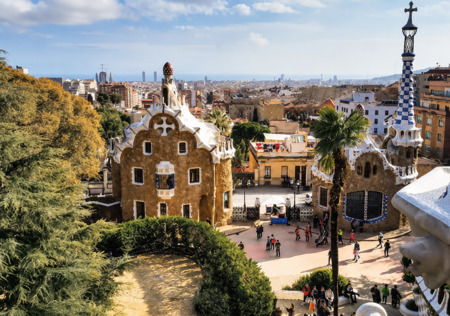
Your visit to Park Güell begins at the main entrance, where two unusual pavilions with undulating roofs and whimsical shapes welcome visitors. They are often compared to gingerbread houses from a fairy tale, although Gaudí himself drew inspiration from natural forms and traditional Catalan architecture. Even here, it becomes clear that the familiar rules of architecture have been left outside the park.
As you climb the central staircase, it is impossible not to notice that there are almost no straight lines around you. The stairways, walls and pathways follow the natural contours of the hillside, as though they have always belonged there. Gaudí believed that people feel far more comfortable surrounded by forms found in nature, so rather than forcing the landscape to conform to architecture, he allowed the architecture to become its natural continuation.
The Mosaic Salamander
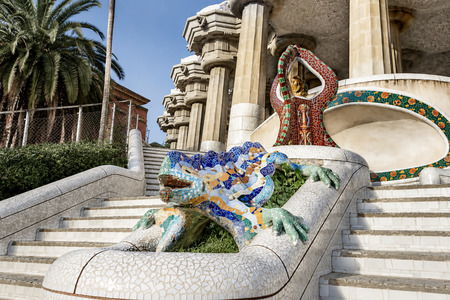
As you make your way up the central staircase, it is impossible to miss the most famous “resident” of Park Güell — the colourful mosaic salamander, often referred to as the dragon. It is here that queues of visitors gather every day to take a photograph, and over time this remarkable sculpture has become one of the most recognisable symbols not only of the park but of Barcelona itself.
However, it is not only the salamander that captures attention, but also the technique used to create it. Instead of traditional ceramic tiles, Antoni Gaudí employed trencadís — a mosaic made from broken pieces of ceramic, glass and porcelain. At the beginning of the 20th century, this was an unusual approach: discarded materials that would normally have been considered building waste were transformed into vibrant works of art.
This technique made it possible to cover complex curved surfaces that could not be finished with whole tiles. As a result, the mosaic seems to follow the natural forms of the landscape, preserving the flowing lines of the architecture. That is why the colourful patterns appear so natural, as though they have always belonged to their surroundings.
Today, the trencadís technique is inseparably associated with the work of Antoni Gaudí. It can also be seen in several of his other creations, but nowhere is it displayed more vividly than in Park Güell. Many visitors admit that after only a few minutes of walking through the park, they begin to notice how the mosaics accompany them almost everywhere, uniting staircases, benches, fountains and decorative details into one harmonious artistic space.
The Hypostyle Room and the Main Terrace
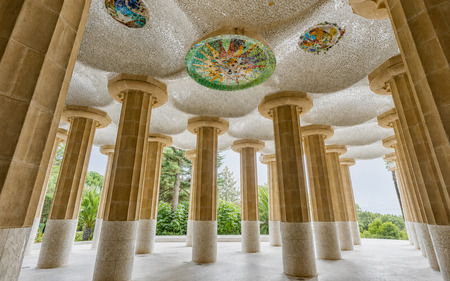
Climbing the mosaic staircase brings you to one of the most impressive spaces in Park Güell — the famous Hypostyle Room. Despite its popular nickname as the Hall of One Hundred Columns, there are in fact only eighty-six columns, although the historic name has remained to this day. Originally, this space was designed to serve as a covered market for the residents of the planned garden city.
At first glance, the columns appear to be completely identical, but as soon as you look upwards, it becomes clear that this is far from an ordinary architectural hall. Their proportions and arrangement create the impression of a real forest, where mighty tree trunks support not a ceiling but the vast terrace above. Even here, Gaudí once again turned to nature, demonstrating that it remains the greatest architect of all.
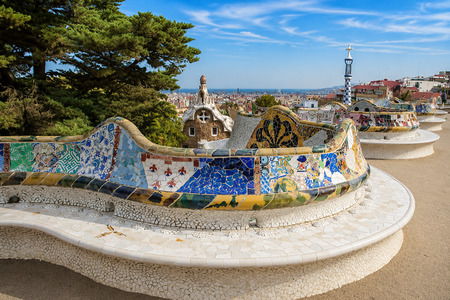
Climbing a little higher, you arrive at the Main Terrace — the most famous spot in Park Güell. It is surrounded by the park’s iconic undulating bench, entirely covered with trencadís mosaic. It is said that Gaudí deliberately gave it this shape to make it as comfortable as possible, allowing the bench to follow the natural curves of the human body.
From here, one of the finest panoramic views of Barcelona unfolds before you. The city gradually reveals itself — the towers of the Sagrada Família, the Mediterranean Sea, green hills and the endless neighbourhoods of the Catalan capital. It is no coincidence that many visitors spend the longest time here, simply enjoying a view and an atmosphere that no photograph can truly capture.
The Little Houses, Galleries and Hidden Corners of the Park
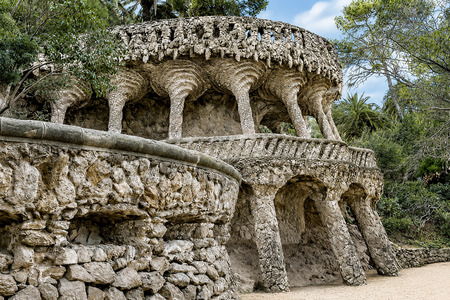
After visiting the Main Terrace, many people turn back towards the exit, believing they have already seen the park’s highlights. In reality, it is beyond this point that you begin to experience the part of Park Güell where Antoni Gaudí’s vision is felt most clearly.
Winding paths weave between pine trees, stone viaducts seem to grow directly out of the hillside, and arched galleries blend almost seamlessly into the surrounding rock. It feels as though these structures have always been part of the landscape, so naturally do they fit into their surroundings.
It is during this unhurried walk that you realise Park Güell is not simply a collection of individual attractions, but a single work of art in which it is impossible to draw a clear line between architecture and nature. Perhaps that is why so many people describe it as Antoni Gaudí’s most “living” creation.
To enjoy the entire route at a relaxed pace, reach the Main Terrace and explore the park’s hidden corners without rushing, it is best to choose a convenient visiting time in advance. This is especially important during the peak tourist season, when the number of visitors allowed into the Monumental Zone is limited.
Tickets for Park Güell
Your choice of ticket depends on how you would like to experience Park Güell. For some visitors, a standard admission ticket is enough to explore the famous Monumental Zone at their own pace. Others prefer to visit the park with a guide, who explains the history of the project, the symbolism behind the architecture, and the lesser-known aspects of Antoni Gaudí’s work. Combined tickets are also available, allowing you to visit Park Güell together with other iconic attractions in Barcelona.
It is best to plan your visit in advance, especially if you are travelling between spring and autumn. Access to the Monumental Zone is limited, so tickets are sold for specific time slots. During the peak tourist season, the most convenient times often sell out several days in advance, and sometimes even earlier. If you would like to explore the park at a relaxed pace, join a guided tour or combine your visit with other works by Gaudí, it is advisable to book your tickets in advance.
What to See After Visiting Park Güell
Park Güell is just one aspect of Antoni Gaudí’s remarkable work. If you would like to gain a deeper understanding of his architecture and discover how differently he approached space in each project, it is well worth continuing your journey to some of Barcelona’s other iconic landmarks. After a rewarding walk through the park’s hills, you may also wish to stop at one of the city’s restaurants and sample traditional Catalan cuisine.
- Sagrada Família — Antoni Gaudí’s greatest masterpiece, where architecture, light and symbolism come together to create a single work of art.
- Casa Batlló — one of Barcelona’s most extraordinary Modernist buildings, famous for its fantastical façade and unique interiors.
- Casa Milà (La Pedrera) — Gaudí’s final civil work, renowned for its undulating façade and remarkable rooftop with sculptural chimneys.
- Picasso Museum — one of Barcelona’s most celebrated art museums, revealing the close connection between the great artist and the city.
- Barcelona’s Main Attractions — a ready-made itinerary featuring the city’s most interesting sights, helping you plan a walk for one or several days.
- Where to Eat in Barcelona — the best Catalan dishes, popular restaurants and recommendations on where to enjoy a gastronomic break after exploring the city.
This itinerary will allow you to discover Barcelona through the eyes of Antoni Gaudí and then experience the city through its atmosphere, cuisine and most famous landmarks.

 English
  Español
  Русский