
Baeza — one of the most atmospheric historic towns in Andalusia, located in the province of Jaén. Together with neighboring Úbeda, the town was included in the UNESCO World Heritage List in 2003 thanks to its exceptionally well-preserved Renaissance architecture and unique historical character.
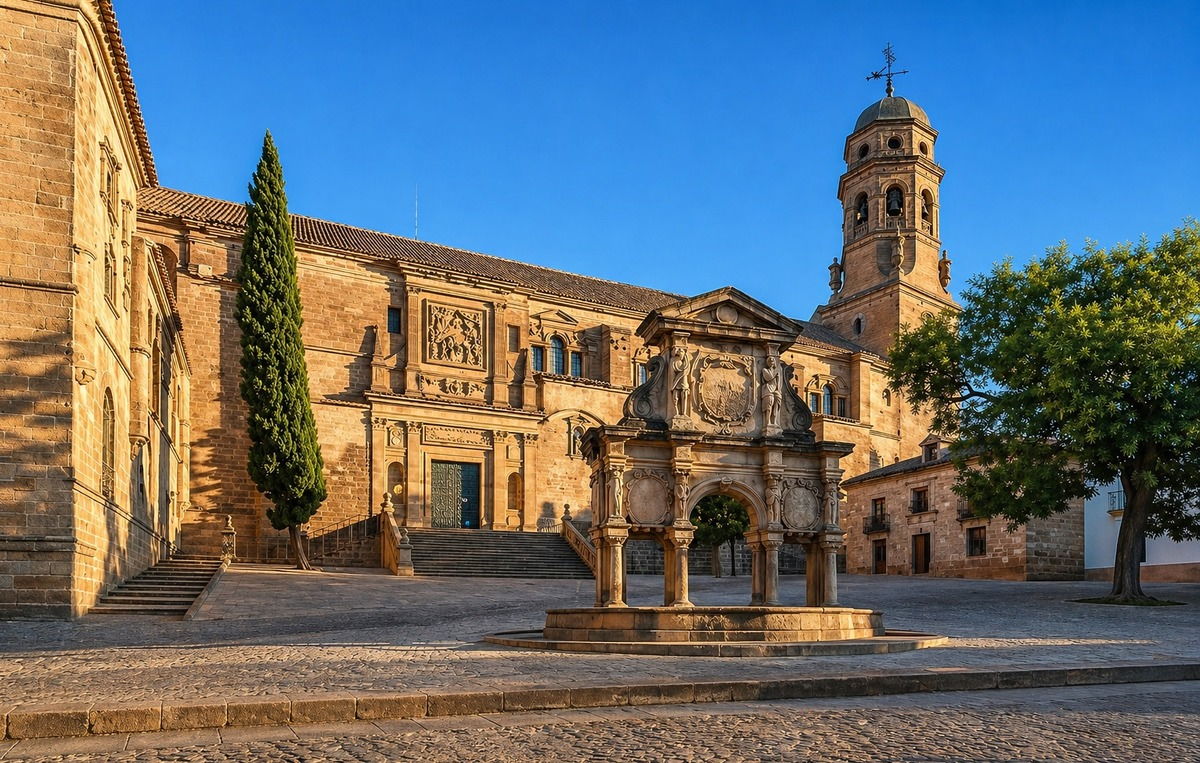
Baeza stands out for its special atmosphere of calm and comfort: narrow stone streets, historic squares, and majestic buildings create the feeling that time flows more slowly here. The town is known for its university heritage — it was here that one of the oldest universities in Andalusia was located, playing an important role in the development of culture and education in the region.
Walking through Baeza, it is easy to notice the harmonious combination of architecture and surrounding landscapes: from the town walls, beautiful views open over the Guadalquivir River valley and the endless olive groves of the province of Jaén.
In this article, you will learn what to see in Baeza: the town’s main attractions, historic squares, ancient buildings, and the most interesting places worth including in your walking route.
What to see in Baeza in 1 day — walking route
Baeza is a compact town with a well-preserved historic center, so most of the main attractions can be easily explored on foot. A walk around the town takes several hours and allows you to see historic squares, Renaissance buildings, and picturesque panoramic viewpoints.
The route begins from the town’s central promenade street and gradually leads to the main historical attractions of Baeza.
- Plaza de España
- Paseo de la Constitución
- Plaza del Pópulo (Plaza de los Leones)
- Puerta de Jaén
- Baeza cathedral (Catedral de Baeza)
- Fuente de Santa María
- Palacio de Jabalquinto
- Plaza Santa Cruz
- Historic university of Baeza (Universidad Antigua de Baeza)
- Walk along the city walls (Paseo de las Murallas)
Additionally:
The route through the town is designed to gradually move from one point to another and see the most important architectural landmarks of Baeza. It forms a kind of circular route, making the walk convenient and logical, without unnecessary backtracking. If desired, the walk can also be done in the opposite direction — all the main points are located quite compactly and close to each other.
Plaza de España
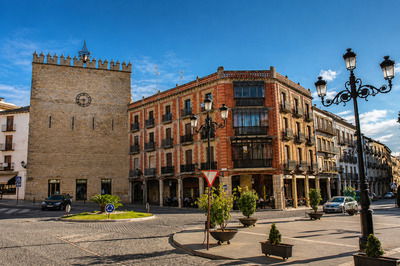
You can conveniently begin your introduction to Baeza from Plaza de España — one of the town’s central transport hubs. Essentially, it is a modern roundabout square with several roads leading to different parts of Baeza, making it easy to orient yourself here before starting your walk through the historic center.
Despite its significant name, the square itself looks rather simple and does not feature particularly expressive historic architecture. However, it is surrounded by cafés, shops, banks, and other urban facilities, making it an important place of city life and a meeting point for local residents.
On the square stands the tower Torre de los Aliatares — one of the preserved elements of Baeza’s medieval fortifications, dating back to the 14th–15th centuries. In the past, it served as part of the town’s defensive system and was used to monitor the surroundings. Today, the tower with its clock remains one of the most recognizable historic landmarks in the central part of the town.
Among the several directions leading from the square, Paseo de la Constitución is particularly interesting. This is the direction most tourists take, as it leads to the historic part of the town and the main attractions of the route.
Paseo de la Constitución
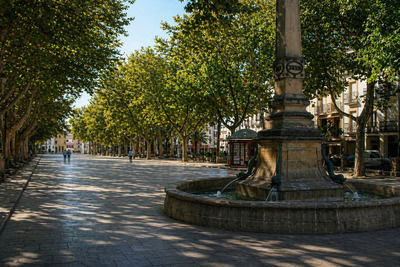
Paseo de la Constitución is a wide city boulevard with trees, benches, and shaded areas where it is pleasant to walk at any time of day. In the center of the promenade, there is a small fountain, and around it you can often see families with children, elderly residents, and tourists leisurely heading toward the historic center.
Along the Paseo there are small cafés, pastry shops, and shops, making it a good place to take a short break before continuing your walk. Many travelers feel the atmosphere of a living Spanish town here for the first time — not only historic, but also modern.
Gradually moving forward along the Paseo, you will reach the boundary of the old part of Baeza and head toward Plaza del Pópulo — one of the most recognizable historic points of the town.
Plaza del Pópulo (Plaza de los Leones)
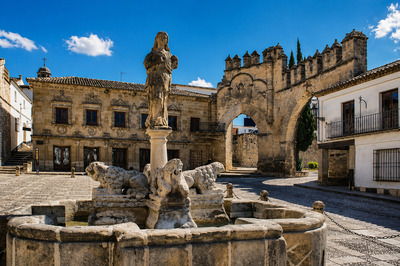
Plaza del Pópulo — one of the most atmospheric and photogenic places in Baeza. It is also known as Plaza de los Leones and is considered one of the oldest squares in the town, formed in the 16th century.
The main decoration of the square is the famous Lions Fountain (Fuente de los Leones), installed in the 16th century. The sculptural composition with lion figures is considered one of the symbols of Baeza and often appears in tourist photographs. According to one version, the central figure of the fountain may have an even older origin and is connected to the ancient past of the region.
The square is surrounded by expressive historic buildings. Particular attention is drawn to Casa del Pópulo — one of the most recognizable Renaissance buildings, whose façade is decorated with ornamental elements and coats of arms. Nearby stands the building of the former meat market (Antigua Carnicería), reminding visitors of the town’s commercial past.
One of the notable architectural elements of the square is the Arco de Villalar — a historic 16th-century arch that once served as one of the entrances to the town and today remains an important symbol of medieval Baeza.
Thanks to the harmonious combination of architecture and compact space, Plaza del Pópulo is considered one of the most picturesque corners of Baeza. It is a pleasant place to make a short stop, examine architectural details, and take photos before continuing your walk through the historic center.
Puerta de Jaén
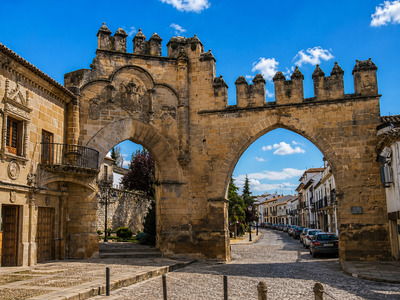
Continuing the walk from Plaza del Pópulo, the route leads to Puerta de Jaén — one of the best-preserved historic entrances to Baeza. These gates are part of the town’s ancient defensive system and recall the time when it was surrounded by strong fortifications.
Puerta de Jaén was built on the site of earlier fortifications that existed during the period of Arab rule, and its present appearance was formed in the 16th century. Merchants and travelers once passed through these gates on their way to the neighboring town of Jaén — which is how the gate received its name.
Near the gate, sections of ancient walls have been preserved, allowing visitors to imagine what the defensive system looked like in the Middle Ages. A characteristic feature of the structure is its double-arched design, clearly visible when approaching the gate.
After exploring the gate, the route continues deeper into the historic part of the town. Walking slightly uphill along the old streets, you will soon notice the tower of Baeza Cathedral — it serves as a good landmark and makes it easy to find.
Baeza cathedral (Catedral de Baeza)
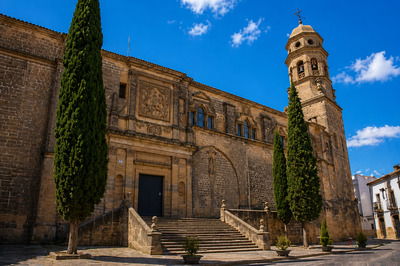
Baeza Cathedral — one of the main architectural symbols of the town and an important monument of the Renaissance era. The cathedral is located on Plaza de Santa María, which is considered one of the central historic squares of Baeza.
The history of the cathedral begins in the 13th century, when construction of a Christian church started on the site of a former mosque after the Reconquista. The modern appearance of the building was largely shaped in the 16th century thanks to the work of the famous architect Andrés de Vandelvira, who played a key role in the development of Renaissance architecture in the province of Jaén.
The façade of the cathedral is designed in the Spanish Renaissance style and is distinguished by strict lines and harmonious proportions. Above the building rises the bell tower, which is clearly visible from different parts of the town and serves as one of the main landmarks of the historic center.
Over the centuries, the church was rebuilt several times, including after the destructive earthquake of 1567. As a result, the cathedral’s architecture combines elements from different historical periods — from Gothic to Renaissance and Baroque.
Inside the cathedral, visitors can see ancient altars, decorative elements, and spacious halls that create an atmosphere of calm and solemnity. This church is one of the key sites thanks to which Baeza was included in the UNESCO World Heritage List.
In front of the cathedral lies the spacious Plaza de Santa María — a convenient place to stop, take photos, and examine the architectural details of the building, as well as the unusually shaped fountain — Fuente de Santa María.
Visiting: entry to the cathedral is usually paid. Inside, visitors can explore the main halls, chapels, and climb to viewing areas. Opening hours may vary depending on the season and religious events, so it is recommended to check the current schedule before visiting.
Fuente de Santa María
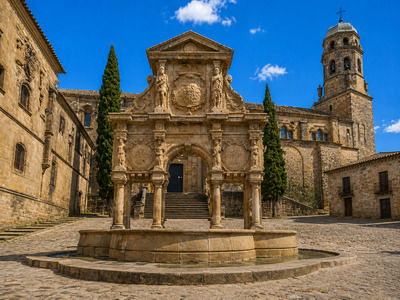
Fuente de Santa María — one of the most recognizable decorative elements of the historic center of Baeza.
It was built in 1564 to commemorate the completion of the town’s water supply system — an important event for the residents of Baeza at that time. Water was supplied here from the Fuente del Moro spring, and the fountain itself became a symbol of the development of urban infrastructure during the Renaissance.
The architecture of the fountain is designed in the Renaissance style and harmoniously complements the surrounding buildings, creating a unified architectural ensemble of the square. The façade is decorated with ornamental elements, coats of arms, and sculptural details that give the structure a solemn and expressive appearance.
The light-colored stone and elegant forms make the fountain one of the most photogenic objects in the town center. Thanks to its location next to the cathedral, it naturally fits into the walking route through the historic center.
From Plaza de Santa María, the route conveniently continues toward Palacio de Jabalquinto — one of the most expressive architectural monuments of Baeza. Walking along the narrow streets of the historic center, you will soon see its richly decorated façade, considered one of the most recognizable in the town.
Palacio de Jabalquinto
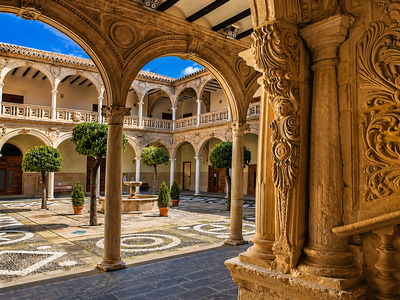
Palacio de Jabalquinto — one of the most impressive buildings in Baeza. It was built at the end of the 15th century by order of the noble Benavides family and received its name from the title of the Marquises of Jabalquinto. The architecture of the building combines elements of Late Gothic and Early Renaissance styles, making it one of the most expressive architectural monuments in the town.
The façade of the palace is decorated with intricate carved ornaments, coats of arms, and decorative elements that create the effect of a rich stone composition. This façade most often appears in photographs of the town and is considered one of its architectural “hallmarks.”
Inside the palace there is an elegant inner courtyard — a patio surrounded by columns and arches in Renaissance style. Today, the building is part of an educational complex and is used by the International University of Andalusia (Universidad Internacional de Andalucía — UNIA).
Visiting: the façade of the palace can be freely viewed from Plaza Santa Cruz. The inner courtyard (patio) is sometimes open to visitors free of charge, but access depends on the university’s schedule and events. Therefore, if you see that the doors are open — feel free to enter.
Nearby is Plaza Santa Cruz and the Church of Santa Cruz (Iglesia de Santa Cruz) — one of the oldest buildings in the town, built in the 13th century and representing a rare example of Romanesque architecture in Andalusia.
Plaza Santa Cruz
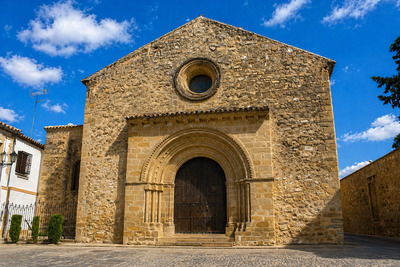
Plaza Santa Cruz — small but very atmospheric. There is no large flow of people here, so the place feels calm and almost secluded, despite its proximity to the town’s main attractions.
The main highlight of the square is the Church of Santa Cruz — one of the few preserved Romanesque churches in Andalusia, built in the 13th century. Thanks to its strict architecture and ancient origin, it clearly stands out against the later Renaissance buildings.
💡 Plaza Santa Cruz is an excellent place to take a few photos and carefully examine the architectural details of the buildings before moving on to one of the most impressive historic universities.
Historic university of Baeza (Universidad Antigua de Baeza)
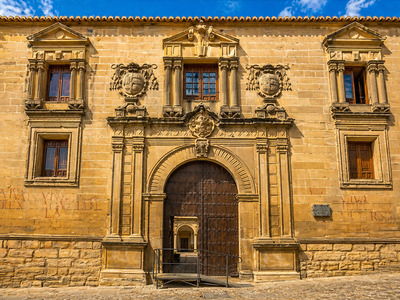
Continuing the walk from Plaza Santa Cruz and the Church of Santa Cruz (Plaza Santa Cruz / Iglesia de Santa Cruz), you will soon reach the historic University of Baeza — one of the most significant historic buildings in the town.
The university was founded in 1538 by Saint John of Ávila (San Juan de Ávila) and for a long time was considered one of the most important educational centers in Andalusia. Students from different regions of Spain studied here, and the institution itself played an important role in the development of science and culture in the region.
The university building features strict and harmonious Renaissance-style architecture. Special attention is drawn to the inner courtyard with columns and arches, creating an atmosphere of calm and comfort. On the façade of the building, you can notice characteristic red inscriptions — the so-called vítores, which students left to celebrate their successful graduation.
The university is connected with the name of the famous Spanish poet Antonio Machado, who taught French here at the beginning of the 20th century. The classroom where he taught has been preserved, and today it is considered an important cultural site of the town.
In the 19th century, the university was closed, but the building continued to be used for educational purposes. Today, it houses the educational institution IES Santísima Trinidad, preserving the historical significance of this place to this day.
Visiting: the university courtyard (patio) can usually be visited free of charge if the main entrance is open. Since the building continues to function as an educational institution, access may depend on the time of day, class schedule, or events.
💡 After visiting the university, it is convenient to continue the walk toward the city walls and viewpoints (Paseo de las Murallas), from where beautiful views open over the Guadalquivir River valley and the surrounding olive groves.
Walk along the city walls and viewpoints (Paseo de las Murallas)
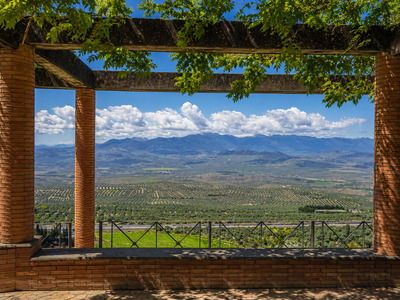
After visiting the historic university, the route gradually leads to one of the most picturesque parts of Baeza — the walking area along the city walls (Paseo de las Murallas). The road passes through quiet streets of the historic center and gradually opens up panoramic views of the surroundings.
The city walls were built in the Middle Ages and served as an important defensive structure protecting Baeza from attacks. Separate fragments of the fortifications have survived to this day and have become part of a pleasant walking area and one of the most enjoyable viewpoints in the town.
While walking along Paseo de las Murallas, it is worth stopping at one of the viewpoints — miradores — located along the wall. One of the most popular is Mirador del Guadalquivir, offering impressive views over the Guadalquivir River valley and the endless olive groves of the province of Jaén.
The route along the walls follows a flat and comfortable path and takes approximately 10–15 minutes of a leisurely walk, allowing time for photo stops and rest. On clear days, the rural landscapes of Andalusia and hills covered with thousands of olive trees are especially visible from here.
The best time for a walk is morning or evening, when the soft light makes the landscapes more expressive and the town looks especially atmospheric.
💡 A walk along the city walls and viewpoints makes an excellent ending to the route through Baeza and allows you to see the town from another perspective — calmer and more picturesque.
Useful information for visiting Baeza
Baeza is a compact town with a well-preserved historic center, so most attractions can be conveniently explored on foot. Before your trip, it is worth considering several practical points that will help make your walk more comfortable.
How much time you need: the main attractions of Baeza can be explored in 2–3 hours, while a more relaxed walk with museum visits and viewpoints will take about half a day.
Where to Park in Baeza
The historic center of Baeza consists of narrow streets, so it is best to choose a convenient place for parking near the main attractions in advance.
💡 If you are traveling around Andalusia by car, it is helpful to plan routes and stops in advance. For trips between Baeza, Úbeda, Jaén, and the natural areas of the province, many travelers choose car rental 🚗 — it is one of the most convenient ways to see more interesting places during one trip.
- Parking Paseo de la Constitución — one of the most convenient options near the historic center. From here, you can reach Plaza del Pópulo in about 5–7 minutes on foot.
- Parking area near Plaza de España — a popular option for starting a walk through the historic streets.
- Parking near Paseo de las Murallas — a good option if you plan to walk along the city walls and visit viewpoints.
💡 During the high tourist season, it is better to arrive in the morning — by midday, fewer spaces may be available.
When Is the Best Time to Visit Baeza
The best time for walking in Baeza is spring and autumn, when temperatures remain comfortable and the weather is ideal for leisurely walks through the historic center and viewpoints.
In summer, Baeza can be quite hot, especially in the middle of the day, when temperatures often exceed 30–35 °C. During this period, it is better to plan walks for the morning or evening hours.
💡 Useful tip: for walking in Baeza, it is best to wear comfortable shoes — many streets in the historic center are paved with stone and have slight slopes.
How Long to Spend in Baeza
Most of the main attractions of Baeza can be seen in 3–4 hours during a relaxed walk through the historic center. Thanks to the compact location of the sites, the route is convenient and does not require long distances.
If you plan to carefully explore buildings, visit museums, or make longer stops at viewpoints, it is worth allocating half a day for exploring the town.
Many travelers include Baeza in a route through the province of Jaén together with the neighboring town of Úbeda. Due to the short distance between the towns, this option is considered one of the most convenient and popular.
Can you combine Úbeda and Baeza in one day
Yes, many travelers explore Úbeda and Baeza in one day, as the distance between the towns is only about 10 kilometers.
The journey between the towns takes approximately 10–15 minutes by car, making this route one of the most convenient in the province of Jaén.
Travelers usually start the day with a visit to Úbeda — a larger town with more architectural landmarks — and then head to Baeza, where they spend the second half of the day enjoying the calm atmosphere and walks through the historic center.
💡 This route is especially popular among tourists, as both towns are included in the UNESCO World Heritage List and are located very close to each other.
What to see near Baeza
Baeza is conveniently located in the province of Jaén, close to historic towns and natural areas of Andalusia. Thanks to the short distances between settlements, it is easy to include it in a regional travel route and combine visits to several interesting places in one trip.
- The most obvious destination is Úbeda, located only about 9–10 kilometers from Baeza. These two towns are included in the UNESCO World Heritage List and are often visited together. The journey between them takes about 10–15 minutes.
- About 50 kilometers (40–50 minutes drive) away is the town of Jaén, known for its cathedral, Arab baths, and the Santa Catalina fortress.
- Nature lovers should visit Cazorla, located about 45 kilometers (45–60 minutes drive) away. This picturesque town is considered the gateway to the Sierras de Cazorla Natural Park.
- Not far from Úbeda is the small town of Sabiote (about 17 kilometers from Baeza), known for its Castillo de Sabiote and atmospheric historic center.
- If you have more time, you can visit Granada, located about 130 kilometers (1 h 40 min — 2 hours drive) away. This city is famous for the Alhambra Palace and its rich Moorish heritage.
- Fans of mountain landscapes should consider visiting Sierra Nevada, located about 160 kilometers (about 2–2.5 hours drive) away.
- During trips between Baeza, Úbeda, and Jaén, you can see the endless olive groves of the province of Jaén — one of the most recognizable landscapes of the region.
💡 Thanks to its convenient location, many travelers combine Baeza and Úbeda in one day and then continue the route toward Jaén, Cazorla, or Granada.

 English
  Español
  Русский