
Seville — the hot capital of Andalusia, a city of orange trees, white houses, historic palaces and evening flamenco. Here, Moorish heritage stands alongside magnificent cathedrals, luxurious royal residences and picturesque squares, while a walk through the historic centre can easily become a journey through several different eras.
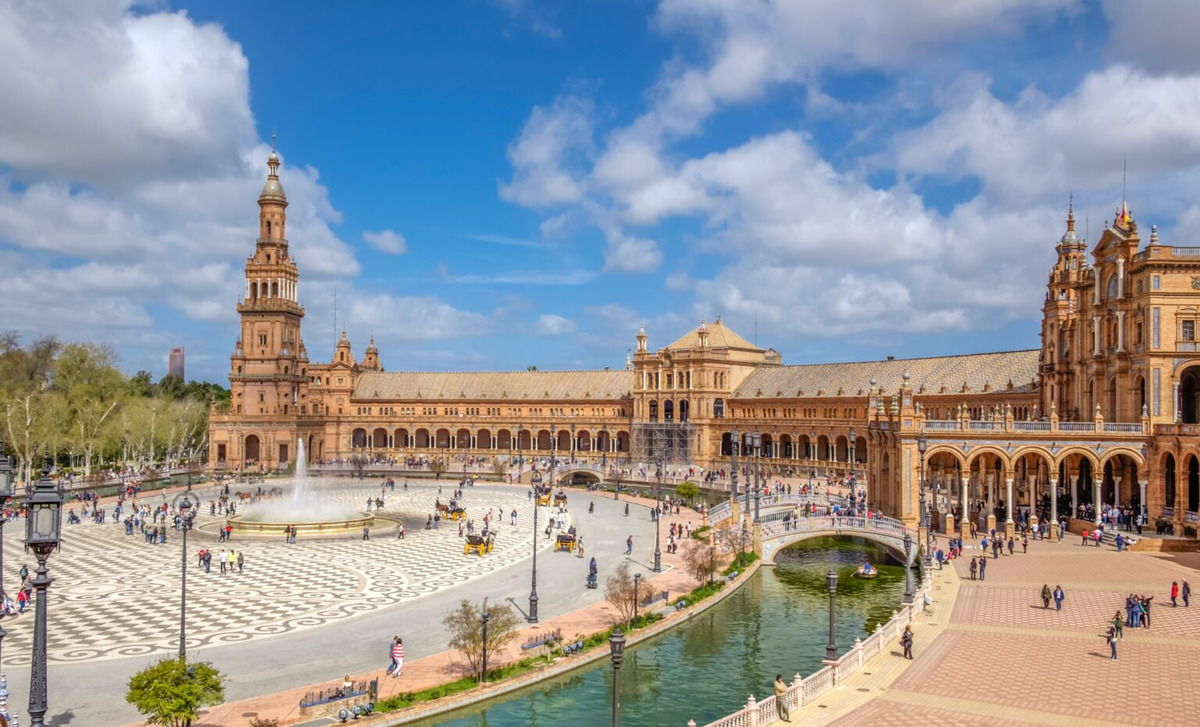
The city's main symbols are familiar from photographs — the Royal Alcázar, the Cathedral with the Giralda, Plaza de España and the historic neighbourhoods along the Guadalquivir. But Seville is worth discovering beyond its best-known attractions: between them are quiet streets, historic corners and places where the character of Andalusia can be felt particularly strongly.
Main attractions in Seville
Seville's main attractions are located both in the historic centre of the city and on the opposite bank of the Guadalquivir River. In one or two days, you can see famous UNESCO monuments, historic neighbourhoods, modern architectural landmarks and some of the most atmospheric areas of the Andalusian capital.
The Giralda and Seville Cathedral (La Giralda y la Catedral de Sevilla)
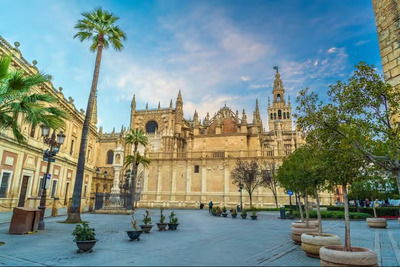
Seville Cathedral, together with the Giralda, is one of the city's main symbols. The huge Gothic cathedral was built in the 15th century on the site of the former Almohad mosque, while retaining part of its heritage. This makes it particularly interesting to see how different periods of Seville's history have come together in one place.
The Giralda, originally the minaret of a 12th-century mosque, became the cathedral's bell tower after the Reconquista. Today, its silhouette, crowned by the bronze figure of «El Giraldillo», is impossible to imagine separately from Seville, while climbing the tower allows you to see the historic centre from above and appreciate how closely its historic neighbourhoods, squares and architectural monuments are intertwined.
Inside the cathedral, the vast Gothic spaces, numerous works of art and the tomb of Christopher Columbus are particularly impressive. The surviving Patio de los Naranjos — the former mosque courtyard with orange trees, arcades and water — creates a completely different atmosphere and serves as a reminder of the city's Moorish past.
The Royal Alcázar (Real Alcázar de Sevilla)
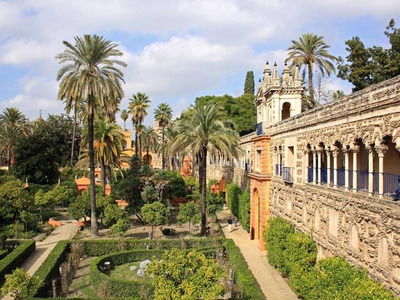
The Royal Alcázar is one of Seville's main attractions and one of the oldest working royal palaces in Europe. The palace complex was created and modified over many centuries, which is why its architecture combines Moorish traditions, Gothic, Renaissance and later elements in a remarkable way.
The Alcázar impresses not only with its richly decorated palaces, carved arches and colourful tiles, but also with its gardens — green, shady spaces filled with fountains, ponds, orange trees and pavilions. Together, the architecture and gardens create a unique atmosphere in a place where the Eastern heritage of Andalusia intertwines with the history of the Spanish monarchy.
Today, the Alcázar remains a working royal residence and is a UNESCO World Heritage Site. It gained additional fame through the filming of Game of Thrones: the palace and its gardens served as the setting for the Water Gardens of Dorne. But the main impression of the Alcázar is created not by the cinema, but by its remarkable combination of history, architecture and nature.
The Archive of the Indies (Archivo General de Indias)
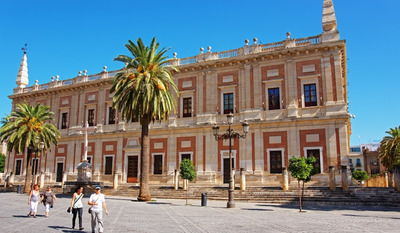
The Archive of the Indies is an unusual historic site in the very centre of Seville, where documents connected with the Age of Discovery, Spanish expeditions and the history of the New World have been preserved. The building itself was originally constructed as a trading exchange for merchants and later became one of Spain's most important archives.
Documents connected with Christopher Columbus, Ferdinand Magellan and other famous explorers are preserved here. The Archive of the Indies is therefore interesting not only as a historic building: behind its walls, real evidence has survived from an era when Seville was one of the main centres of Spanish trade and maritime expeditions.
The building's austere architecture, spacious courtyard and exhibition spaces create a completely different atmosphere from the luxurious interiors of the Alcázar and the magnificent Cathedral. The Archive of the Indies forms part of a UNESCO World Heritage Site together with them, and admission is free. This makes it an especially pleasant opportunity to discover another important side of historic Seville without any additional expense.
The Santa Cruz neighbourhood (Barrio de Santa Cruz)
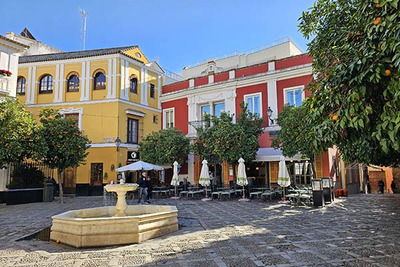
Santa Cruz is one of the most picturesque and atmospheric areas of Seville. It was once the city's Jewish quarter and remained the centre of the local Jewish community for several centuries. After Seville was conquered by King Ferdinand III in 1248, the neighbourhood gradually changed while retaining its characteristic layout of narrow streets and traces of the cultural heritage of different eras.
Today, Santa Cruz is considered one of the most popular areas for walking in the historic centre. Its maze of alleyways, whitewashed houses decorated with wrought-iron balconies and flowers, shady courtyards and small squares create a distinctive Andalusian atmosphere.
During your walk, it is worth visiting Plaza de Doña Elvira, Plaza de Santa Cruz and Plaza de los Venerables, as well as looking out for the many orange trees, traditional patios and historic mansions. This is where you can particularly appreciate the character of old Seville.
It is best to visit Santa Cruz in the morning or towards the evening, when the heat subsides. At this time, the neighbourhood is particularly beautiful, while its many bars and restaurants open their terraces, offering the chance to try traditional Andalusian tapas.
Plaza de España and María Luisa Park (Plaza de España y Parque de María Luisa)
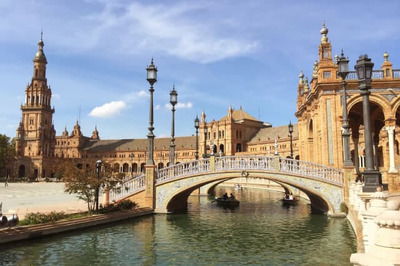
Plaza de España is considered one of the most beautiful squares not only in Seville, but in the whole of Spain. It was built between 1914 and 1929 for the Ibero-American Exposition, which was intended to highlight Spain's historical and cultural ties with the countries of Latin America.
The monumental semi-circular building combines elements of Neo-Mudéjar architecture, Art Deco and Renaissance motifs. Four picturesque bridges cross the canal surrounding the square, symbolising Spain's historic kingdoms — Castile, León, Aragon and Navarre.
Particular attention is drawn to the 48 tiled alcoves dedicated to the Spanish provinces. Each is decorated with traditional azulejos, historical scenes, a coat of arms and a map of the corresponding province. Many tourists specifically look for the panel representing their region or city.
The square has been used as a filming location for several famous films, including Star Wars and Lawrence of Arabia. As a result, it is recognisable far beyond Spain.
Nearby is María Luisa Park — the largest green space in Seville's historic centre, with fountains, shady avenues, pavilions and exotic plants. It is an excellent place to take a break from the bustle of the city after sightseeing.
The Triana neighbourhood
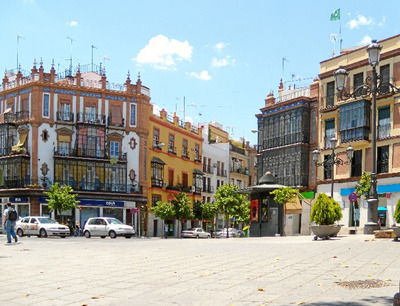
Triana is one of Seville's most colourful neighbourhoods, located on the western bank of the Guadalquivir River. For many centuries, this neighbourhood developed separately from the historic centre and formed its own character, traditions and cultural identity.
The area is considered one of the cradles of flamenco. Many famous dancers, singers and musicians lived here, and the local tablaos still allow you to see authentic Andalusian performances in a more traditional atmosphere than in the city's tourist centre.
Triana is also known for its traditions of producing ceramics and azulejos. In its numerous workshops and small shops, you can buy both contemporary handmade items and pieces made using traditional techniques.
During your walk, it is worth visiting the Triana Market, located next to the Puente de Isabel II. Here you can buy fresh produce, local delicacies, jamón, cheeses and Andalusian dishes. It is one of the best places in the city to discover the local cuisine.
Triana is particularly pleasant in the evening, when the many bars and restaurants along the Betis riverside (Calle Betis) open their doors. From here, you can enjoy some of the finest views of Seville's historic centre, the Giralda tower and the Guadalquivir River.
Metropol Parasol (Setas de Sevilla)
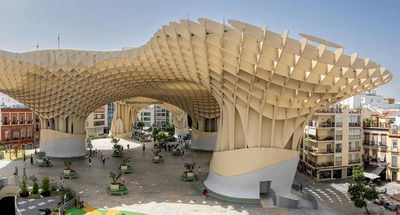
Metropol Parasol, better known as Setas de Sevilla ("Seville Mushrooms"), is one of the city's most unusual attractions and a striking example of contemporary architecture. The project was designed by German architect Jürgen Mayer and completed in 2011. The structure is considered one of the world's largest wooden architectural forms.
The complex is located in Plaza de la Encarnación and brings together several different spaces. Beneath its canopy is the Antiquarium archaeological museum, where you can see Roman mosaics, the remains of ancient Roman houses and other finds discovered during construction. Here, you can see how the city has changed over many centuries.
The structure acquired its unofficial name because of its unusual shape, which resembles giant mushrooms. Today, Setas de Sevilla is considered one of the symbols of modern Seville and provides a striking contrast with the historic architecture of the old city.
The main reason to visit Metropol Parasol is the panoramic viewing platform on the roof. From the top, you can enjoy magnificent views over the historic centre, the Cathedral, the Giralda and Seville's many bell towers. It is one of the best places in the city for photographs and watching the sunset.
Practical tips for tourists
A few simple recommendations will help make your visit to Seville more comfortable and help you avoid common mistakes that tourists often make on their first trip.
Getting around the city
Seville is fairly compact, and most of the main attractions are easy to explore on foot. The city's historic centre brings together the Cathedral, the Alcázar, the Santa Cruz neighbourhood, Plaza de España and many other interesting places, all located relatively close to one another.
For longer journeys, you can use the metro, TUSSAM city buses or the bicycle hire system. Seville is considered one of the most cycle-friendly cities in Spain thanks to its extensive network of cycle paths.
Parking in Seville
If you are travelling by car, it is not worth trying to drive right up to the main attractions. Seville's historic centre consists of narrow streets, many of which have restrictions on vehicle access, so experienced travellers prefer to leave their car near the centre and continue on foot.
One of the most convenient areas for parking is considered to be the area around María Luisa Park and Plaza de España. From here, it is just a 10–15-minute walk to the Alcázar, the Cathedral and the Santa Cruz neighbourhood. Parking areas along Paseo de Colón, near the Maestranza bullring and the Guadalquivir riverside, are also popular — they are convenient starting points for a walk through the city's historic centre.
If you want to save money, many drivers leave their cars on La Cartuja Island (Isla de la Cartuja), where it is easier to find free parking spaces. From there, you can walk to the centre in around 15–20 minutes via the bridges over the Guadalquivir.
Best time to visit
The most comfortable months for a trip are considered to be March, April, May, October and November. In spring, the city is particularly beautiful thanks to the flowering orange trees, while in autumn the summer heat no longer gets in the way of walking around.
In summer, temperatures in Seville often exceed +40 °C, so it is better to plan sightseeing for the morning or evening and take a break in the shade, museums or cafés during the middle of the day.
Safety and useful tips
Seville is considered one of the safest tourist cities in Spain. Nevertheless, pickpocketing does occur in busy areas, around attractions, at railway stations and on public transport, so it is best to keep a particularly close eye on your belongings.
For walks around the historic centre, comfortable footwear is recommended, and you should always carry water with you, especially during the warmer months. Many streets are paved with stone, and the distances between attractions often turn out to be greater than they appear on a map.
If you are planning to visit the Alcázar, the Cathedral or the Setas de Sevilla viewing platform, it is better to book tickets in advance, especially in spring, during Semana Santa and Feria de Abril, when the number of visitors increases significantly.
What else to see in and around Seville
If you are spending several days in Seville, it is worth setting aside some time to explore other interesting places in Andalusia. Many of them are just 1–2 hours away and are ideal for a day trip.
For a convenient and comfortable journey, the easiest option is to use car hire — this allows you not to depend on public transport timetables and to explore other cities at your own pace.
- Street markets in Seville — an opportunity to experience everyday life in the city, try local produce and visit atmospheric markets where the locals shop.
- Theme parks and family activities in Seville — Isla Mágica, water parks, the aquarium, parks for walks, indoor entertainment and the best ideas for family activities in the capital of Andalusia.
- Ronda — one of the most picturesque cities in Spain, with the impressive El Tajo Gorge, a historic bridge and one of the oldest bullrings.
- Setenil de las Bodegas — an unusual Andalusian town where houses are built directly into the overhanging rocks.
- Cádiz — one of the oldest cities in Europe, with a beautiful historic centre, Atlantic beaches and excellent cuisine.
- Málaga — the capital of the Costa del Sol, with the Alcazaba fortress, the Picasso Museum, a Mediterranean atmosphere and numerous beaches.
- Córdoba — a city famous for its Mezquita, historic Jewish quarter and flower-filled Andalusian patios.
- Huelva — a starting point for exploring Doñana National Park, the Atlantic coast and places associated with Christopher Columbus's expedition.
Most of these destinations are convenient to visit independently by car, allowing you to see many more interesting places and small Andalusian towns in a single day.

 English
  Español
  Русский