
If you are searching for this three-letter abbreviation, you probably already know that NIE in Spain is one of the most important documents for a foreigner. You will need it to open a bank account, buy property or a car, take up employment, register a business and complete various administrative procedures.

You can obtain an NIE either in Spain or through a Spanish consulate, but the application process is different in each case. That is why it is important to find out in advance which documents you will need, where to apply and how the process works.
Contents:
What is an NIE?
NIE (Número de Identidad de Extranjero) is a personal, unique identification number for foreigners in Spain. It is used for identification in various administrative, financial, professional and legal procedures.
An NIE consists of a letter at the beginning, seven digits and a check letter at the end, for example Y1234567X. It is assigned to a foreigner who has economic, professional or social interests in Spain and remains permanently assigned to them.
In practice, you may need an NIE to open a bank account, buy property or a car, take up employment, register a business and complete various administrative procedures. However, an NIE itself is not a residence permit in Spain and does not confirm that you have the right to reside there.
When dealing with documents in Spain, you may also come across other abbreviations — NIF, DNI and TIE. Let’s look at how they differ and when each one is used.
The difference between NIE, NIF, DNI and TIE
NIE, NIF, DNI and TIE are different numbers and documents used in Spain for identification, but they apply to different categories of people and purposes:
What is an NIF?
NIF (Número de Identificación Fiscal) is a tax identification number. For Spanish citizens, it is the same as their DNI number, while for foreigners, the NIE number is used as the NIF.
Therefore, if you see a field labelled “NIF” when filling in forms, a foreigner will usually need to enter their NIE number.
What is a DNI?
DNI (Documento Nacional de Identidad) is the national identity card of a Spanish citizen. The DNI number is also their NIF tax identification number.
DNI is not issued to foreigners — instead, the NIE is used to identify them in Spain.
What is a TIE?
TIE (Tarjeta de Identidad de Extranjero) is a physical foreigner's identity card that confirms their legal status in Spain and includes, among other details, their NIE number.
It is important to understand that a TIE is not a number but a physical document containing your NIE. The NIE itself is used to identify a foreigner in various procedures, while the TIE confirms their right to stay legally in Spain.
In everyday life, the TIE is the card that a foreigner carries with them and presents when they need to prove their status in Spain. When travelling outside the country, the TIE does not replace your passport.
| Document | Who it is issued to | What it is |
|---|---|---|
| NIE | Foreigners | Identification number |
| NIF | Everyone | Tax identification number |
| DNI | Spanish citizens | Identity document |
| TIE | Foreigners with a residence permit | Physical card (document) |
Documents required to obtain an NIE
The basic set of documents required to obtain an NIE is quite small. It includes the EX-15 application form, passport, proof of the reason for obtaining the number and proof of payment of the fee. When applying through a consulate, additional documents may be required depending on the specific consulate and your circumstances.
- Completed EX-15 application form
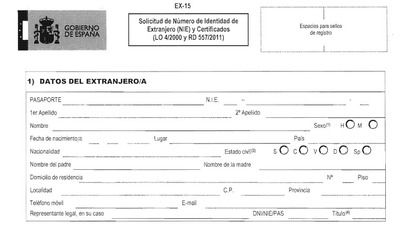
This is the main document required to obtain an NIE. You can find the EX-15 form on official websites or simply search for it online. When completing it, pay particular attention to the “Motivo” (reason for obtaining the number) section — this may include economic, professional or social reasons. For example, buying property, opening a bank account or completing residence-related paperwork.
- Passport (original and copy)
You must provide a valid passport and a copy of it. In some cases, you may be asked for copies of all pages containing entries, so it is best to prepare them in advance.
- Document confirming the reason for obtaining an NIE
If you have a document confirming the reason for obtaining an NIE, be sure to attach it to your application. This could be a property purchase or rental agreement, documents relating to the purchase of a car, an employment contract, documents relating to education or inheritance, or other documents confirming your economic, professional or social links with Spain.
However, having a property agreement or an employment contract is not a mandatory requirement for obtaining an NIE. The main thing is to state the genuine reason for obtaining the number on the EX-15 form.
Example of wording for the reason in EX-15:
“Solicitud de NIE para apertura de cuenta bancaria en España” — request for an NIE to open a bank account in Spain. - Proof of payment of the fee (Modelo 790, código 012)
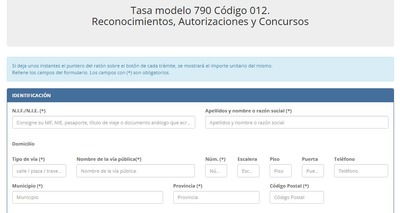
To pay the fee, you need to complete the Modelo 790 (código 012) form. After entering your details, select “Asignación de Número de Identidad de Extranjero (NIE) a instancia del interesado”, and the amount will be calculated automatically. At present, the fee is €9.84.
If you are applying through a consulate, you may also need to provide proof of residence — a registration certificate. If you are applying through a representative, you will also need the representative’s documents and proof of their authority to act on your behalf. It is best to check the exact list on the website of the relevant consulate before booking an appointment.
Applying for an NIE
There are two ways to obtain an NIE:
- through a Spanish consulate in your country
- directly in Spain
In most cases, applying for an NIE through a consulate is the more convenient option. The average processing time through a consulate is around two weeks, and sometimes longer, but it gives you time to prepare for your move and deal with other organisational matters.
If you have the opportunity to apply in advance, before arriving in Spain, this can make the process of settling in much easier.
Obtaining an NIE through a Spanish consulate
You can apply in person or through a representative. In the latter case, you will need a notarised power of attorney and an identity document for the representative (original and copy).
The first step is to check the application procedure on the website of the Spanish consulate. The appointment process differs between consulates: in some cases, you need to book an appointment in advance, in others, you first need to send the documents by email, while some consulates use their own appointment system.
For example, at the Spanish consulate in Moscow, you first need to email the completed EX-15 form and a copy of the first page of your passport. After checking the documents, the consulate will arrange an appointment for you to sign the application and pay the fee.
Overall, the application process is fairly straightforward: on the appointed day, you attend with your documents, submit them and wait for the NIE to be ready. Depending on the application method, you will either be told when you can collect the document or it will be sent to the address you provided.
If you did not obtain an NIE in advance in your home country, you can do so in Spain. It is important to bear in mind that you must be legally present in the country to apply.
Obtaining an NIE in Spain
You can obtain an NIE in Spain while legally present in the country, including during a tourist trip. However, you must have a valid reason for obtaining the number. An NIE itself does not give you the right to reside in Spain.
In practice, the main difficulty can be getting an appointment to submit your documents — the so-called cita previa. You often have to “hunt for appointments”, meaning you need to check the website regularly to catch an available slot. Sometimes this takes time, although in some cases you can get an appointment quite quickly.
Booking an appointment to submit the application (cita previa)
The first thing you need to do is book an appointment to submit your application. This is done online through the official government administration website. To avoid searching for the relevant section manually, the easiest option is to search for “NIE cita previa”.
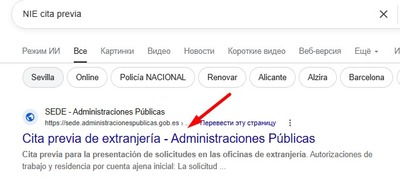
Once you access the official website, you will be taken to the appointment booking page. At the top, you can select English to make it easier to navigate. Scroll down the page and click the large “Acceder al procedimiento” button.
A form will then open where you need to select the province in which you will submit your documents.
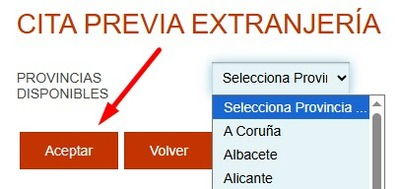
You now need to select the place where you will submit your application. NIEs are processed at police stations, so select TRÁMITES POLICÍA NACIONAL, then choose asignación de NIE and click “Aceptar”.
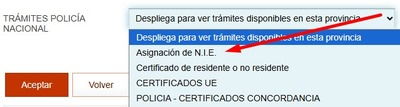
A window will then appear with a list of the required documents (see the list above). Check the list and click “Entrar”.
A window with fields for entering the applicant’s details will then open. Select PASAPORTE and enter your passport number.
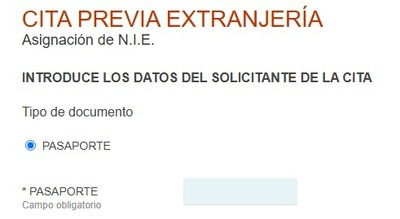
Further down in the same form, you will need to enter your first and last name, year of birth and country of citizenship. Make sure that all the details exactly match those in your passport, then click “Aceptar”.
The system will then display the details you have entered and offer you the next action. Check your name, document details and other information carefully once again. If everything is correct, click “Solicitar Cita” to proceed to selecting an appointment date and time.
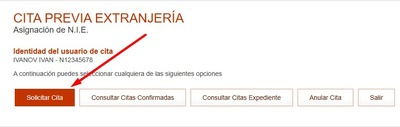
At this stage, you will often see the message “En este momento no hay citas disponibles” — this means that there are no available appointments.
In this case, you need to keep trying regularly. As soon as appointment slots become available, the system will ask you to enter your telephone number, after which a list of available dates and times will appear.
Tip: when available slots appear, do not delay — choose any available time, as they disappear quickly.
On the appointed day, you need to go to the address provided — it will be included in your appointment confirmation — and submit the prepared documents. Once the application has been entered into the register of the competent authority, the NIE assignment procedure should be processed within a maximum of five days. However, the overall waiting time also depends on how quickly you were able to obtain a cita previa.
What else may be useful after moving to Spain:
- Empadronamiento in Spain — how to register your place of residence and what this registration is needed for.
- Digital nomad visa in Spain — requirements, documents and the application process for remote workers.
- Driving licence in Spain — how to obtain or exchange your driving licence after moving.
- Cost of living in Spain — the main costs of housing, food, transport and everyday needs.
- Parking rules in Spain — the main rules, signs and restrictions that drivers need to know.
- Fines in Spain — common offences and what drivers and residents need to know.

 English
  Español
  Русский