
The City of Arts and Sciences in Valencia (Ciudad de las Artes y las Ciencias) is one of the most impressive architectural landmarks in Europe and a true symbol of the city. This huge futuristic complex is located in the former riverbed of the Turia River and looks as if it was built by the set designers of a science fiction movie.
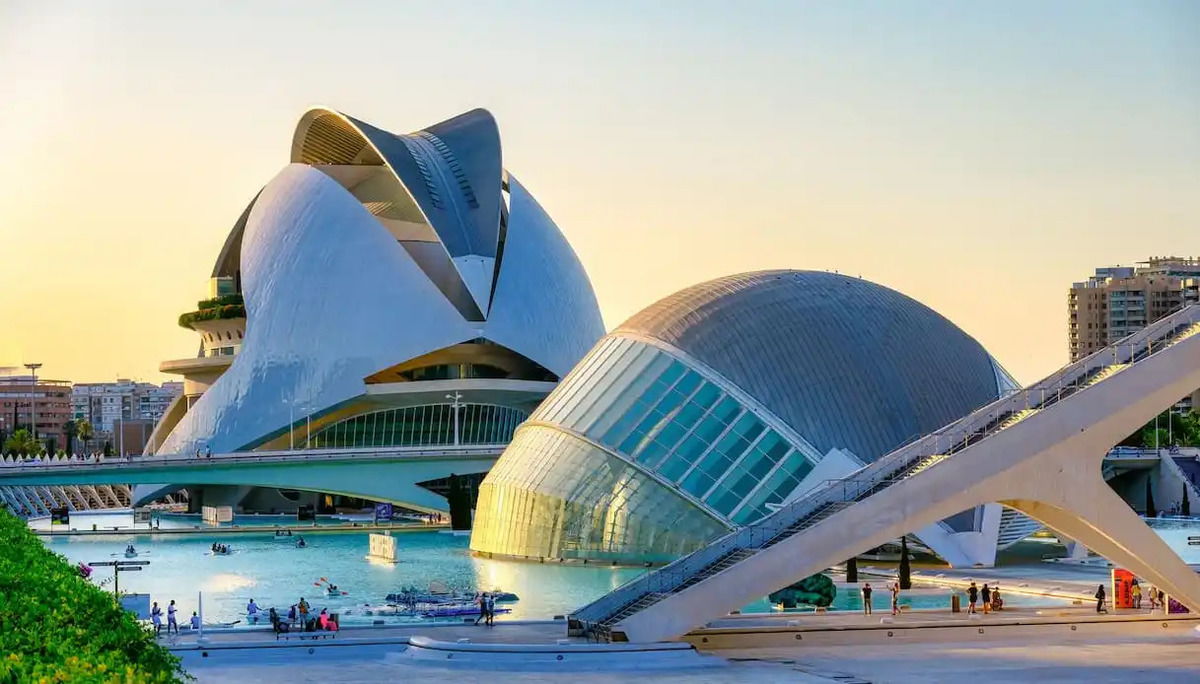
And this impression is no coincidence: thanks to its unusual architecture, the complex has been used as a filming location for movies and TV series, including the Star Wars universe series “Andor”, as well as the science fiction film “Tomorrowland”. The white buildings, mirror-like water pools and unusual structures create the atmosphere of a city of the future.
The complex covers an area of more than 350,000 m² and includes a science museum, the largest aquarium in Europe, an IMAX planetarium, an opera house, an exhibition gallery and venues for international events.
If you are planning a trip to Valencia, this place is almost impossible to miss. Below we explain what to see in the City of Arts and Sciences, how much time to plan for your visit and which buildings make up this unique complex.
Why visit the City of Arts and Sciences
Even if you have already seen photos of this complex, in reality it is even more impressive. Futuristic buildings, huge pools of water and unusual architectural forms create an almost unreal landscape — it feels as if you have stepped into a city of the future.
Here you can walk across modern bridges, visit the largest aquarium in Europe, explore an interactive science museum, watch shows in the IMAX planetarium or simply enjoy one of the most beautiful architectural panoramas in Spain.
That is why the City of Arts and Sciences is considered the main attraction of Valencia and one of the most photographed places in the country.
What to see in the City of Arts and Sciences
The City of Arts and Sciences is not just a single building, but an entire architectural complex consisting of several unique structures. Each of them serves its own purpose: here you will find science museums, cultural venues, a huge aquarium and even an opera house.
Main attractions of the complex:
- Museo de las Ciencias Príncipe Felipe — an interactive science museum where visitors can explore technology, nature and modern discoveries.
- Oceanogràfic de València — the largest aquarium in Europe, featuring marine ecosystems from different climate zones.
- Hemisfèric — a planetarium and IMAX cinema located in a building shaped like a giant eye.
- L'Umbracle — an open-air gallery and botanical garden with exotic plants and sculptures.
- Palau de les Arts Reina Sofía — an opera house and cultural center where concerts and international festivals take place.
- Àgora — a modern venue for major events, exhibitions and sports tournaments.
Below we take a closer look at each of the buildings in the complex and what makes them interesting for visitors.
Science Museum (Museo de las Ciencias Príncipe Felipe)
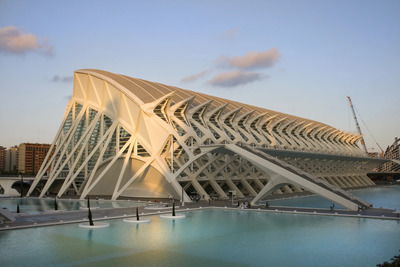
This is one of the most popular attractions in the complex — an interactive museum dedicated to science, technology, ecology and the future of humanity. Its main idea is to show that science can be not only educational, but also fascinating.
The museum building was designed by the famous architect Santiago Calatrava and resembles the skeleton of a giant whale. The white structure made of glass and metal looks especially impressive next to the reflective pools of the complex.
The museum covers an area of about 26,000 m². The interior space is designed so that visitors can move freely between floors and interactive zones.
The museum opened to visitors in 2000 and has since become one of the most visited attractions in Valencia. Over the years, its exhibitions have been seen by tens of millions of guests from all over the world.
The main feature of the museum is its interactivity. The principle here is “It is forbidden not to touch”. Visitors can experiment with exhibits, take part in scientific demonstrations, explore physical phenomena and learn more about nature and technology.
The exhibitions cover a wide range of topics: genetics, space, robotics, climate change and the evolution of life on Earth. Thanks to modern multimedia technologies, complex scientific ideas are presented in a simple and engaging way.
The museum is especially popular with families with children, but adults will also find it fascinating — many exhibitions allow visitors to look at familiar things from a new perspective and feel like real researchers.
Oceanographic Park (Oceanogràfic de València)
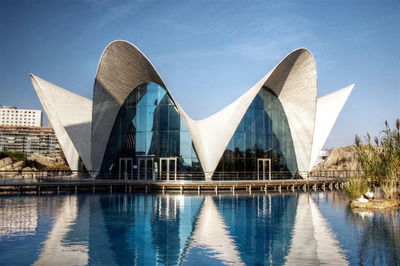
The Oceanographic Park is the largest aquarium in Europe and one of the largest marine research centers in the world. It occupies a vast area of about 110,000 m² and represents a true underwater world in the heart of Valencia.
The main building of the complex was designed in a futuristic style and resembles a blooming water lily. The architecture fits perfectly with the overall design of the City of Arts and Sciences and creates the impression that the structures have grown directly out of the water.
Oceanogràfic opened in 2003 and has since become one of the most visited attractions in the city. Here you can explore marine ecosystems from different parts of the planet: the Mediterranean Sea, tropical oceans, the Arctic, the Antarctic and the Red Sea.
More than 500 species of marine animals live in the aquarium. Visitors can see sharks, rays, dolphins, sea lions, walruses, penguins and even beluga whales — rare Arctic whales.
One of the most impressive places in the complex is the underwater glass tunnel. Walking through it, visitors can watch sharks and huge fish swimming right above their heads, creating the feeling of being immersed in the ocean.
In addition to aquariums, the park hosts educational shows, animal feeding demonstrations and scientific programs that explain marine ecosystems and their protection.
Oceanogràfic is considered one of the main reasons why tourists visit the City of Arts and Sciences, and for many visitors this park becomes the highlight of their trip to Valencia.
Planetarium (Hemisfèric)
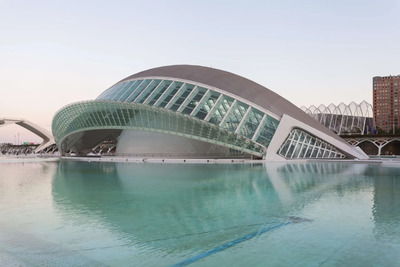
One of the most recognizable buildings in the complex is the Hemisfèric planetarium. Its architecture resembles a giant human eye looking up at the sky. When the white structure is reflected in the surrounding pool of about 24,000 m², it creates the impression of a huge eye opened to the world.
According to the idea of architect Santiago Calatrava, this image symbolizes a vision of knowledge and observation — the opportunity to discover new worlds and explore space, science and technology.
Hemisfèric was the first building of the City of Arts and Sciences opened to the public in 1998. It was the beginning of the entire complex.
Inside there is a modern planetarium as well as a large IMAX Dome cinema with a dome-shaped screen more than 20 meters in diameter. During the screening, the image literally surrounds the audience from all sides, creating a full immersion effect.
Here visitors can watch popular science films about space, nature, oceans and the history of Earth. Thanks to modern audiovisual technologies, viewers can “travel” through galaxies, observe planets or dive into the depths of the ocean.
In addition to the planetarium, the building also hosts laser shows and special educational programs, making Hemisfèric one of the most impressive scientific spaces in the complex.
Botanical Garden and Gallery (L'Umbracle)
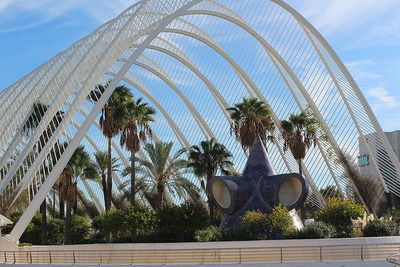
L'Umbracle is an open-air gallery and botanical garden that serves as a kind of entrance to the City of Arts and Sciences. The space was designed by architect Santiago Calatrava as a walking area where architecture and nature harmoniously complement each other.
The long gallery consists of 119 white arches forming a light and airy structure. Beneath them grow Mediterranean and tropical plants: palm trees, orange trees, shrubs and flowers that create a green oasis among the futuristic architecture of the complex.
In addition to the garden, there is also an open-air exhibition of contemporary art. Along the walkways visitors can see sculptures and installations by modern artists, turning a simple walk into a kind of artistic exhibition under the open sky.
Especially impressive is the panoramic view from the northern side of the gallery. From here you can enjoy one of the best views of the entire City of Arts and Sciences complex — white buildings, mirror-like pools and futuristic bridges.
L'Umbracle is also considered one of the most photogenic places in the complex. Tourists and locals love to walk here, and in the evening the space gains a special atmosphere thanks to soft lighting and a calm environment.
Palace of Arts Reina Sofía (Palau de les Arts Reina Sofía)
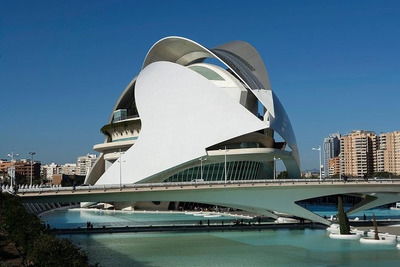
Palau de les Arts Reina Sofía is a grand opera house and cultural center in Valencia where opera performances, concerts, ballet shows and international festivals take place.
The building reaches a height of about 75 meters and looks truly futuristic. Its curved white roof seems to float above the main structure, which is why many compare the building to a giant sea creature or a spaceship.
This is the largest and most impressive structure in the entire complex. Architect Santiago Calatrava worked on its design for almost ten years, and the palace finally opened to the public in 2005.
Inside there are several concert halls, including the main opera hall with almost 1,500 seats. Thanks to modern acoustics and architecture, Palau de les Arts is considered one of the most advanced theatres in Europe.
Even if you do not plan to attend a performance, it is worth at least walking around the building — its unusual architecture and reflections in the water make it one of the most spectacular places in the City of Arts and Sciences.
Àgora Center (Àgora)
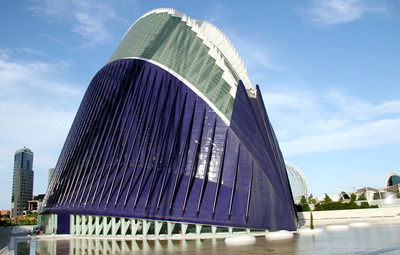
Àgora is a multifunctional space designed for large-scale events such as sports tournaments, exhibitions, concerts, conferences and international forums.
This is the newest building of the complex, opened in 2009. On regular days the building is often closed to visitors, as it is mainly used during scheduled events.
The architecture of Àgora was also designed by Santiago Calatrava. The enormous metal structure resembles an elongated ellipse or a giant futuristic tent. According to the architect, the form symbolizes intertwined hands or wings that appear to open into space.
The structure reaches a height of almost 80 meters, making it stand out among the other buildings of the complex and serving as one of the architectural landmarks of the City of Arts and Sciences.
Today Àgora hosts international exhibitions, cultural events and sports competitions, continuing to develop the complex as an important center of science, culture and public life in Valencia.
Interesting facts about the City of Arts and Sciences
- The project was designed by the famous architect Santiago Calatrava. He created most of the buildings in the complex. His style is easily recognizable thanks to the white structures inspired by natural forms and the skeletons of marine animals.
- The complex was built in the former bed of the Turia River. After the devastating flood of 1957, the river was diverted and the old riverbed was transformed into a huge green park, where the City of Arts and Sciences was later built.
- The complex covers an area of about 350,000 m². It is essentially an entire “city” within Valencia with its own squares, bridges, water pools and walking areas.
- Oceanogràfic is the largest aquarium in Europe. Here you can see more than 500 species of marine animals, including sharks, beluga whales, walruses, penguins and dolphins.
- The futuristic architecture attracts filmmakers. Thanks to its unusual appearance, the complex has been used as a filming location for science-fiction movies and TV series, including the film “Tomorrowland” and scenes from the “Andor” series from the Star Wars universe.
- It is one of the most photographed places in Spain. The mirror-like pools surrounding the buildings create stunning reflections that make photographs of the complex look almost unreal.
The City of Arts and Sciences is one of those places in Valencia that impresses visitors at any time of the year. Below we have collected answers to the most common questions travelers have before visiting the complex.
What else to see in Valencia
If you are planning to visit the City of Arts and Sciences, it is worth planning your route around Valencia in advance. Below you will find useful materials about the city’s attractions, local cuisine and interesting places near Valencia.
- Tickets to the City of Arts and Sciences in Valencia — up-to-date information about ticket prices, combined tickets and online booking.
- Main attractions of Valencia — the most interesting places in the city that are worth visiting during your trip.
- Parks and entertainment in Valencia — Oceanogràfic, Bioparc, water parks and the best places for family fun.
- Attractions near Valencia — beautiful places and towns that can be visited during a trip around the region.
- Traditional food in Valencia — dishes you should try in the city, including the famous paella and local gastronomic traditions.
- Street markets in Valencia — where the most atmospheric markets in the city take place and what you can buy there.
- Municipal markets of Valencia — the best food markets in the city and the real gastronomic life of Valencia.
Frequently asked questions
Where is the City of Arts and Sciences located in Valencia?
The complex is located in the eastern part of Valencia, in the former bed of the Turia River. It is about 3 kilometers from the historic city center.
You can get here by bus, metro, bicycle or on foot through the Turia Park. Many tourists prefer walking or cycling because the route passes through one of the most beautiful parks in Valencia.
When is the best time to visit the City of Arts and Sciences?
The best time to visit is in the morning or in the evening. During the day, especially in summer, it can be quite hot in the open areas of the complex.
Many tourists recommend visiting twice: during the day to explore the museums and aquarium, and in the evening to see the buildings beautifully illuminated and reflected in the water.
Do you need to buy tickets in advance?
Tickets for most attractions in the complex can be purchased on site, but during the high tourist season and on weekends it is better to buy them online in advance.
This is especially relevant for the Oceanogràfic aquarium, which is one of the most popular attractions in Valencia and often attracts large queues.
How much does it cost to enter the City of Arts and Sciences?
Walking around the complex is free — visitors can stroll between the buildings, take photos and enjoy the architecture. Tickets are only required to visit specific attractions such as the aquarium, the science museum or the planetarium. Prices depend on the selected attractions and combined tickets.
How much time is needed for a visit?
If you just want to walk around the complex and take photos, 1–2 hours is enough. To visit one museum or the aquarium, it is better to plan about 3–4 hours. If you want to explore several attractions, it is best to set aside a full day.
Can you walk around the complex for free?
Yes, the territory of the complex is open for free visits. Many tourists come here simply to walk along the waterfront areas, admire the architecture and take photos near the famous pools.
Is the City of Arts and Sciences suitable for visiting with children?
Yes, it is one of the best places in Valencia for a family trip. Children especially enjoy the interactive science museum and the aquarium, where they can see marine animals and attend educational shows.
Is there parking near the City of Arts and Sciences?
Yes, there are several parking areas near the complex for visitors, including a large parking lot near the Oceanogràfic aquarium. It has space for about 800 cars.
The standard parking price is around €2.30 per hour, while the maximum daily price can reach about €24. If you have a ticket to one of the attractions in the complex (for example the aquarium, science museum or planetarium), you may receive a special rate of about €7 per day.
You can also sometimes find free parking spots on nearby streets or near the El Saler shopping center.
Can you bring food with you to the City of Arts and Sciences?
On the open territory of the complex you can bring water, drinks or snacks and take a short break during your walk.
However, inside the buildings — the science museum, planetarium and aquarium — bringing your own food is usually not allowed. Eating is only permitted in designated areas or cafés.
Are there cafés and restaurants in the complex?
Yes, there are several cafés, restaurants and fast-food areas within the City of Arts and Sciences. They are located both inside some of the buildings and along the main visitor routes.
Prices here are slightly higher than in regular city cafés, which is typical for popular tourist attractions, but the selection is quite wide — from coffee and light snacks to full meals.

 English
  Español
  Русский