
Sooner or later, many people start thinking about buying their own home. If you already have the necessary amount of money, the matter is fairly straightforward. But if you do not have enough money to buy the entire property, one option is a mortgage.
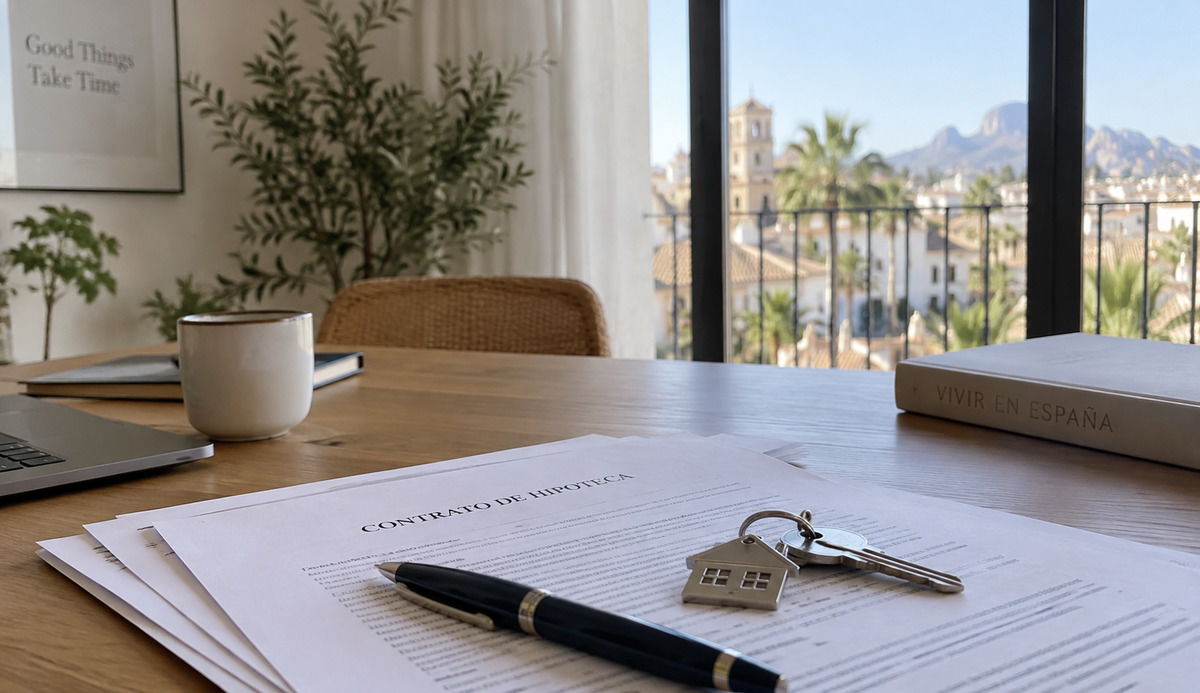
In Spain, both residents and foreign non-residents can obtain a mortgage, but the terms differ for each group. The important questions here are how much of your own money you will need, how much you can borrow from a bank and how the mortgage application process works.
Contents:
- Requirements for getting a mortgage in Spain
- How much you can borrow with a mortgage
- How much of your own money you will need
- Mortgage rates and monthly payments
- What documents are required
- How the mortgage application process works
Requirements for getting a mortgage in Spain
Spanish citizenship is not in itself a mandatory requirement for obtaining a mortgage. Much more important for the bank is understanding how stable your financial situation is and whether you will be able to repay the loan without difficulty. Therefore, when assessing an application, banks look at your income, employment, existing financial commitments, personal savings and residency status.
Stable income. First and foremost, the bank needs to understand what money you will use to make your mortgage payments each month. Your salary, income from your own business and other verified sources of income are taken into account. However, it is not only the amount of income that matters: the bank also looks at the type of employment contract, length of employment and how stable that income is.
Other loans and debts. This is fairly logical: if a significant part of your income is already going towards other loans, obtaining another large loan will be more difficult. Therefore, the bank checks your existing financial commitments and credit history. As a guideline, banks often use a debt-to-income ratio of around 30–35% — in other words, it is advisable not to spend too large a share of your income on all your loan repayments.
Personal savings. Even a good income does not remove the need to have your own money available. The bank will normally finance only part of the property's value, so the buyer will need funds not only for the deposit but also for additional costs associated with purchasing the property.
Residency. Both residents and non-residents can take out a mortgage in Spain. But there is an important difference here: if a person lives and earns an income in another country, the bank has to assess their financial situation based on documents from abroad. Therefore, lending terms may be different for non-residents.
How much you can borrow with a mortgage
For many mortgages, a guideline is financing of up to 80% of the property's value, but the specific terms depend on the bank and the programme chosen. In some cases, a bank may finance a smaller or larger share, while certain programmes allow you to obtain up to 100% of the property's value.
At the same time, a mortgage does not necessarily have to be for the maximum possible amount. You may already have some of the money needed for the purchase, with the loan only covering the shortfall. For example, if a house costs €300 000 and you have €210 000, you can take out a mortgage for only the remaining €90 000.
There is another point to consider. The bank does not look only at the price of the flat in the listing. Before the mortgage is arranged, a tasación — an official property valuation — is carried out. If the assessed value turns out to be lower than the sale price, this may affect the amount the bank is willing to provide.
In addition, banks may have their own minimum mortgage amounts. So if you need to borrow a relatively small amount, for example €50 000–60 000, it is worth checking the specific bank's terms in advance: in some cases, they may offer a different type of loan for such an amount.
For non-residents, lending terms are usually different, and the maximum amount or proportion of financing may be lower. But here too, there is no single figure that applies to everyone — the bank assesses the buyer's financial situation and the property being purchased separately.
How much of your own money you will need
Even if the bank is willing to provide a mortgage, you will usually need to have some of the money for the purchase yourself. Exactly how much depends on the loan amount: if the bank finances 70% of the property's value, you need to cover the remaining 30% with your own money; if it finances 80%, you will need to cover 20%, respectively. In some cases, you may need even less of your own money if the bank approves a larger mortgage.
For example, if a flat costs €200 000, with 80% financing the mortgage would be €160 000, and you would need to contribute €40 000 yourself. If the bank agrees to finance only 70%, you would need €60 000 of your own money. And if 100% financing is approved, no deposit for the property itself would be required.
But the deposit is not the only amount you need to have available. When buying a property, you will also have to pay taxes and other costs associated with completing the transaction — usually 10-15%. Therefore, before looking for a property, it is better to calculate the entire purchase budget in advance, rather than only the amount you are prepared to contribute as a deposit.
Mortgage rates and monthly payments
The interest rate is one of the most important parts of a mortgage: it directly affects how much you will pay the bank each month and how much you will ultimately overpay on the loan. In Spain, you can choose a mortgage with a fixed, variable or mixed rate.
A fixed rate remains the same for the entire term of the loan, so the monthly payment is known in advance and does not depend on changes in interest rates. With a variable rate, the interest rate may change during the mortgage term — it is usually calculated based on Euríbor and the bank's spread. A mixed rate combines both options: a fixed interest rate applies initially, after which the rate becomes variable.
According to INE, in June 2026 the average interest rate on new mortgages for homes in Spain was 2.96%, while the average loan term was 25 years. At the same time, the average initial rate was 2.89% for fixed-rate mortgages and 3.07% for variable-rate mortgages. These are average market figures, so a specific offer from a bank may be higher or lower.
The monthly payment depends primarily on the mortgage amount, interest rate and loan term. The longer the term, the lower the monthly payment will be, but ultimately more money will be spent on interest. With a standard fixed-rate mortgage, the monthly loan payment remains the same, while with a variable rate it may change after the interest rate is reviewed.
For example, with a mortgage of €150 000 over 25 years at a rate of around 3%, the monthly loan payment would be approximately €711. With the same amount and term but at a rate of 4%, it would already be around €792 per month. The difference may seem small, but over the entire loan term it becomes quite significant.
What documents are required
When a bank starts reviewing a mortgage application, it needs to verify not only the buyer's identity but also their income and financial situation. As a result, the list of documents can be quite extensive, although in practice much depends on your individual circumstances.
If you live and work in Spain, you will normally need your passport and valid TIE residence card with your NIE, as well as your most recent payslips, employment contract, latest IRPF tax return and current vida laboral. The bank may also ask for bank statements, proof of other income and information about any existing loans.
If you are autónomo (self-employed), there are usually more documents. In addition to your passport and NIE, you may need your tax return, IVA and IRPF records, documents confirming your Social Security contributions and other information about your business activity.
If you have already chosen a property, the bank will also ask for documents relating to the property itself — for example, the purchase agreement or arras agreement, as well as the information about the property required for its valuation and checks.
If you live outside Spain, you will need your passport and documents confirming your income and financial situation in your country of residence. Depending on the circumstances, the bank may request tax returns, proof of income, bank statements and information about any existing loans. Documents issued outside Spain may also require an official translation into Spanish.
It is difficult to give an exact list in advance: the bank may request additional documents depending on the circumstances. Therefore, it is better to start gathering the main documents before submitting your application — this makes the subsequent process considerably easier.
How the mortgage application process works
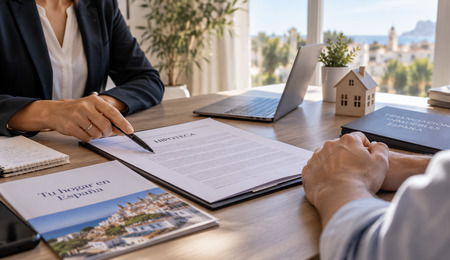
After you submit your documents, the bank reviews your financial situation, checks your existing loans and carries out a property valuation. If your application is approved, the bank informs you of the mortgage terms: the interest rate, term, loan amount and monthly payment.
Once the terms have been agreed, the mortgage process with the notary begins. You can choose the notary yourself. If you do not have a preferred notary, you can choose a suitable notary's office, for example one close to your future home.
Before the mortgage is signed, there is a separate meeting with the notary — acta de transparencia material. During this meeting, the notary checks that the bank has provided you with all the necessary documents, including the FEIN and FiAE, explains the loan terms and answers your questions. A short test is also carried out to make sure that you understand the mortgage terms. The preparation of this document is free of charge for the borrower.
At least 10 calendar days must pass after this meeting before the mortgage agreement can be signed. During this time, you can calmly read through the documents once again and clarify any remaining questions. The date for signing the mortgage with the notary is then arranged.
And on the appointed day, once all the documents have been signed, the most pleasant part remains — congratulating yourself on your purchase: you now have your own home in Spain.
Useful information when buying property in Spain:
- Applying for an NIE in Spain — what an NIE is, who needs one and how to obtain it.
- Property prices in Spain and main costs — property prices and the costs you need to consider when buying.
- Empadronamiento in Spain — how to register your place of residence in Spain.
- Cost of living in Spain — the main costs of housing, transport, food and everyday needs.
- Pros and cons of living in Spain — what to consider before moving to Spain and choosing it as a place to live.

 English
  Español
  Русский