
El Escorial (or San Lorenzo de El Escorial) is one of the most impressive historical attractions in the area surrounding Madrid. Just an hour’s drive from the Spanish capital, at the foot of the Sierra de Guadarrama mountains, stands an enormous 16th-century stone complex that brings together a royal palace, monastery, basilica, library and pantheon of Spanish monarchs. Behind its austere façades lie magnificent halls, masterpieces of painting and interiors that preserve the memory of several generations of the Spanish royal family.
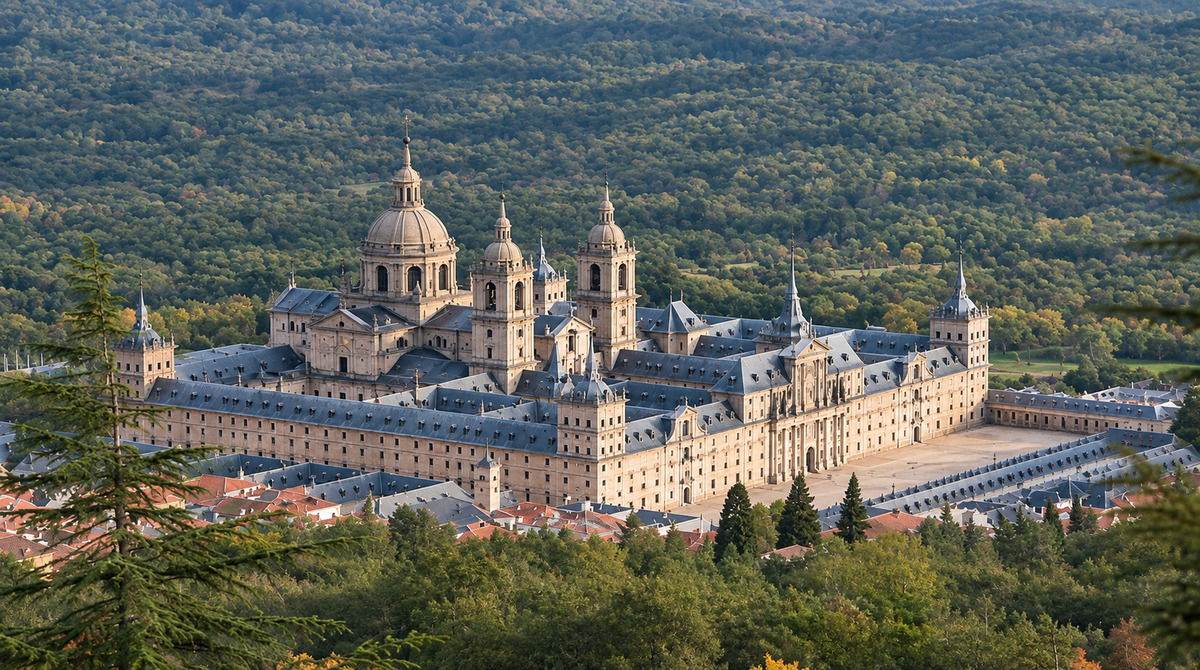
El Escorial was conceived by King Philip II as something far greater than an ordinary royal residence. The monarch sought to embody in stone the grandeur of the Spanish Crown and the deep religious devotion of his era. Every part of the complex had a specific purpose, and the entire architectural design followed a single idea — to unite state power, faith and the memory of the dynasty. This is what makes the complex so unusual and unlike any other palace in Spain.
What to expect inside El Escorial
El Escorial is an enormous complex, and even if you do not try to examine every detail, you should set aside several hours to explore it. It is far more enjoyable to wander leisurely through the halls, stopping at the most impressive spots and simply taking in the palace’s splendour.
Patio de los Reyes — court of the kings
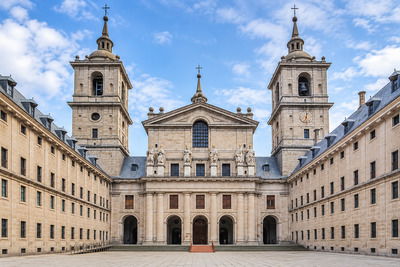
The first thing visitors see after entering El Escorial is Patio de los Reyes (Court of the Kings). This is a spacious rectangular courtyard surrounded by austere stone façades. At the far end stands the magnificent basilica, with its two towers and large dome, while above its façade you can see six statues of biblical kings: David, Solomon and other rulers of Judah.
These figures are what gave the courtyard its name. They are a reminder of the biblical King Solomon, who built the Temple of Jerusalem, and with whom Philip II symbolically associated the creation of El Escorial. The king saw himself as continuing this tradition, while the complex itself was conceived as a kind of new temple, bringing together religion and royal power. That is why even the architecture of the first courtyard here is rich in meaning, rather than serving simply as a grand entrance.
The royal basilica of El Escorial
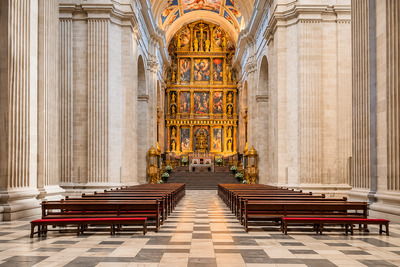
Behind the façade with its six statues of biblical kings lies the Royal Basilica — the central part of the entire complex and one of the most impressive buildings of the Spanish Renaissance. The church is built from massive blocks of granite, and its floor plan is shaped like a Greek cross: four arms of equal length meet beneath a large dome. The space feels solemn and majestic, yet retains the austerity and restraint characteristic of El Escorial.
Particular attention is drawn to the main altar, with its richly decorated tabernacle made of different-coloured Spanish marble. On either side stand two bronze sculptural groups by Pompeo Leoni, depicting Charles V and Philip II together with members of their families. The monarchs are shown kneeling, as if facing the altar in prayer. In this way, the very heart of the complex brings together the two main ideas behind the creation of El Escorial: faith and the memory of the royal dynasty.
The royal pantheon
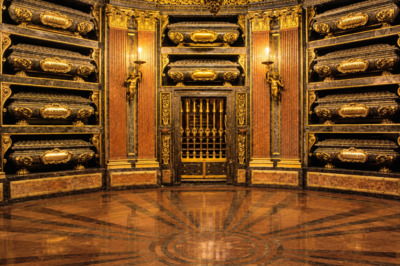
Below the Royal Basilica lies the Royal Pantheon (Panteón de Reyes) — the burial place of Spanish monarchs, where members of the Habsburg and Bourbon dynasties rest. Unlike the solemn grandeur of the basilica, the atmosphere here is quite different: a small circular crypt with marble decoration, bronze details and rows of sarcophagi arranged along the walls. At the centre stands an altar with a crucifix, while the subdued lighting further emphasises the solemnity of this place.
Spanish kings from Charles V onwards are buried here, along with their wives who became the mothers of future monarchs. Among them are Philip II, Philip III, Philip IV, Charles III and other members of the Spanish Crown. Interestingly, Philip II never saw the Pantheon in its present form: although El Escorial was originally conceived as a royal mausoleum, its final decoration was not completed until the 17th century, during the reign of his grandson Philip IV. Thus, one of the complex’s main purposes was fulfilled only after the death of its founder.
The royal library of El Escorial
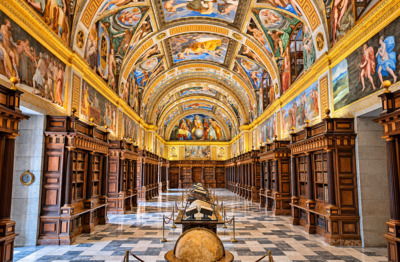
One of the most beautiful rooms in the complex is the Royal Library, founded by Philip II in the 16th century. Its main hall, known as the Hall of Frescoes, is impressive above all for its size: it stretches for 54 metres, and along its walls stand tall wooden bookcases filled with rare volumes, their spines turned inwards according to an old tradition. But the hall’s most striking feature is its vaulted ceiling, decorated with frescoes depicting allegories of the seven liberal arts: grammar, rhetoric, dialectic, arithmetic, geometry, music and astronomy.
Philip II envisaged the library as much more than simply a collection of books. It was intended to house not only rare editions and manuscripts, but also everything that could help people study the world around them: geographical maps, globes, astrolabes, and mathematical and scientific instruments. The library therefore became a true centre of Renaissance learning. Today, its collections contain thousands of ancient manuscripts and engravings, while the hall itself still conveys the atmosphere of an era when science and art held a special place at the royal court.
The private apartments of Philip II and the royal rooms
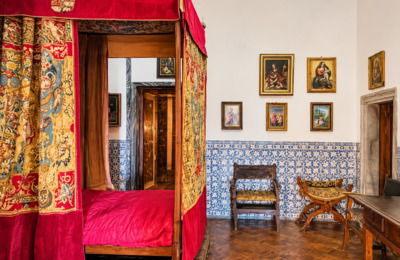
El Escorial has rooms that offer a glimpse not only into the ceremonial life of the Spanish court, but also into the daily life of Philip II himself. His private apartments are quite modest compared with the luxurious palaces of other European monarchs. The king preferred to spend his time in seclusion, and from his bedroom he could see the main altar of the basilica and attend religious services without even getting out of bed. This unusual arrangement of rooms reflects the monarch’s deep religious devotion and the important place faith held in his life.
The palace’s ceremonial rooms, associated with later generations of the Spanish royal family, make a very different impression. They preserve reception rooms and spaces for official ceremonies, antique tapestries, historic furniture and objects used in everyday palace life. The Bourbon apartments stand out in particular, having been decorated in a later period and differing noticeably from the austere interiors of the complex’s founder. This is also where you will find the famous Hall of Battles (Sala de las Batallas) — a long gallery whose walls are decorated with large-scale frescoes depicting historic battles fought by the Spanish army.
The gardens of the friars
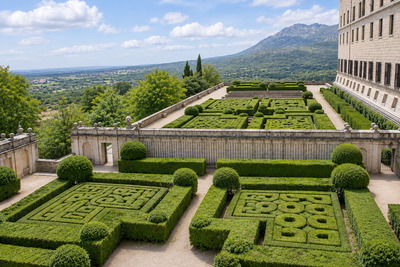
After exploring the monastery’s interiors, you can take a stroll to the Gardens of the Friars (Jardín de los Frailes), which stretch along the southern façade of El Escorial. They are laid out on artificial terraces that follow the slope of the land while also offering beautiful views of the surrounding area. Unlike the lush royal parks, everything here follows a more austere style: straight paths, geometric flowerbeds and neatly trimmed box hedges.
The gardens took on this appearance during the reign of Philip II. Originally, brightly coloured flowers grew between the green hedges, and the flowerbeds themselves resembled expensive oriental carpets brought from Damascus. Today, the floral patterns have given way to more restrained boxwood designs, but the space still retains an atmosphere of peace and seclusion. From here, you can enjoy views of an old pond, orchards and distant mountain slopes.
What else to see and do in Madrid
If you are staying in Madrid for a few days, you can combine your trip to El Escorial with exploring the capital itself — its palaces, museums, food markets and other interesting places.
- Attractions in Madrid — the main historical sites, squares, museums and architectural landmarks of the Spanish capital.
- The Royal Palace of Madrid — a luxurious residence of the Spanish monarchs, with grand reception rooms, art collections and a rich history.
- The Prado Museum — a famous art gallery featuring works by Velázquez, Goya, Bosch and other great masters.
- Where to eat in Madrid and what to try — traditional dishes, the capital’s culinary specialities and places where you can discover local cuisine.
- Madrid’s food markets — municipal and food markets where you can buy fresh produce, discover local delicacies or grab a bite to eat at one of the many bars and cafés.
- Street markets in Madrid and the surrounding area — flea markets, market stalls and interesting places to explore and shop.
- Theme parks and family activities in Madrid — amusement parks, water parks and other family attractions and ideas for days out with children.

 English
 Español
 Русский