
Altea is one of the most picturesque towns on the Costa Blanca. It is known for its whitewashed houses, narrow cobbled streets and famous church with blue domes, which rises above the old town. There are no skyscrapers or crowds of holidaymakers here — Altea has a very different atmosphere, peaceful and truly Mediterranean.

However, there is also plenty to discover beyond the old town: beaches, a seafront promenade, a picturesque port and even an unusual Russian Orthodox church. So it is worth exploring these corners too, to see Altea in all its diverse beauty.
Contents
- Altea's historic centre (Casco Antiguo)
- Plaza de la Iglesia square
- Nuestra Señora del Consuelo Church
- Mirador de los Cronistas de España viewpoint
- Altea's beaches
- Paseo Marítimo promenade
- Marina Greenwich
- Russian Orthodox Church of Archangel Michael
Most of Altea's attractions are close to one another. The old town is situated on a hill above the coast, while the beaches and promenade are down below. This means you can easily visit many of the interesting places in a single day.
Altea's historic centre (Casco Antiguo)

Altea's historic centre is situated on a hill, so exploring it becomes a little journey up and down narrow cobbled streets. White houses with flowers on their balconies, small squares, art galleries and workshops create the image of Altea that you so often see in photographs of the Costa Blanca.
This place also has its own history. In 1617, Altea was granted a new town charter, after which a fortified town perimeter was built on the hill. The old entrances to it have survived to this day — Portal Vell and Portal Nou. You can see them as you walk through the historic centre, imagining what the town looked like several centuries ago.
From the mid-20th century onwards, Altea began attracting artists, sculptors and craftspeople. Workshops and galleries gradually appeared here, many of which are still open today. So, as you explore the town, take a look inside the small art shops: sometimes you can find not just an ordinary souvenir, but a piece created by a local artist.
The streets gradually lead to the upper part of the hill, where Plaza de la Iglesia is located. This is where you can discover one of the town's most recognisable landmarks — Nuestra Señora del Consuelo Church, with its famous blue domes.
Plaza de la Iglesia square

Plaza de la Iglesia is the main square in Altea's historic centre. It is located at the top of the hill, where the town's narrow streets converge. Here you will find cafés, restaurants and small shops, as well as spots where you can admire panoramic views of the coast and the Mediterranean Sea.
The square occupies the site where Altea Castle once stood. A fortified town perimeter with defensive towers and gates surrounded it. The castle itself has not survived, but much of the historic layout of this part of the town remains to this day.
Today, the square has become one of the liveliest places in Altea. People come here not only to take photos and enjoy the beautiful views, but also to sit on a terrace, browse the craft shops or simply watch the town go about its daily life.
Nuestra Señora del Consuelo Church

Nuestra Señora del Consuelo Church (Iglesia de Nuestra Señora del Consuelo) is one of Altea's best-known attractions. The church is easy to recognise by its famous blue domes, covered in brightly coloured ceramic tiles. These domes have become a true symbol of Altea and can be seen from almost anywhere in the town, as well as from the sea.
The present church building was constructed in the early 20th century, although older religious buildings once stood on this site. Thanks to its position at the top of the hill, the church seems to tower above the town and serves as the main landmark of old Altea.
Inside, the church is striking for its abundance of natural light, elegant stained-glass windows and harmonious combination of blue and gold tones in the decoration, echoing the building's exterior.
Admission to the church is free. It is an excellent place to take shelter from the hot Mediterranean sun for a while and experience the peaceful atmosphere of the old town.
Mirador de los Cronistas de España viewpoint

If you want to see Altea from above, it is worth making your way up to the Mirador de los Cronistas de España viewpoint. It is just a few steps from Plaza de la Iglesia and is considered one of the best spots for panoramic views of the coast.
From here, you can enjoy sweeping views of the Mediterranean Sea, the white houses of the old town and the mountain ranges surrounding Altea. On a clear day, you can see Benidorm's skyscrapers in one direction and the silhouette of the famous Peñón de Ifach rock near Calpe in the other.
The viewpoint's name is linked to the Association of Chroniclers of Spain — historians and researchers who study the history of Spanish towns and regions. A commemorative plaque has been installed here in their honour.
Altea's beaches
Altea is not quite a typical Costa Blanca resort with wide sandy beaches. Its coastline is mostly covered with pebbles and gravel, and the main attractions of the local beaches are their clear waters and beautiful views of the mountains and the Mediterranean Sea. If you want to explore the town's coastline, there are two beaches worth considering in particular — Cap Negret and La Roda.
Cap Negret beach
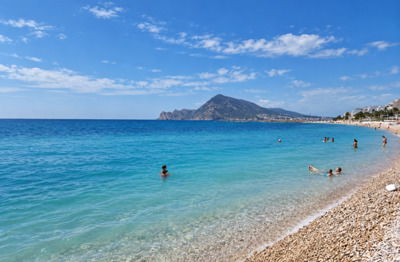
Cap Negret is one of Altea's longest beaches. It is located to the north of the town centre and is particularly popular with those who prefer a more peaceful setting. There is less hustle and bustle here, and the shore offers beautiful views of the Sierra de Bernia mountain range.
The beach is covered with pebbles and gravel, and the water is clear. There are restaurants and hotels nearby, and sun loungers and parasols can be hired during the beach season. There are also paths providing easy access to the water and foot showers.
La Roda beach
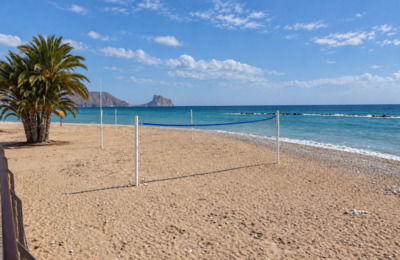
La Roda is Altea's main town beach, located close to the centre. It stretches for approximately 1.4 kilometres along the promenade, so after a swim you can head straight out for a walk or choose one of the many nearby restaurants and cafés.
The beach has a mixed surface of pebbles, gravel and patches of sand. The water is usually calm, but it gets deep quite quickly, which is worth bearing in mind if you are visiting with children. During the high season, lifeguards are on duty, children's play areas are provided, and there are toilets and accessible bathing facilities for people with reduced mobility.
La Roda is a good choice if you want to combine a day at the beach with exploring the town without having to travel to the sea. You can also enjoy water sports here, including windsurfing, kayaking and diving.
One of the town's liveliest promenades, Paseo Marítimo, is located right here.
Paseo Marítimo promenade

Paseo Marítimo is one of the most pleasant places for a walk in Altea. It runs along La Roda beach and connects the town centre with Altea's small port.
There is always a relaxed holiday atmosphere here: people stroll by the sea, cycle, sit on restaurant terraces or simply enjoy the views of the Mediterranean.
There are plenty of cafés, restaurants and small shops along the promenade. It is particularly pleasant to stop here in the evening, when the terrace lights come on and the air fills with the aromas of Mediterranean cuisine and the fresh sea breeze.
As you walk along the promenade, you can reach Altea's small port, where fishing boats and pleasure boats are moored. It is a cosy spot with beautiful sea views and another great place to take photos.
And if you travel a little further along the coast, you can reach another interesting marina — Marina Greenwich.
Marina Greenwich

About three kilometres from the centre of Altea, in the Mascarat area, lies Marina Greenwich — one of the most unusual marinas on the Costa Blanca. It was formerly known as Puerto Deportivo Luis Campomanes, but in 2009 it was given a new name because it is located directly on the Prime Meridian (Greenwich Meridian). There is even a special marker within the marina where tourists like to take photos standing between the Western and Eastern Hemispheres.
Today, this modern marina can accommodate more than 500 boats, and a pleasant promenade lined with restaurants, bars and shops runs along the quays. It is a lovely place to visit for a stroll by the sea or lunch overlooking the white yachts. For those who enjoy active pursuits, the El Mascarat yacht club operates here, while local companies offer boat hire, sailing lessons, diving and coastal excursions.
Russian Orthodox Church of Archangel Michael

In the hills not far from the centre of Altea, among the pine trees and residential villas of the Altea Hills area, you will find an unusual sight for Spain — the Russian Orthodox Church of Archangel Michael (Iglesia Ortodoxa Rusa San Miguel Arcángel). It was the first church of the Russian Orthodox Church to be built in Spain and on the entire Iberian Peninsula.
The church is built in the style of traditional 17th-century Russian wooden architecture. Its architectural model was an old church from the Arkhangelsk region, while the wooden structure itself was made in Russia and transported to Altea. Five golden domes, carved wooden details and an octagonal bell tower give the building a look quite unlike anything else on the Costa Blanca.
The story behind its construction is also worth noting. The foundation stone was laid in November 2002, and the church was solemnly consecrated on 11 November 2007. On the eastern side of the building, you can see a colourful mosaic depicting Christ — it is clearly visible even from the road leading from Altea to Calpe.
Today, the church remains an active Orthodox parish and is open not only to worshippers but also to visitors interested in its architecture and history. If you decide to stop by, take a look inside when access is permitted: you can see traditional Orthodox decorations and icons.
What to see and do near Altea
Altea is ideally located for exploring other interesting places on the Costa Blanca. The surrounding area offers Mediterranean towns, mountain villages, natural attractions and theme parks for the whole family. If you are planning trips around the region, you can hire a car.
- Benidorm — a popular Costa Blanca resort with long sandy beaches, skyscrapers, restaurants and plenty of entertainment.
- Calpe — a town at the foot of the famous Peñón de Ifach rock, with a picturesque promenade, beaches and a historic centre.
- Guadalest — one of the best-known mountain villages in Alicante province, perched on a rock above a turquoise reservoir. You can visit an old castle here and enjoy views of the mountains.
- Algar Waterfalls — a natural area with cascading waterfalls and natural pools where you can swim in cool mountain water during the warmer months.
- Dénia — a Mediterranean town with a historic castle, a marina, old streets and long sandy beaches.
- Alicante — the provincial capital, with Santa Bárbara Castle, the famous Explanada de España promenade and a historic centre at the foot of Mount Benacantil.
- Parks and family attractions in Alicante province — places to visit with children for a fun day out, including theme parks with rides, water parks, zoos and other family-friendly attractions.

 English
 Español
 Русский