
Guadalest is one of the most unusual attractions in the province of Alicante. This small medieval village seems to rise straight out of the rock, surrounded by mountain peaks and deep valleys. Its ancient fortresses, narrow cobbled streets and whitewashed houses create a special atmosphere, while the viewpoints offer impressive views of the mountains and the turquoise reservoir. It is no wonder that Guadalest has become one of the most popular day-trip destinations on the Costa Blanca.

A walk through Guadalest is an opportunity to step back in time for a while: pass through a tunnel carved into the rock, explore historic buildings, visit unusual museums and admire landscapes that are quite unlike the familiar coastal scenery.
Contents:
The tunnel and entrance to the historic centre

To reach the historic part of Guadalest, you need to walk through the 8-metre-long Portal de San José tunnel, carved directly into the rock. It is one of the village’s most recognisable and atmospheric features, immediately creating a sense of travelling back in time.
It is impossible to get lost here — there is effectively only one road. It is through this stone passage that visitors enter the town’s charming historic centre, with its ancient fortress at the very top.
The historic centre of Guadalest
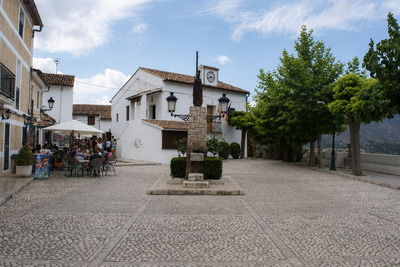
Guadalest’s historic centre is a maze of narrow cobbled streets, stone houses, small squares and souvenir shops. Despite its compact size, there is plenty to see here: historic architecture, small museums and picturesque spots overlooking the mountain valley. This part of the village has a distinctive medieval character, which is one of the reasons Guadalest is so popular with tourists.
The heart of the old town is Plaza de San Gregorio. From here, you can enjoy breathtaking views of the reservoir and the surrounding mountains.
It gets quite busy here during the day, especially in the tourist season. However, it is this lively atmosphere, shops selling local products and cosy cafés that make a walk around the village so enjoyable. You can stop at one of the establishments overlooking the valley for a bite to eat, but it is best to plan lunch for earlier in the day: in our experience, kitchens usually serve food until 16:00, while cafés and restaurants themselves close at around 18:00.
San José Castle
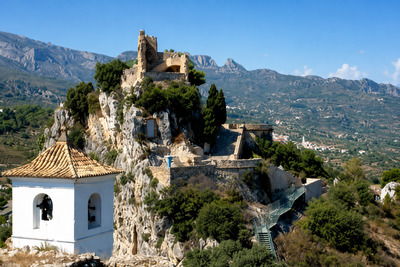
San José Castle (Castillo de San José) is Guadalest’s main historical attraction. Due to its unique location, it is often called the “Eagle’s Nest”. The citadel stands on the highest rocky outcrop above the village, offering stunning panoramic views of the mountain ranges, valley and turquoise reservoir.
The fortress was built by the Moors in the 11th century and played an important role in defending the area. Throughout its history, it has endured many hardships: earthquakes in 1644 and 1748 destroyed a significant part of the buildings, while in 1708, during the War of the Spanish Succession, the castle was damaged by an explosion. Today, only separate sections of the former fortifications remain, but its position high above the village is still impressive.
The ruins can only be accessed through the Casa Orduña museum — the former home of a noble family that ruled these lands for several centuries. Admission to the manor house and castle is covered by a single ticket (adult price: €4.50). It is worth allowing time to visit both: first explore the interior of the historic house, then climb to the top of the rocky outcrop to enjoy the viewpoints.
Museums in Guadalest

For such a tiny village, Guadalest has a surprisingly large number of exhibition spaces, some of which are truly unique. You can see works of art no bigger than a grain of sand, discover how people lived in the mountain valley in centuries past, or explore huge collections of objects that most people would never think of collecting.
Among the most interesting museums, it is worth looking out for the following:
- Museum of Microminiatures (Museo Microminiaturas) — this museum houses works by artist Manuel Ussá, created on an incredibly tiny scale. For example, the Statue of Liberty is placed in the eye of a needle, a copy of a Goya masterpiece is painted on a grain of rice, and the “Naked Maja” is depicted on a fly’s wing. These masterpieces can only be viewed through powerful magnifying lenses.
- Museum of Microgiants (Museo Microgigante) — another collection by the same artist, where the miniatures truly challenge the imagination. Exhibits include a bullring on the head of a pin, a Bible written on a cross-section of a human hair, and the famous flea riding a bicycle along the edge of a seed.
- Ethnological Museum (Museo Etnológico) — housed in a traditional 18th-century building constructed directly on the rock. Its exhibition introduces visitors to the everyday lives of local people, featuring antique household items, tools, equipment used to produce olive oil and traditional crafts.
- Salt and Pepper Shaker Museum (Museo de Saleros y Pimenteros) — one of the Costa Blanca’s most amusing collections, featuring more than 20,000 exhibits from different countries. Here, you can discover just how varied, charming and original these familiar kitchen items can be.
If you have time, visit at least one or two of them. This experience can be particularly interesting for those travelling with children: little ones are usually fascinated by looking at details that are almost invisible to the naked eye.
Guadalest Reservoir

Guadalest Reservoir (Embalse de Guadalest) is an iconic landmark in this part of Alicante province. This emerald artificial lake, surrounded by majestic rocky slopes, contrasts sharply with the familiar coastal scenery of the Costa Blanca. Its turquoise waters are what you will most often see on postcards and photographs of the village.
This reservoir was created in the mid-20th century following the construction of a large dam on the Guadalest River, a project that lasted from 1952 to 1969. Today, the reservoir holds around 13 million cubic metres of water and plays a vital role: it not only supplies drinking water and irrigates the region’s agricultural land, but also protects the valley from seasonal flooding.
The best panoramic views of the lake can be enjoyed from the viewpoints in the old town and from the grounds of the upper fortress. The colour of the water changes remarkably depending on the light and the season: on a clear day and towards sunset, it takes on an incredibly rich, almost neon turquoise hue, while the surrounding mountains turn golden.
How to get there and where to park
Guadalest is located in the mountainous part of Alicante province and is ideal for a day trip from the Costa Blanca. The route follows the scenic CV-70 mountain road, so the drive through the rocky landscape becomes an enjoyable part of the journey.
- 🚗 By car — the most convenient way to get around. The drive from Benidorm takes approximately 30–40 minutes, while from Alicante it takes around 1–1.5 hours, depending on the route chosen and traffic conditions.
- 🚌 By bus — you can take a direct service on route 016 from Benidorm, which runs via La Nucía and Polop. If you are travelling from Alicante, you will need to change buses.
Having your own transport is particularly convenient if you want to combine a visit to Guadalest with a trip to the Algar Waterfalls or nearby mountain villages in the region. This allows you to plan your own stops and avoid depending on public transport timetables.
🚗 For trips like these, it is convenient to hire a car in Alicante in advance and explore the coast at your own pace.
Parking in Guadalest
The historic centre is completely closed to traffic, so you will need to leave your car in one of the public car parks at the entrance to the village. Most of them are paid, with parking costing around €2–3 for the whole day.
During the peak season, at weekends and on public holidays, spaces fill up quickly. It is best to arrive in the morning — this makes it easier to park closer to the old town without wasting time looking for an available space.
Useful tips before your visit
- ⏰ You will usually need 2–3 hours to explore Guadalest. However, if you want to visit several unusual museums, stop at a restaurant and take your time with photographs, it is better to allow half a day.
- 👟 Wear comfortable shoes: the old part of the village has plenty of steep slopes, stone steps and cobbled streets.
- ☀️ In summer, be sure to bring water, sun cream and a hat — it can get very hot in the mountain valley on sunny days.
- 📸 Don’t forget your camera or phone: the views of the valley and turquoise reservoir are considered some of the most photogenic in Alicante province.
- 📅 To enjoy a leisurely walk and take photos without crowds of tourists in the background, try to plan your visit for the morning, especially on Saturdays and Sundays.

 English
 Español
 Русский