
Torrevieja is one of the most popular resort towns in the south of the Costa Blanca, attracting visitors with its mild climate, sandy beaches and relaxed pace of life.

One of Torrevieja’s most unusual features is its famous pink salt lakes. The colour of the water changes with the light and weather, taking on new and fascinating shades each time. But the town has more to offer than its lagoons. You’ll find inviting promenades, well-maintained beaches, green parks and attractions that are well worth seeing as you explore the town centre or venture into the surrounding area.
Contents
- Torre del Moro tower
- Church of the Immaculate Conception
- Paseo Marítimo Juan Aparicio promenade
- Beaches in Torrevieja
- Park of Nations
- The salt lakes of Torrevieja
- La Mata Lagoons Natural Park
- Water parks in Torrevieja
Torre del Moro tower

Today, Torrevieja is a lively resort town, but several centuries ago it was a small coastal settlement where people made their living from fishing and salt production. In those days, the Mediterranean coast was vulnerable to pirate attacks, so watchtowers were built to protect local residents and keep an eye on the sea. One of them, Torre del Moro, was built on Cabo Cervera between the 14th and 16th centuries.
The tower formed part of the coastal defence system of the Kingdom of Valencia. Watchmen kept an eye on the sea from here and, if danger appeared, used fire and smoke signals to warn neighbouring settlements. Over time, the structure fell into disrepair and underwent several restorations. In the 20th century, the tower was restored, retaining its original cylindrical shape. In 1985, it was granted protected cultural heritage status.
Today, Torre del Moro is surrounded by a spacious park covering around 23,000 m². It is worth visiting for more than just its history: the hill offers beautiful views along the coast towards La Mata and Guardamar del Segura, and on a clear day you may even spot Tabarca Island.
Church of the Immaculate Conception (Iglesia de la Inmaculada Concepción)

The Church of the Immaculate Conception is Torrevieja’s main church, located right in the town centre. Its history began in 1789, when the small fishing settlement started to grow and local residents needed a church of their own.
In 1829, a powerful earthquake destroyed much of Torrevieja, and the church was also badly damaged. Reconstruction began in 1844, using stones from the old watchtower that gave the town its name. The present Neoclassical building was completed in 1880, while its two bell towers were added later, in 1907.
The exterior of the church is fairly understated, while inside you’ll find a bright, spacious interior with vaulted arches and a main altar dedicated to the Immaculate Conception of the Virgin Mary, the patron saint of Torrevieja. If you’re nearby while exploring the town centre, it’s worth stepping inside for a few moments of peace away from the bustle of the town.
The church stands in Constitution Square, one of the town’s main meeting places and a focal point for local celebrations. It becomes particularly beautiful and lively in the weeks leading up to Christmas, when a large nativity scene is set up in the square, featuring biblical scenes and recognisable corners of Torrevieja itself.
Juan Aparicio promenade (Paseo Marítimo Juan Aparicio)

The Juan Aparicio promenade is one of the liveliest and most pleasant places for a stroll in Torrevieja. A pedestrian walkway runs along the seafront, lined with palm trees, benches, shops and cafés with outdoor terraces. As you walk, you’ll hear a variety of languages all around you. Many people from different countries live in or visit Torrevieja, so it’s easy to experience the atmosphere of an international resort that still retains its Spanish character.
Alongside the usual sandy beaches, you’ll also find the unusual Las Rocas bathing areas along the promenade. Stone breakwaters create small sheltered sections of sea, with little sandy patches and platforms for relaxing between the rocks. You can sunbathe by the water or access the sea using specially installed ladders.
One of the promenade’s most recognisable landmarks is the Bella Lola sculpture. A bronze woman sits on a stone bench, gazing into the distance as if waiting for her loved one to return from the sea. She is a reminder of the wives and families of fishermen and sailors who watched their loved ones sail away and anxiously awaited their return. Today, Bella Lola has become one of Torrevieja’s symbols and a popular spot for photographs.
Beaches in Torrevieja
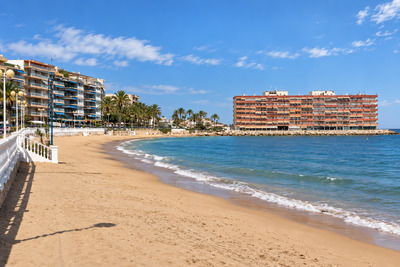
Torrevieja has beaches to suit every taste: lively urban stretches close to cafés and promenades, wide sandy beaches perfect for long walks, and small coves tucked between the rocks. Most are within the town or nearby, so it’s easy to choose a spot for swimming depending on the kind of beach holiday you prefer.
The best-known town beach is Playa del Cura. It is located in the centre of Torrevieja, close to the Juan Aparicio promenade, cafés and restaurants. It’s easy to combine a swim here with a stroll around town, and in summer the beach hosts events, including the Habaneras on the Beach concert, part of Torrevieja’s musical traditions.
Playa de Los Locos is a wide sandy beach north of the centre, popular with both visitors and local residents. Facilities include cafés, sun lounger and parasol hire, children’s play areas and water-based activities. The beach has an unusual story behind its name: in the early 20th century, a psychiatric sanatorium operated nearby, and over time the beach became known as Los Locos, meaning ‘beach of the mad’.
If you’d prefer somewhere quieter, consider Playa del Acequión and Playa de los Náufragos, both in the southern part of the town. Los Náufragos is a spacious sandy beach with palm trees right by the shore, facilities for a relaxing day out and a small water play area for children. It has been awarded Blue Flag status, recognising the quality of the beach and its facilities.
Playa de La Mata is an excellent choice if you enjoy long sandy beaches. Stretching for around 2.4 km, it’s ideal not only for sunbathing and swimming but also for walking along the seafront. In the central section of the beach, you’ll find the Molino del Agua natural area, with sand dunes and vegetation that are carefully protected.
Another interesting spot is Cala de Cabo Cervera, near the headland of the same name. It has a sandy section and a bathing area among the coastal rocks, with ladders providing access to the water. The clear water and rocky seabed make the cove an attractive spot for snorkelling. From here, you can also continue your coastal walk towards La Mata beach.
Park of Nations (Parque de las Naciones)

If you fancy a short break from the beaches and the hustle and bustle of the town, head to the Park of Nations. It’s a lovely place to stroll among the greenery, sit by the water or spend some time with the children. The park also has an interesting feature: it was created as a symbol of unity between European countries. It opened on 9 May 1999, and at its centre is a large artificial lake shaped like a map of Europe. Flags from different countries flutter along its banks.
The park has fountains, benches and a large children’s playground with a dragon-shaped slide that’s hard to miss. There’s also a small café nearby where you can take a break during your walk.
One of the pleasures of visiting is watching the local wildlife: peacocks and roosters wander along the paths, while ducks, fish and turtles swim in the lake. This makes the park particularly popular with families with children, as there’s plenty to see and enjoy beyond the play area.

💡 If you have trouble finding a parking space, you could try looking near the Habaneras or Carrefour shopping centres.
The salt lakes of Torrevieja (Lagunas de Torrevieja)

The salt lakes of Torrevieja are one of the town’s greatest natural assets and one of its best-known attractions. These lagoons have helped make Torrevieja one of Europe’s largest salt-producing centres.
The pink lake is the main attraction: this unusual natural phenomenon draws large numbers of visitors every year. In the past, people even bathed in its waters for their supposed health benefits, as the high salt concentration was believed to be good for the skin and general wellbeing.
The water’s pink colour is caused by particular microorganisms that thrive in high salt concentrations and strong sunlight. The intensity of the colour can vary depending on the time of year, light and weather conditions. Sometimes the water appears bright pink, while at other times it takes on a softer shade.
Swimming here was officially banned several years ago because the area is part of a natural park. Despite this, the lakes remain one of the town’s most popular natural attractions. Visitors come to admire the unusual colour of the water, explore the surrounding area and take beautiful photographs.
The best time to visit is on a sunny day, when the colour of the water looks most vivid and your photographs are particularly striking.
In recent years, there have been discussions about a project to create a dedicated bathing and leisure area within the lagoon. For now, these are only plans, so it’s best to admire the pink lake from the designated viewpoints and walking routes.
La Mata Lagoons Natural Park (Parque Natural de las Lagunas de La Mata)

La Mata Lagoons Natural Park is a large protected area with a green saltwater lagoon, located near Torrevieja, in the La Mata area. It’s an excellent place for peaceful walks and enjoying the outdoors, including with children. Here, you can take a break from the hustle and bustle of town and enjoy the tranquillity, fresh air and beautiful natural scenery.
The park is particularly well known for its rich wildlife. Dozens of bird species live here, and at certain times of year you may spot flamingos visiting the lagoons. For nature lovers and photographers, it’s one of the most interesting places around Torrevieja. The park has designated birdwatching viewpoints, as well as information boards with interesting facts about the local flora and fauna.
There are walking and cycling routes throughout the park, so visitors often come not only for a stroll but also for a bike ride.
There are also picnic areas in the shade of the trees. At weekends and on public holidays, families often gather in the park: adults relax and explore the trails, while children play or feed the squirrels, which are quite plentiful here.
Most visitors arrive by car. There is a large car park nearby, and on the other side there is an additional recreational area with a children’s playground (Albentosa Park).
Water parks in Torrevieja
There are several water parks in and around Torrevieja, with everything from quieter areas for little ones to more thrilling slides for adults.
Aquopolis water park

Aquopolis is one of the most popular water parks on the Costa Blanca and the largest water park in Torrevieja itself.
There are plenty of water attractions for all ages, from relaxing pools and children’s areas to tall slides and high-speed rides for those who enjoy an adrenaline rush.
It’s an excellent place to spend a whole day with the family. You’re allowed to bring your own food, and there are also cafés and rest areas where you can grab a bite to eat or take a short break.
The water park is located next to the N-332 national road, close to the square where various events take place and where the town’s weekly street market is held on Fridays.
There is plenty of parking here, but it is paid parking, costing around €6. There are also large free car parks nearby, opposite the water park, for example near Zona El Parking.
Aquapark Flamingo

Aquapark Flamingo is an excellent place for a day out with young children and one of the cosiest water parks in the Torrevieja area.
It’s a small but tidy and clean water park, which is generally less crowded than the larger parks. There are several slides for adults and children, two swimming pools and a separate pool for the youngest visitors.
Flamingo is located in the La Siesta area, just a few minutes from the Habaneras and Carrefour shopping centres, making it a convenient option even if you only have half a day to spare.
There is a small café on site where you can grab a bite to eat or enjoy a refreshing drink. The water park also has free parking, which is particularly convenient during the height of the summer season.
Aqua Park Ciudad Quesada

Aqua Park Ciudad Quesada is located in a small settlement of the same name, around a 15-minute drive from Torrevieja. The area is known for its attractive houses, green hills and panoramic views of the surrounding countryside.
The water park is fairly compact but convenient and well organised. It has several water attractions, including slides for adults and children, swimming pools and separate areas for families to relax.
There are plenty of picnic spots, so you’re allowed to bring your own food. However, as in most water parks, glass containers and cans are prohibited for safety reasons, so it’s worth bearing this in mind in advance.
Parking is usually straightforward: there is a large free car park next to the entrance, which is particularly convenient if you’re arriving by car.
You can buy tickets at the entrance or book them in advance online through the official website. The latter option often works out slightly cheaper.
What to see near Torrevieja
Torrevieja is ideally located for short trips, with picturesque towns and interesting places nearby that you can visit in a day or even explore over a weekend. To get around the region more easily, you can hire a car.
- Parks and family activities in Alicante province — ideas for days out with children and active leisure.
- Benidorm — a lively resort with skyscrapers, beaches and major theme parks.
- Alicante — a port city with Santa Bárbara Castle, a historic centre and a lively seafront promenade.
- Altea — a whitewashed town with narrow streets in the old town and panoramic sea views.
- Calpe — a resort at the foot of the Peñón de Ifach rock, with sandy beaches and walking trails.
- Elche — a city with a historic centre and a famous palm grove listed as a UNESCO World Heritage Site.
- Archena — a thermal resort in the neighbouring region of Murcia, well worth a visit for its hot mineral springs, thermal pools and spa treatments.

 English
 Español
 Русский