
Cádiz is one of the oldest cities in Europe and, according to historians, the oldest city in Spain, founded by the Phoenicians more than 3,000 years ago. It is located on a narrow peninsula on the Atlantic coast and has played an important role as a trading and maritime centre of Andalusia for centuries.
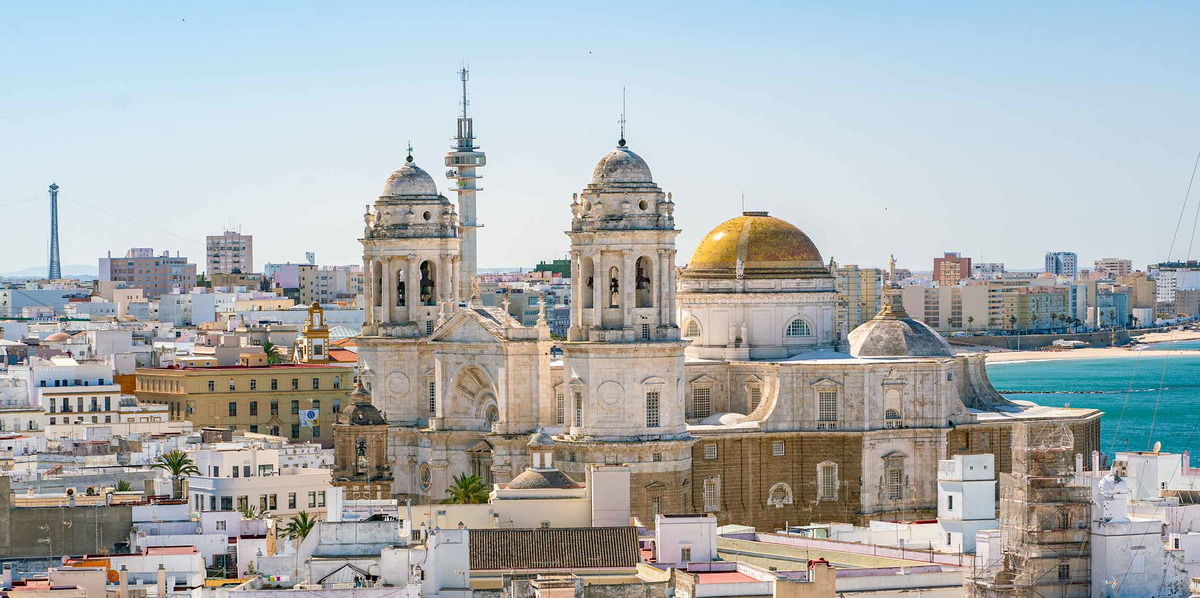
Today, Cádiz is a remarkable combination of ancient history, a maritime atmosphere and genuine Andalusian character. Here, the narrow streets of the old town lead to the ocean, historic fortresses remind visitors of the city's past, and the sound of the Atlantic accompanies your walk along much of the route.
In this article, you will discover which attractions are worth visiting in Cádiz, which places are considered the most interesting, what local dishes you should try, and how best to plan your walk in order to experience the spirit of one of the most distinctive cities in southern Spain.
Contents:
- Main Attractions of Cádiz — a walking route through the old town, the cathedral, fortresses and the city's most interesting sights
- Beaches of Cádiz — La Caleta, Victoria and relaxing on the Atlantic coast
- Where to Eat in Cádiz and What to Try — local cuisine, seafood and traditional dishes
- Parking and Visitor Tips — where to leave your car and how to plan your visit
- What to See Nearby — Jerez, the White Villages and other places in Andalusia
Main Attractions of Cádiz
Cádiz is a city best explored on foot. The most convenient way to begin your walk is in the historic centre, where most of the city's main attractions are located. The first stop on our route is the Puerta de Tierra — the symbolic gateway to the old part of the city.
Puerta de Tierra
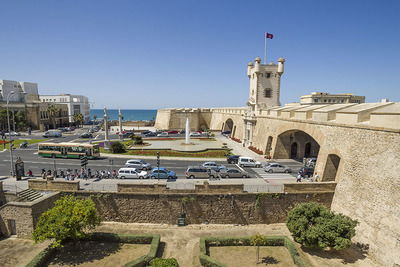
Puerta de Tierra is the Spanish name for the main entrance to the historic centre of Cádiz, which for centuries served as the boundary between the old town and the newer part of the city. It is the ideal place to begin exploring Cádiz: beyond the gate lies a maze of narrow streets, squares and historic neighbourhoods in one of Europe's oldest cities.
The gate was built in the 18th century as part of a powerful defensive wall designed to protect the city from attacks by land. At the time, Cádiz was effectively a fortified city on a narrow peninsula surrounded by the Atlantic Ocean, and Puerta de Tierra played a key role in its defence.
This period became one of the most important in the city's history. After the transfer of the Casa de la Contratación — the institution responsible for regulating Spain's trade with the New World — to Cádiz in 1717, the city experienced a remarkable period of prosperity and became one of the country's principal trading ports. The wealth and strategic importance of Cádiz largely explain the construction of such impressive fortifications.
Today, Puerta de Tierra remains an important historical landmark and a logical starting point for discovering Cádiz. Walking through the gate, it is easy to imagine the city during the great age of maritime trade, when ships, merchants and goods from different parts of the world arrived here.
The route then continues through the historic streets of Barrio del Pópulo — the oldest part of Cádiz — towards Plaza de San Juan de Dios, located just a few minutes' walk away.
Cádiz City Hall (Ayuntamiento) and Plaza de San Juan de Dios
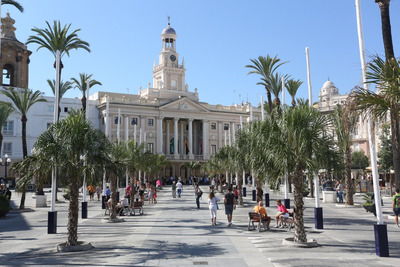
Cádiz City Hall and the adjacent Plaza de San Juan de Dios are considered one of the central and liveliest places in the city's historic centre. It is a space where the everyday life of Cádiz is closely intertwined with its centuries-old history.
For a long time, this part of the city was closely connected with the sea and trade. Before the expansion of Cádiz, the square stood next to the old port and was one of the first places seen by sailors and merchants arriving in the city. It is here that the connection between Cádiz, the Atlantic Ocean and its past as one of Spain's most important maritime centres can be felt most strongly.
The City Hall building was designed in the neoclassical style and stands out for its imposing columns and elegant arches. Construction began in the late 18th century, during a period when Cádiz was flourishing thanks to trade with the Americas and was one of the most influential cities in the country.
Today, Plaza de San Juan de Dios remains one of the most pleasant places to stop for a short break during a walk around the city. Cafés and restaurants line the square, local events take place here, and the open space with palm trees and views of the City Hall perfectly captures the atmosphere of a southern Andalusian city.
From Plaza de San Juan de Dios, the route continues deeper into the old Barrio del Pópulo quarter towards the Roman Theatre, one of the city's most important reminders of Cádiz's ancient past.
Roman Theatre
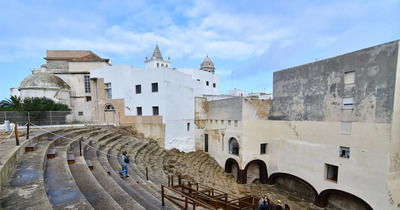
Hidden among the narrow streets of the old Barrio del Pópulo quarter in the historic centre of Cádiz lies one of the city's most surprising archaeological discoveries — the ancient Roman Theatre, which was only accidentally uncovered in the 1980s.
The history of this site takes visitors back to the days of ancient Gades, the name by which Cádiz was known during the Roman era. Founded by the Phoenicians more than 3,000 years ago, the city later became part of the Roman Empire and developed into one of its most important ports on the Atlantic coast.
The theatre was built in the 1st century BC and is considered one of the largest Roman-era structures in Spain. Its scale clearly demonstrates the importance of ancient Gades: buildings of this size were constructed only in wealthy and influential cities.
Interestingly, the theatre remained hidden beneath later buildings for many centuries. It was only discovered in 1980 during construction works, meaning that a visit to this site today offers a unique opportunity to see the different historical layers of Cádiz, from antiquity to the modern city.
Admission to the Roman Theatre is free, making it a particularly worthwhile stop during a walk through the old centre. A visit does not take long, but it helps explain why Cádiz is considered one of the oldest continuously inhabited cities in Europe.
Cádiz Cathedral
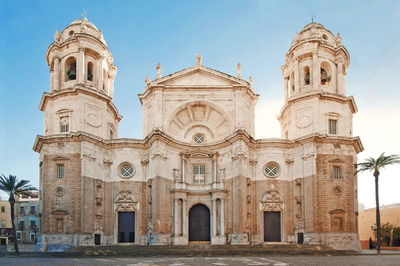
Cádiz Cathedral is one of the city's most recognisable landmarks. Its golden dome can be seen from various parts of Cádiz and has long become one of the city's principal architectural symbols.
Construction of the cathedral began in the 18th century during Cádiz's golden age, when the city became one of Spain's wealthiest ports thanks to trade with the Americas. The new cathedral was intended to reflect the city's importance and prosperity, which is why the project was exceptionally ambitious for a comparatively small historic centre.
Building work continued for more than a century, and architectural styles changed during that time. As a result, the cathedral's appearance combines elements of both Baroque and Neoclassical architecture in a harmonious way. Its location is also symbolic: one façade faces the old town, while the other looks towards the Atlantic Ocean, which shaped the destiny of Cádiz for centuries.
Inside, the cathedral impresses visitors with its sense of space and light. High vaults, elegant columns and abundant natural light create a very different atmosphere from that found in many of Spain's darker medieval churches. The crypt is also home to the tomb of the famous composer Manuel de Falla, who was born in Cádiz.
One of the highlights of a visit to the cathedral is climbing the Torre de Poniente bell tower. From the top, visitors can enjoy one of the finest views in Cádiz: the whitewashed houses of the old town, church domes, the harbour and the Atlantic Ocean that surrounds the city on almost every side.
Admission to the cathedral is charged, and tickets with an audio guide are also available, allowing visitors to explore the history and architecture of this remarkable monument in greater detail.
Central Market
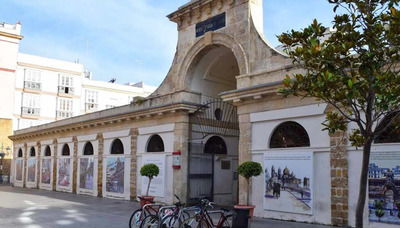
The Central Market of Cádiz, or Mercado Central, is one of the most atmospheric corners of the old town and an excellent place to experience the city's everyday life. Built in 1838, it is considered one of the oldest covered markets in Spain and has remained an important meeting place for local residents for almost two centuries.
The proximity of the Atlantic Ocean is particularly evident here, as much of the market is dedicated to fresh fish and seafood, for which the Cádiz coast is renowned. In the morning, locals come here to buy the catch of the day, while later on the gastronomic area surrounding the traditional market stalls comes to life with small bars and tapas venues.
Mercado Central is a wonderful place to experience the flavours of Cádiz first-hand: fresh seafood, fried fish, local snacks and dishes typical of this part of Andalusia. We will look at the city's traditional cuisine in more detail later, but even a brief visit to the market offers a clear insight into Cádiz's strong maritime character.
The square surrounding the market often becomes the centre of local events and celebrations, particularly during the famous Cádiz Carnival, one of the most renowned festivals in Spain. During this time, the streets fill with music, costumes and the unique atmosphere for which the city is known far beyond the borders of Andalusia.
The next stop on the route is Torre Tavira, which offers one of the finest panoramic views over the old town and the Atlantic Ocean.
Torre Tavira
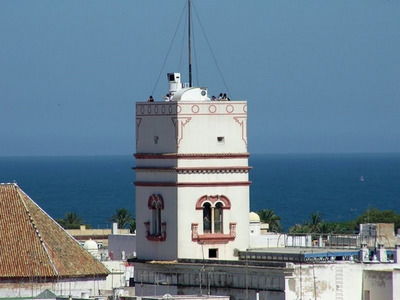
Torre Tavira is one of the most famous surviving watchtowers in Cádiz and the tallest of them within the city's historic centre. It rises approximately 33 metres above ground level and 45 metres above sea level, offering one of the finest views of the old town and the Atlantic Ocean.
In the 18th century, towers such as this became a true symbol of Cádiz. After the city assumed a leading role in Spain's trade with the Americas, wealthy merchant families began building their own towers on top of their houses to watch for arriving ships. At one time there were more than a hundred of them, and together they shaped the distinctive skyline of the historic centre.
Torre Tavira gained particular importance because of its location: it served as the official watchtower of the Port of Cádiz. From here, observers monitored ships arriving from the Atlantic, making the tower directly connected to the period when the city was one of Europe's principal maritime centres.
Today, visitors can climb to the viewing platform and see Cádiz much as the watchmen saw it centuries ago: the whitewashed houses of the old town, church domes, fortifications, the harbour and the endless ocean surrounding the peninsula.
Another unique feature of Torre Tavira is its camera obscura, a remarkable optical device that projects a live image of the city onto a special screen inside a darkened room. It provides an unusual and fascinating way to observe the streets, squares and everyday life of Cádiz from above.
Admission to the tower is charged. Visitors can choose between standard entry to the viewing platform or a ticket that also includes access to the camera obscura.
From Torre Tavira, the route continues towards the Atlantic Ocean and the castles of San Sebastián and Santa Catalina, which protected Cádiz from the sea for centuries.
Castillo de San Sebastián and Castillo de Santa Catalina
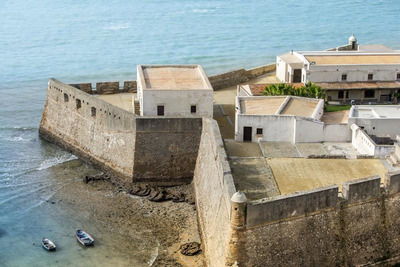
Cádiz is surrounded by historic fortifications, among which Castillo de San Sebastián and Castillo de Santa Catalina are considered the most famous and the easiest to visit. Situated on opposite sides of La Caleta Beach, they serve as reminders of a time when the city's security depended directly on control of the sea.
Both structures stand on the Atlantic coastline and perfectly illustrate the unique setting of Cádiz, a city almost entirely surrounded by water. For centuries, the sea brought prosperity through trade, but it also made the city vulnerable to attack, which is why the system of coastal defences played such a vital role.
Castillo de San Sebastián stands on a small island connected to the city by a long stone causeway. The walk to the fortress is an attraction in itself, offering magnificent views of the ocean, the old town and the famous La Caleta waterfront.
Castillo de Santa Catalina is located on the opposite side of the bay and was built after the attack of the Anglo-Dutch fleet at the end of the 16th century, when it became clear that the city's defences needed strengthening. Today, the fortress serves not only as a historical monument but also as a cultural venue hosting exhibitions and events.
Although these are primarily military fortifications rather than traditional medieval castles, they are well worth including in your itinerary. Few places capture the maritime character of Cádiz so well — a city whose history has always been closely linked to the Atlantic Ocean.
After a walk along the oceanfront, the route continues to Genovés Park, one of the greenest and most peaceful corners of Cádiz's historic centre.
Genovés Park
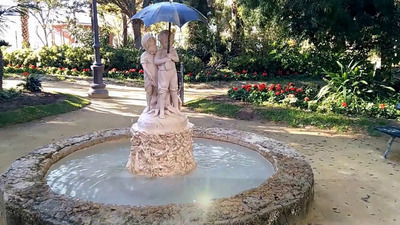
After a walk along the fortifications and the Atlantic Ocean, the route leads to one of the greenest corners of old Cádiz — Genovés Park (Parque Genovés). It is a peaceful place to relax within the historic centre, where visitors can take a short break between sightseeing stops.
The history of the gardens began in the 18th century, but the park acquired its present appearance later, when it was expanded and transformed into an elegant botanical garden. Thanks to Cádiz's maritime connections, unusual plants from different parts of the world were brought here, so today visitors can see not only familiar Mediterranean species but also more exotic trees.
The park is known for its beautifully maintained grounds, carefully shaped trees, green avenues and tranquil atmosphere. It is particularly pleasant to stroll here during the summer months, when the shade provided by the vegetation offers welcome relief from the bright Andalusian sun.
One of the most unusual features of Parque Genovés is its pond with a small waterfall and an artificial grotto through which visitors can walk. Various sculptures can be found throughout the park, including the famous statue of children under an umbrella, one of its most recognisable landmarks.
Thanks to its location beside the ocean, Genovés Park reveals another side of Cádiz. It is not only an ancient port city of fortresses and narrow streets, but also a place for peaceful walks with views across the Atlantic.
The next stop on the route is Plaza de España, a square associated with one of the most important events in the history of Cádiz and Spain as a whole.
Plaza de España
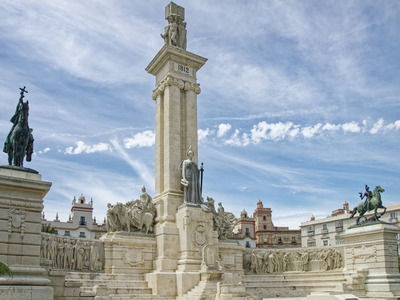
Plaza de España is one of the most significant squares in Cádiz and a place closely linked to key events in the history of both the city and the country. It was created following the redevelopment of the former Plaza del Carbón and became the principal space dedicated to commemorating the Constitution of 1812.
At the beginning of the 19th century, Cádiz found itself at the centre of Spanish political life. During the Napoleonic Wars, the city withstood a lengthy siege by French forces and remained one of the few major Spanish cities that was never captured. Between 1810 and 1813, Cádiz effectively served as the temporary capital of Spain.
It was here, in 1812, that Spain's first Constitution was adopted, known as "La Pepa". For its time, it was one of the most progressive political documents in Europe and transformed Cádiz into a symbol of the struggle for freedom and political reform.
The square's main attraction is the Monument to the Constitution of 1812, created to mark its centenary. Its sculptural compositions reflect the ideals of liberty, civil rights and the role of Cádiz in the history of Spain.
Several notable historic buildings also surround the square, including the House of the Four Towers and the former Customs House, which today serves as the headquarters of the Provincial Council. These buildings recall the period when Cádiz was a wealthy trading city and one of the country's most important ports.
From here, it is easy either to conclude your walk through the old town or to continue exploring Cádiz along the seafront and beaches, where the city's connection with the Atlantic Ocean reveals itself in a completely different way.
Beaches of Cádiz and Walks Along the Atlantic Ocean
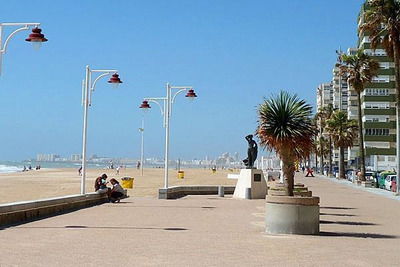
It is impossible to imagine Cádiz without the Atlantic Ocean. Unlike many historic cities in Spain, here it is easy to combine a walk through ancient streets with time by the sea: within just a few minutes, you can move from cathedrals, squares and fortresses directly to beaches and oceanfront promenades.
The most atmospheric beach in Cádiz is La Caleta (Playa de La Caleta), located between the castles of San Sebastián and Santa Catalina. Thanks to its unique setting, old fishing boats along the shore and views of the fortifications, it is considered one of the city's most iconic locations. It is particularly beautiful in the evening, when the sun sets over the Atlantic Ocean.
For a more traditional beach experience, Playa de la Victoria is the better choice. This wide sandy beach stretches for several kilometres and features a spacious promenade lined with cafés and restaurants. There is plenty of room for swimming, walking, sports and relaxing by the water.
Another convenient option close to the old town is Playa de Santa María del Mar. This smaller beach lies between the historic centre and the modern part of Cádiz and is ideal for a short stop during a walk around the city.
A stroll along the oceanfront reveals a completely different side of Cádiz: the sound of the waves, the sea breeze, whitewashed houses by the water and the endless horizon of the Atlantic create the unique atmosphere that sets Cádiz apart from other cities in Andalusia.
Where to Eat in Cádiz and What to Try
After exploring the old town and the seafront, it is worth discovering another essential part of Cádiz — its food. Thanks to its location on the Atlantic coast, the city is particularly renowned for its fresh fish, seafood and simple dishes that focus on the quality of the ingredients.

One of the best places for a first introduction to local gastronomy is the area around Mercado Central. As mentioned earlier, in the morning you can visit the traditional market with its huge selection of fresh fish and seafood, while later in the day the small gastronomic areas open, making it easy to sample several different dishes in tapas format.
One of Cádiz's most famous dishes is tortillitas de camarones. These are thin, crispy fritters made with tiny shrimp and are considered one of the symbols of the cuisine of the Cádiz coast. They are often ordered as a starter alongside other seafood dishes.
You should also try the local fried fish known as pescaíto frito. Small pieces of fresh fish and seafood are lightly coated and fried, preserving the natural flavour of the ingredients. It is one of the most traditional dishes of the Andalusian coast.
Another gastronomic pride of Cádiz Province is almadraba red tuna (atún rojo de almadraba). It is caught using a traditional fishing method along the Atlantic coast, particularly around Barbate and Zahara de los Atunes. During the season, tuna is prepared in countless ways, from simple tapas to contemporary fine dining dishes.
Those who enjoy meat-based specialities should pay attention to chicharrones de Cádiz — thinly sliced seasoned pork, often served cold as a tapa. Despite the city's close connection to the ocean, this remains one of the most characteristic dishes of the local cuisine.
And if you really want to experience the authentic atmosphere of Cádiz, it is best not to limit yourself to a single restaurant. The city is perfect for moving from one small bar to another, sampling different tapas, stopping in the squares of the old town and enjoying the relaxed pace of life by the Atlantic.
Parking and Visitor Tips for Cádiz
Cádiz is best explored on foot, but if you are arriving by car, it is worth planning your parking in advance. The historic centre is located on a narrow peninsula, and the streets are old and quite narrow, making it inconvenient to drive around the old town itself.
Where to Leave Your Car in Cádiz
One of the most convenient options is to leave your car near the entrance to the historic centre and continue your visit on foot. Many visitors choose car parks in the area around Puerta de Tierra and the railway station, as this provides an ideal starting point for following the route through the old town described above.
Underground car parks closer to the centre are also popular, particularly around Plaza de San Juan de Dios and the seafront. These are more convenient if you want to be close to the main attractions from the outset, although spaces can fill up quickly during the high season and at weekends.
Free parking can sometimes be found in the newer districts of Cádiz outside the historic centre, but from there you will need to walk further or use public transport.
How Much Time Do You Need to Visit Cádiz?
The main attractions of Cádiz can easily be seen in a single day. Within a few hours, you can follow the route through the old town, visit the cathedral, Torre Tavira, the fortifications and enjoy a walk along the oceanfront.
However, if possible, it is worth staying longer. In the evening, the city becomes particularly atmospheric. Watching the sunset at La Caleta Beach, enjoying dinner in the tapas bars and strolling through the illuminated streets reveals a completely different side of Cádiz.
When Is the Best Time to Visit Cádiz?
Thanks to its location on the Atlantic Ocean, summer temperatures in Cádiz are generally easier to tolerate than in the inland cities of Andalusia. Spring and autumn are particularly pleasant for sightseeing, offering comfortable conditions for exploring the old centre and spending time outdoors.
One of the highlights of the year is the famous Cádiz Carnival, which is considered one of the most important carnivals in Spain. During this period, the city is completely transformed as the streets fill with music, costumes and performances.
What Else Should You Do During Your Visit?
If you have some time left after completing the main walking route, consider seeing Cádiz from the water on a short boat trip or ferry ride. From the ocean, you can fully appreciate the city's unique location on a narrow peninsula, as well as its domes, fortifications and waterfront promenades.
And be sure to leave some time simply to wander without a plan. Cádiz is a city where it is particularly rewarding to turn into small side streets, discover beautiful balconies, quiet squares and unexpected views of the Atlantic Ocean.
What to See Near Cádiz
Cádiz combines perfectly with many other fascinating destinations in Andalusia. Nearby you will find historic cities, white villages, natural areas and scenic routes that showcase very different sides of southern Spain.
For independent travel around the province, the most convenient option is to use car hire, allowing you to plan your own itinerary, stop in smaller towns and visit places that are more difficult to reach by public transport.
- Setenil de las Bodegas — one of the most unusual towns in Andalusia, where whitewashed houses are built directly beneath enormous rock overhangs.
- Ronda — the famous town above the El Tajo Gorge, with the New Bridge, a historic centre and some of the most spectacular views in Andalusia.
- Jerez de la Frontera — one of the most interesting cities near Cádiz, renowned for its sherry tradition, Andalusian horses, flamenco and beautiful historic centre.
- Arcos de la Frontera — one of the most beautiful white towns in Andalusia, known for its narrow streets, cliffside houses and panoramic views of the surrounding countryside.
- Seville — the capital of Andalusia, home to the Royal Alcázar, the cathedral, Plaza de España and the atmospheric quarters of the old town.
- Málaga — a city on the Costa del Sol with the Alcazaba fortress, museums, beaches and a vibrant cultural scene.
Many of these destinations can easily be combined into a single Andalusian itinerary, bringing together historic cities, the Atlantic coastline and the region's charming traditional towns.

 English
  Español
  Русский