
Montserrat mountain is one of the most mysterious and impressive mountains in Catalonia, located just an hour's drive from Barcelona. Its unusual rock formations, ancient monastery and distinctive spiritual atmosphere make this place more than just a natural attraction — it is a true symbol of faith, history and inspiration.
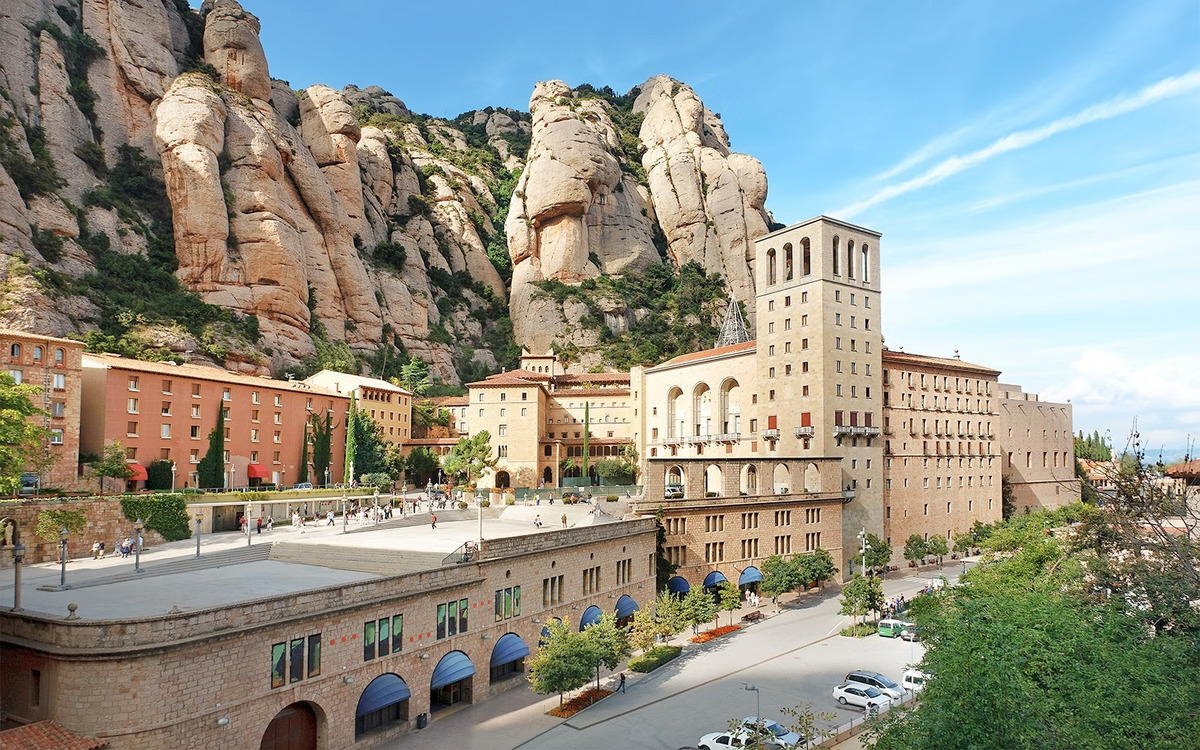
Pilgrims from all over the world come here in search of peace and answers to their questions. For tourists, a trip to Montserrat is considered one of the best day trips from Barcelona, allowing you to enjoy breathtaking views and the unique magnetism of this special place.
The key to visiting Montserrat is not trying to see everything at once. Start by exploring the monastery and basilica, then visit the museum and hear L’Escolania, and spend the remaining time enjoying the viewpoints and walking in the mountains.
- Basilica and monastery
- Black Madonna (La Moreneta)
- Montserrat Museum
- L'Escolania boys' choir
- Panoramic views and walks
- How to get there and useful information
Important information about visiting: completely free visits to Montserrat for tourists are no longer available. Non-residents are required to pay for tourist admission to the sanctuary — this gives access to the atrium, basilica and the Black Madonna. The Montserrat website also offers different ticket combinations, which can include the museum, audio guide and other services.
If you live in Spain or another EU country: tourist admission to the sanctuary is free for you. This applies not only to residents of Catalonia: officially, the resident category also includes residents of other regions of Spain and EU countries. However, visiting the Black Madonna, attending Mass or hearing L’Escolania may require a free advance reservation — the conditions depend on the specific day and time. The museum, funiculars and other additional services are charged separately.
What to see in Montserrat first
Montserrat Basilica and monastery
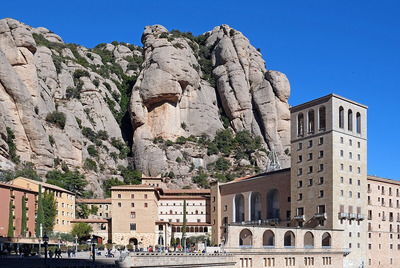
Montserrat Monastery (officially — the Benedictine Abbey of Santa Maria de Montserrat) was founded in 1025 by Abbot Oliba. The complex is located at an altitude of 720 metres above sea level and is literally built into the sheer cliffs. Throughout the 17th and 18th centuries, it developed into a major cultural and religious centre of Catalonia, with its own famous music school and a vast library.
The monastery's present appearance is the result of extensive restoration. In 1811, the monastery was almost completely destroyed and burned by Napoleon's troops, but the Catalans later rebuilt it, carefully preserving its historic spirit.
As you walk around the complex today, you will enter a spacious inner courtyard — the atrium, which is paved with light-coloured marble. It is from here that you get the best view of the basilica's façade. It is decorated with intricate stone carvings depicting saints, which are worth taking your time to admire before entering.
As you step beneath the church's vaulted ceilings, you will immediately feel the change in atmosphere. Inside, you will find soft shadows, a magnificent octagonal dome overhead and elegant rows of side chapels, creating an impressively harmonious and peaceful space.
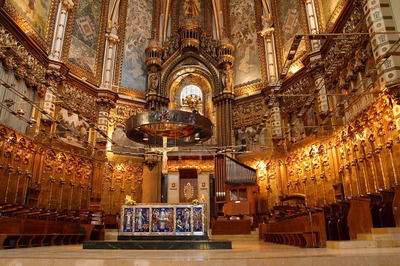
Your gaze is almost immediately drawn to the main altar. Directly above it, surrounded by a golden glow, the main patroness of these lands sits on a silver throne. If you walk further into the church, you can also admire the interior details: expressive wooden figures of biblical prophets and hundreds of carved lamps along the walls. Historically, these lamps were donated to the church by different towns and communities across Catalonia as a sign of devotion to the Virgin Mary.
To the right of the entrance, a corridor leads upwards to the silver throne itself. It was installed here in the mid-20th century with donations from local residents. This is the route that will take you to the legendary Black Madonna — the main sacred image of Montserrat.
Black Madonna — La Moreneta
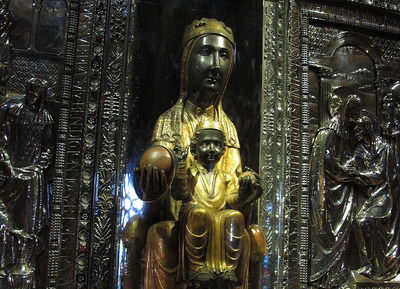
The main sacred image of Montserrat is the statue of the Black Madonna, known in Catalonia as La Moreneta — “the Little Dark One”. For centuries, pilgrims and travellers from all over the world have climbed the mountain to see her.
According to legend, in 880, shepherds saw a great light descending from the sky on the slopes of Montserrat and heard a beautiful melody. The vision appeared on several Saturdays in a row, until a priest came to the place with the children. In one of the caves, they discovered an image of the Virgin Mary.
The Bishop of Manresa decided to move the statue to the city, but as soon as they tried to take it out of the cave, the image became so heavy that it could not be moved. This was taken as a sign that the Virgin Mary wanted to remain at Montserrat. The first written version of this legend appeared as early as 1239.
The statue itself is a Romanesque wooden sculpture dating from the late 12th century. Its dark colour, which gave the image the name La Moreneta, is probably linked to changes in the varnish on the face and hands over time.
Mary holds a round sphere in her right hand, symbolising the cosmos, while with her left hand she touches the Child's shoulder. Jesus blesses with his right hand and holds a pine cone in his left — a symbol of fertility and eternal life.
In 1881, Pope Leo XIII proclaimed Our Lady of Montserrat the patron saint of Catalonia. Since 1947, the image has been located in the upper part of the basilica's apse, on a silver reredos created thanks to donations from the public.
Montserrat Museum
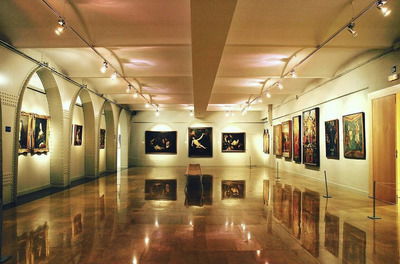
Few people expect to find a museum with such a rich collection in a mountain monastery, but the Montserrat Museum can indeed be a pleasant surprise. It houses more than 1,300 works and art objects from different periods — from archaeological finds from the Ancient Near East to works by European masters of the 19th and 20th centuries.
The museum's collection was built up over many years thanks to the monks and private donors. Among the exhibits are works by El Greco, Caravaggio, Monet, Degas and Picasso. But the museum is interesting for more than just its paintings: it houses a genuine Egyptian sarcophagus that is around 4,000 years old, as well as ancient objects from Egypt, Mesopotamia, the Holy Land and Cyprus.
A separate part of the collection is devoted to Byzantine and Slavic icons, and you can also trace how artists from different periods depicted Our Lady of Montserrat. As a result, the museum is remarkably diverse: in just a few rooms, you can journey from the Ancient Near East to modern art.
Boys' choir in Montserrat — L'Escolania
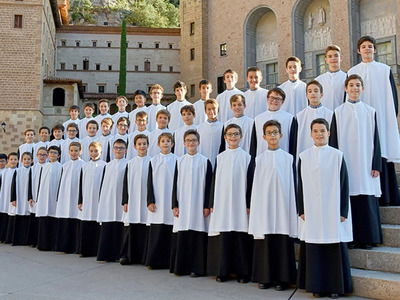
L’Escolania de Montserrat is one of the oldest children's choirs in Europe, with a history spanning more than seven centuries. The first documentary evidence of a music and religious school at the monastery dates back to the 13th century. Today, around fifty boys study here, living at the monastery and combining their regular school education with intensive musical training.
For them, Montserrat is not simply a place where performances take place. It is a school, a home and part of their everyday lives. The boys study singing and music, receive a humanities education, and then take part in religious services and concerts. Over its long history, Escolania has trained many musicians, composers and teachers, and today the choir also performs on international stages and records music.
For visitors, the opportunity to hear Escolania is one of Montserrat's most interesting traditions. The choir performs the famous Salve and Virolai hymns during services in the basilica. From Monday to Friday, the singing usually begins at 13:00, while on Sundays and religious holidays the schedule is linked to the services. The boys do not sing on Saturdays, and there are also no performances during school holidays.
The singing itself lasts only around 10–15 minutes, but if you want to hear it, you will need to plan your entire trip around it. Access to the basilica during the performance times is only possible with an advance reservation, and for tourists, visiting at this time is linked to a tourist ticket. Therefore, if you want to hear the choir, it is best to check the latest schedule and visiting conditions on the Montserrat website in advance.
Even if you are not particularly interested in classical music, it is worth hearing Escolania at least once. The pure voices of the boys beneath the basilica's vaulted ceilings, the silence of the church and Montserrat's unique atmosphere create an impression that is difficult to get simply by exploring the monastery.
Panoramic views and walks
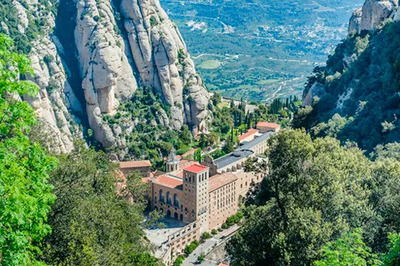
After visiting the monastery, it is worth leaving some time to explore the mountain itself. The unusual rock formations, deep gorges and wide panoramas of Catalonia appear at almost every turn. Even a short walk around the monastery allows you to appreciate the scale of Montserrat and see it not only as a place of pilgrimage, but also as a remarkable natural landscape.
If you want to go higher, take the Sant Joan funicular. In just a few minutes, the train takes you to an altitude of around 1,000 metres above sea level, from where you get the best panoramic view of the monastery from above and the surrounding finger-like rock formations. The ticket is purchased separately (around €17 return). Mountain trails start directly from the upper station: you can stick to an easy walk along the ridge, or continue the hiking route to Sant Jeroni — the highest point of the massif (1,236 metres). A full hike to the summit and back takes around 2–3 hours, but for a basic introduction to the mountain, there is no need to take on such a demanding hike.
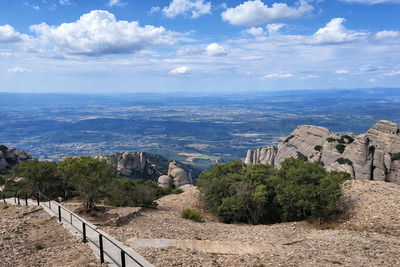
There is also a completely different option — walk down to Santa Cova, the Holy Cave, where, according to tradition, the statue of the Black Madonna was found. The funicular to the cave is temporarily out of service, but the walk itself is easy and does not take too long. Along the way, you will encounter fifteen sculptural compositions dedicated to scenes from the life of Jesus Christ and the Virgin Mary, while the route itself runs along the cliffs and offers beautiful panoramic views. For many pilgrims, this path remains an important part of a visit to Montserrat today.
How to get to Montserrat
By public transport (train + cable car or rack railway)
If you are travelling independently from Barcelona, the most popular option is the FGC R5 suburban train, which departs from Plaça d’Espanya approximately once an hour. However, there is an important point to bear in mind: you need to decide how you will get up to the monastery in Barcelona when buying your ticket, as Aeri and Cremallera use different stations and tickets.
Depending on your choice, you will need to get off at the corresponding station:
- Aeri de Montserrat cable car: you need the Montserrat-Aeri station. The yellow cable car takes you to the monastery in just 5 minutes, offering a breathtaking, albeit slightly exhilarating, view of the cliffs.
- Cremallera de Montserrat rack railway: get off at the next station — Monistrol de Montserrat. The smooth, green mountain train climbs the slope calmly in 15 minutes. This is a good option for those who are afraid of heights or travelling with pushchairs.
By car
For those who want complete freedom of movement and plan to combine Montserrat with other attractions in Catalonia, travelling by car is a convenient option. The drive from Barcelona takes about an hour.
When it comes to parking, you have two options. The first is to leave your car in the huge free car park with around 900 spaces at the lower Monistrol Vila rack railway station and take the Cremallera up the mountain. The second is to drive along the mountain road directly to the monastery. There is a paid car park there, but its capacity is limited, so at weekends and during the high season it is better to arrive early.
If you need a car during your trip, you can hire a car in Barcelona in advance and plan your own route around the surrounding area.
Where else to go after Montserrat
If after your trip to Montserrat you would like to continue exploring Barcelona and Catalonia, you can choose several other interesting places — from city walks and gastronomy to trips to the coast and family entertainment.
- Barcelona sightseeing guide — the city's main sights worth seeing during your trip.
- La Rambla and Passeig de Gràcia — two famous Barcelona boulevards with architecture, shops, cafés and interesting places along the way.
- Tibidabo Mountain — panoramic views of Barcelona, the Temple of the Sacred Heart and a historic amusement park.
- Montjuïc — a green hill with gardens, museums and panoramic views of the city and sea.
- Sitges — a seaside town with beaches, a promenade and a Mediterranean holiday atmosphere.
- Badalona — a relaxing trip from Barcelona with a historic centre, Roman heritage and a long seafront promenade.
- Where to eat in Barcelona and what to try — what to try in the city and which areas to explore for interesting places serving local food.
- Amusement parks and family activities — ideas for family outings and active things to do in Barcelona and around the city.

 English
  Español
  Русский